The Alaska Quitclaim Deed is a vital legal document used in real estate transactions, allowing property owners to transfer their interest in a property to another party without making any guarantees about the title. This form is particularly useful in situations where the seller may not have clear title to the property or when the parties involved have a high level of trust, such as transfers between family members or friends. By using a quitclaim deed, the grantor relinquishes any claim they have to the property, effectively passing on whatever rights they possess. Importantly, this type of deed does not provide the same level of protection as a warranty deed, which assures the buyer that the title is clear of any liens or encumbrances. In Alaska, the quitclaim deed must be properly executed, notarized, and recorded with the local recording office to be legally effective. Understanding the nuances of this form is essential for anyone looking to navigate property transfers in the state.
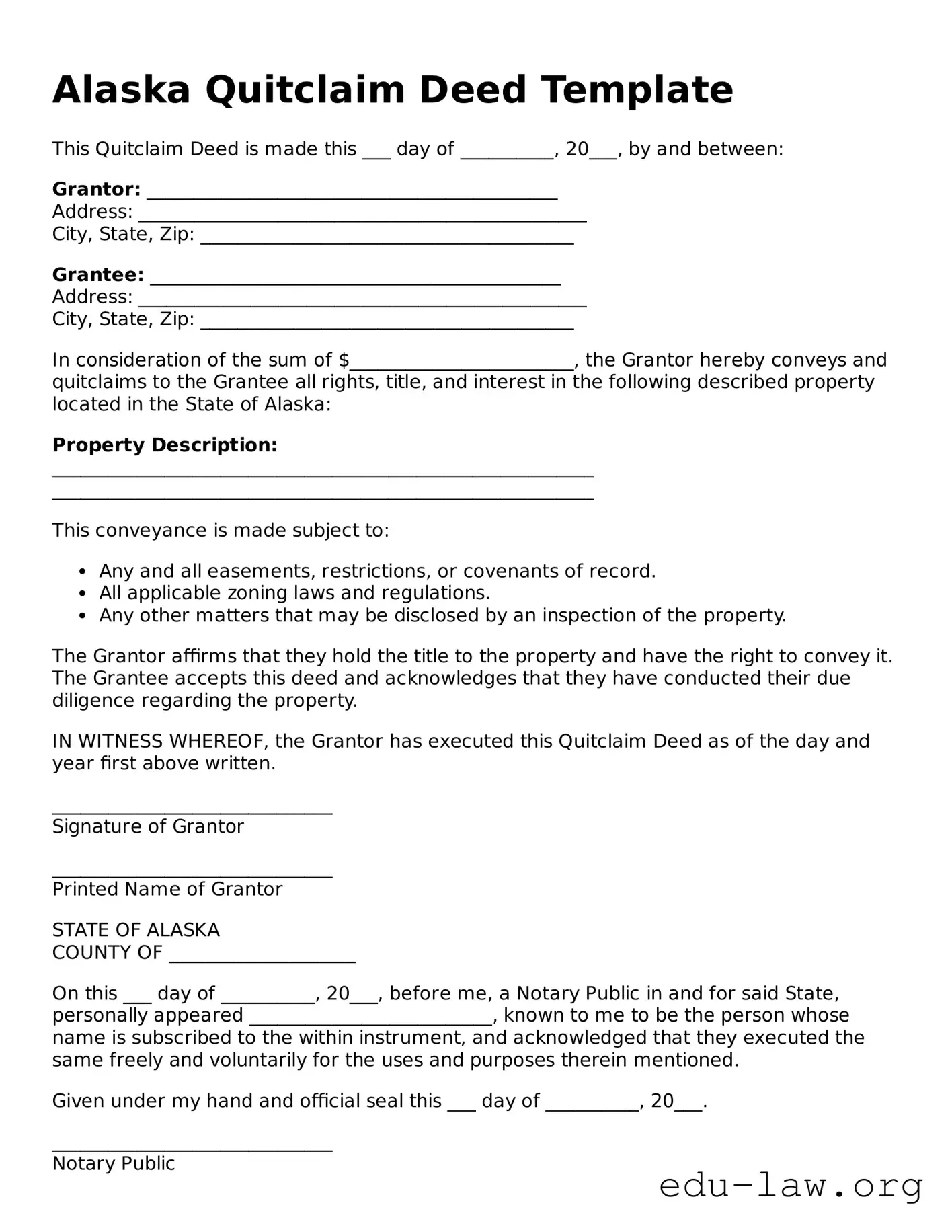
Alaska Quitclaim Deed Template
This Quitclaim Deed is made this ___ day of __________, 20___, by and between:
Grantor: ____________________________________________
Address: ________________________________________________
City, State, Zip: ________________________________________
Grantee: ____________________________________________
Address: ________________________________________________
City, State, Zip: ________________________________________
In consideration of the sum of $________________________, the Grantor hereby conveys and quitclaims to the Grantee all rights, title, and interest in the following described property located in the State of Alaska:
Property Description:
__________________________________________________________
__________________________________________________________
This conveyance is made subject to:
The Grantor affirms that they hold the title to the property and have the right to convey it. The Grantee accepts this deed and acknowledges that they have conducted their due diligence regarding the property.
IN WITNESS WHEREOF, the Grantor has executed this Quitclaim Deed as of the day and year first above written.
______________________________
Signature of Grantor
______________________________
Printed Name of Grantor
STATE OF ALASKA
COUNTY OF ____________________
On this ___ day of __________, 20___, before me, a Notary Public in and for said State, personally appeared __________________________, known to me to be the person whose name is subscribed to the within instrument, and acknowledged that they executed the same freely and voluntarily for the uses and purposes therein mentioned.
Given under my hand and official seal this ___ day of __________, 20___.
______________________________
Notary Public
My Commission Expires: ____________
| Fact Name | Description |
|---|---|
| Definition | An Alaska Quitclaim Deed is a legal document used to transfer ownership of real property without any warranties. |
| Governing Law | The Alaska Quitclaim Deed is governed by Alaska Statutes, specifically Title 34, Chapter 15. |
| Parties Involved | The form requires at least two parties: the grantor (seller) and the grantee (buyer). |
| No Warranty | The grantor does not guarantee the title's validity, meaning the grantee accepts the property "as is." |
| Use Cases | Commonly used for transferring property between family members, in divorce settlements, or to clear up title issues. |
| Signature Requirement | The deed must be signed by the grantor in front of a notary public for it to be valid. |
| Recording | To protect the grantee's interests, the deed should be recorded with the local recorder's office. |
| Consideration | While consideration (payment) is not required, it is customary to note a nominal amount. |
| Legal Advice | It is advisable to seek legal counsel before executing a quitclaim deed to understand its implications fully. |
After you gather the necessary information, you will be ready to fill out the Alaska Quitclaim Deed form. This process is straightforward, and attention to detail will help ensure accuracy. Once completed, you can proceed to file the form with the appropriate local authorities.
What is a Quitclaim Deed in Alaska?
A Quitclaim Deed is a legal document used to transfer ownership of real property from one party to another in Alaska. This type of deed conveys whatever interest the grantor has in the property, if any, without making any guarantees about the title. It is often used in situations where the parties know each other, such as family transfers or divorce settlements.
When should I use a Quitclaim Deed?
You might consider using a Quitclaim Deed when you want to transfer property to a family member, resolve a divorce settlement, or clear up title issues. It is also useful when transferring property into a trust or changing the name on the title due to marriage or divorce.
Do I need a lawyer to prepare a Quitclaim Deed in Alaska?
No, you do not necessarily need a lawyer to prepare a Quitclaim Deed in Alaska. However, it is advisable to consult with a legal professional if you have concerns about the implications of the transfer or if the property has complications related to its title.
What information is required to complete a Quitclaim Deed?
To complete a Quitclaim Deed in Alaska, you will need the names and addresses of both the grantor (the person transferring the property) and the grantee (the person receiving the property). You must also include a legal description of the property, the date of the transfer, and the signatures of the grantor(s). Depending on the county, additional information may be required.
Is there a fee associated with filing a Quitclaim Deed in Alaska?
Yes, there is typically a fee to file a Quitclaim Deed with the local recording office in Alaska. The fee can vary by county, so it is important to check with the local office for specific amounts. Additionally, you may need to pay for any required taxes or additional documentation.
How do I file a Quitclaim Deed in Alaska?
To file a Quitclaim Deed in Alaska, first complete the form with the necessary information. Once completed, you must sign the deed in front of a notary public. After notarization, take the signed document to your local recording office to file it. Ensure that you keep a copy for your records.
Can a Quitclaim Deed be revoked?
A Quitclaim Deed cannot be revoked once it has been executed and filed. However, the parties involved can create a new deed to reverse the transfer if both agree. This process may involve additional legal steps, so consulting a professional may be beneficial.
What are the risks of using a Quitclaim Deed?
The primary risk associated with a Quitclaim Deed is that it does not guarantee that the grantor has a valid title to the property. If there are any liens, encumbrances, or claims against the property, the grantee may inherit those issues. Therefore, it is essential to conduct a title search before proceeding with the transfer.
Are there any specific requirements for notarization in Alaska?
Yes, in Alaska, the Quitclaim Deed must be signed in front of a notary public to be valid. The notary will verify the identities of the signers and witness the signing of the document. This step is crucial to ensure that the deed is legally enforceable.
Not including all required information. People often forget to fill in all the necessary details, such as the names of the grantor and grantee, or the legal description of the property. Missing even one piece of information can lead to issues later on.
Using incorrect property descriptions. It's crucial to provide an accurate legal description of the property. Relying on informal descriptions or vague terms can cause confusion and may invalidate the deed.
Failing to sign the document. A quitclaim deed must be signed by the grantor. Sometimes, people forget this step, which means the deed isn’t legally binding.
Not having the deed notarized. In Alaska, a quitclaim deed typically needs to be notarized. Skipping this step can lead to problems when trying to record the deed.
Ignoring local recording requirements. Each county may have specific rules about how to record a quitclaim deed. Not following these guidelines can result in delays or rejection of the filing.
Overlooking tax implications. Some people forget that transferring property can have tax consequences. It's wise to consult a tax professional to understand any potential liabilities.
The Alaska Quitclaim Deed form is an important document used for transferring property ownership. However, it is often accompanied by several other forms and documents to ensure a smooth transaction. Below is a list of commonly used documents in conjunction with the Quitclaim Deed.
These documents play a crucial role in the property transfer process in Alaska. Ensuring that all necessary forms are completed and submitted can help facilitate a successful transaction and protect the interests of all parties involved.
A Warranty Deed serves a similar purpose to a Quitclaim Deed but offers more protection to the grantee. With a Warranty Deed, the grantor guarantees that they hold clear title to the property and have the right to transfer it. This means that if any issues arise regarding ownership or claims against the property, the grantor is legally responsible. In contrast, a Quitclaim Deed does not provide such assurances, making it a quicker but riskier option for transferring property rights.
A Bargain and Sale Deed is another document that shares similarities with a Quitclaim Deed. It conveys property from the seller to the buyer but does not include warranties against any claims on the property. Like a Quitclaim Deed, it transfers whatever interest the grantor has in the property, but it may imply that the grantor has some ownership interest. This type of deed is often used in transactions where the seller is not providing full guarantees about the title.
A Special Purpose Deed is also comparable to a Quitclaim Deed in that it is typically used for specific transactions, such as transferring property between family members or in divorce settlements. This type of deed may not require extensive title searches or warranties, focusing instead on the particular circumstances of the transfer. While it simplifies the process, it does not offer the same level of security as a Warranty Deed.
Lastly, a Trustee's Deed is similar in that it is often used to transfer property held in a trust. This document allows a trustee to convey property to beneficiaries or third parties. While it may be used in conjunction with a Quitclaim Deed, a Trustee's Deed typically provides more clarity regarding the authority of the trustee and the terms of the trust. However, like a Quitclaim Deed, it does not guarantee the title, leaving the grantee exposed to potential claims.
Filling out the Alaska Quitclaim Deed form requires careful attention to detail. Here are some important guidelines to follow:
By adhering to these guidelines, individuals can help ensure a smoother process when completing the Alaska Quitclaim Deed form.
There are several misconceptions about the Alaska Quitclaim Deed form that can lead to confusion. Here are six common misunderstandings:
Many people believe that a quitclaim deed transfers full ownership of a property. In reality, it only transfers whatever interest the grantor has in the property, if any. If the grantor has no ownership, the recipient receives nothing.
While quitclaim deeds are often used among family members, they can be used in various situations. They are suitable for any transfer of property interests, including sales or transfers between strangers.
This is false. Quitclaim deeds are legal documents that must meet specific requirements to be valid. They should be signed, dated, and notarized to ensure proper execution.
Some believe that using a quitclaim deed removes any liabilities tied to the property. However, the new owner may still face existing liens or mortgages. A quitclaim deed does not clear these obligations.
This is a common misconception. A warranty deed provides guarantees about the title, while a quitclaim deed offers no such assurances. It simply conveys whatever interest the grantor has.
Some think quitclaim deeds are unsuitable for real estate sales. However, they can be used in real estate transactions, especially when the parties trust each other and there is no need for title insurance.
Filling out and using the Alaska Quitclaim Deed form involves several important steps and considerations. Below are key takeaways to keep in mind: