The Alaska Promissory Note form serves as a vital financial instrument that facilitates the borrowing and lending process between parties. This legally binding document outlines the terms of repayment, including the principal amount, interest rate, and schedule for payments. It is essential for both lenders and borrowers to understand the implications of this form, as it provides clarity and protection for all parties involved. By detailing the obligations of the borrower, such as the timeline for repayment and any penalties for late payments, the note ensures that expectations are set from the outset. Furthermore, the form may include provisions for prepayment, allowing borrowers the flexibility to pay off their debt early without incurring additional fees. In the event of a default, the promissory note also specifies the rights of the lender, including the potential for legal recourse. Understanding these key elements is crucial for anyone considering entering into a loan agreement in Alaska.
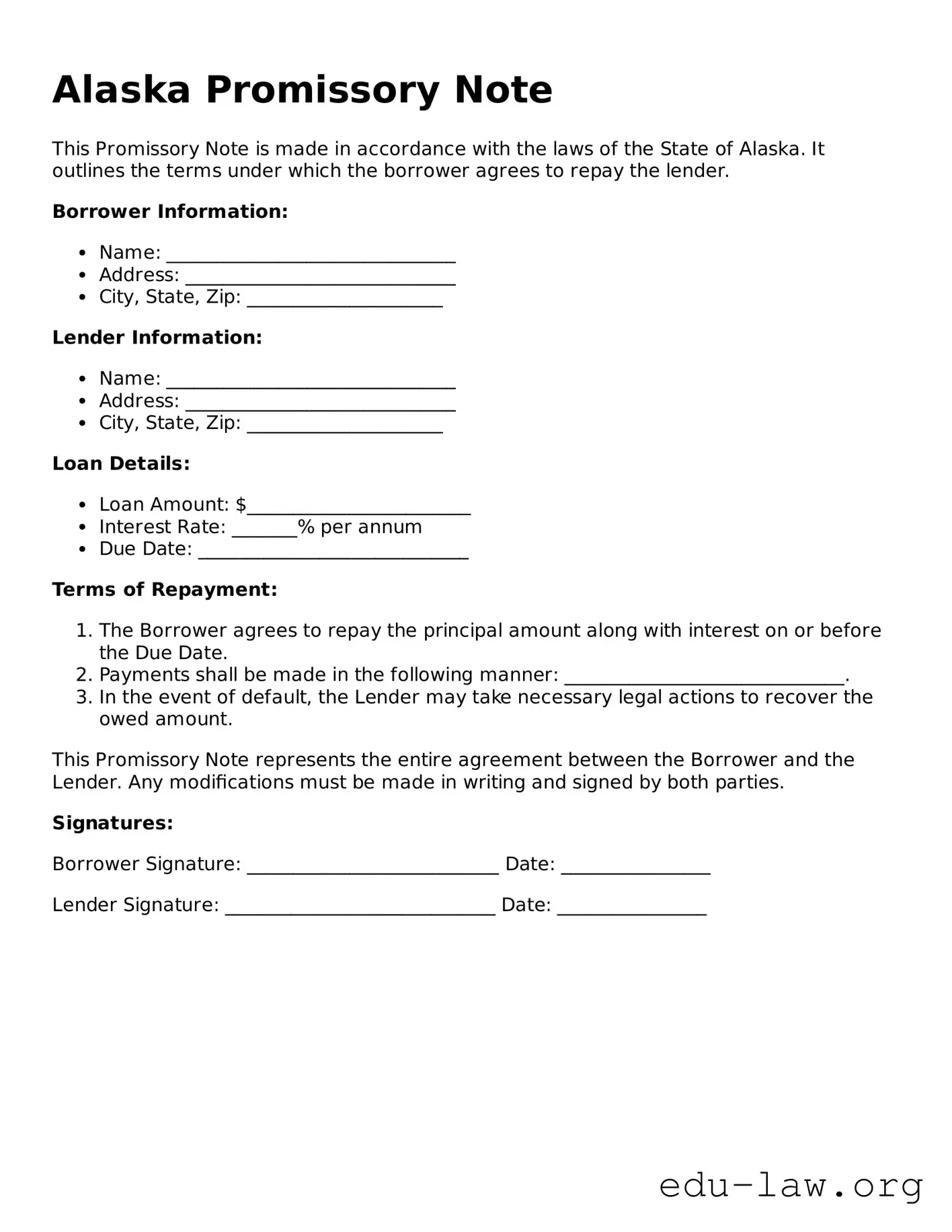
Alaska Promissory Note
This Promissory Note is made in accordance with the laws of the State of Alaska. It outlines the terms under which the borrower agrees to repay the lender.
Borrower Information:
Lender Information:
Loan Details:
Terms of Repayment:
This Promissory Note represents the entire agreement between the Borrower and the Lender. Any modifications must be made in writing and signed by both parties.
Signatures:
Borrower Signature: ___________________________ Date: ________________
Lender Signature: _____________________________ Date: ________________
| Fact Name | Description |
|---|---|
| Definition | An Alaska Promissory Note is a written promise to pay a specified amount to a designated person or entity. |
| Governing Law | The Alaska Uniform Commercial Code (UCC) governs promissory notes in Alaska. |
| Parties Involved | The note involves at least two parties: the borrower (maker) and the lender (payee). |
| Payment Terms | It outlines specific payment terms, including the amount, interest rate, and due dates. |
| Default Clause | A default clause may be included, detailing the consequences if the borrower fails to make payments. |
| Signatures Required | The document must be signed by the borrower to be legally binding. |
| Notarization | While notarization is not mandatory, it can enhance the document's enforceability. |
| Use Cases | Commonly used for personal loans, business loans, and real estate transactions. |
Once you have the Alaska Promissory Note form ready, it's time to fill it out accurately. This document is essential for establishing a clear agreement between the borrower and the lender. Follow these steps to ensure you complete the form correctly.
After completing the form, review it for accuracy. Make sure all information is correct and clear. Both parties should retain a copy of the signed document for their records.
What is an Alaska Promissory Note?
An Alaska Promissory Note is a legal document in which one party (the borrower) agrees to repay a specific amount of money to another party (the lender) under agreed-upon terms. This document outlines the loan amount, interest rate, repayment schedule, and any penalties for late payments.
Who can use an Alaska Promissory Note?
Any individual or business in Alaska can use a Promissory Note. It is commonly used for personal loans, business loans, or any situation where one party lends money to another. Both parties should be in agreement about the terms before signing.
What are the key components of the form?
The key components include the names and addresses of both the borrower and lender, the loan amount, interest rate, repayment schedule, and any provisions for default or late payments. It may also include clauses about prepayment and governing law.
Is a notary required for an Alaska Promissory Note?
While a notary is not strictly required for the validity of a Promissory Note in Alaska, having it notarized can provide an additional layer of security and authenticity. It can help prevent disputes regarding the signatures and terms of the agreement.
Can I modify the terms of the Promissory Note after it is signed?
Yes, the terms can be modified, but both parties must agree to the changes. It is advisable to create a written amendment to document any changes. This ensures clarity and helps prevent misunderstandings in the future.
What happens if the borrower defaults on the loan?
If the borrower defaults, the lender may take legal action to recover the owed amount. The Promissory Note typically outlines the consequences of default, which may include late fees, acceleration of the debt, or legal proceedings to collect the debt.
How can I ensure my Promissory Note is enforceable?
To ensure enforceability, make sure the document is clear and complete. Both parties should sign the note, and it is advisable to have witnesses or a notary present. Keeping a copy of the signed document is also essential for record-keeping.
Where can I obtain an Alaska Promissory Note form?
An Alaska Promissory Note form can be obtained from various online legal form providers, local stationery stores, or legal professionals. Ensure that the form complies with Alaska state laws to avoid any issues.
Incomplete Information: One common mistake is leaving sections of the form blank. Every part of the form should be filled out completely. Missing information can lead to confusion or disputes later on.
Incorrect Dates: Failing to include the correct date can create complications. It is essential to ensure that the date of the agreement reflects when the note is signed.
Improper Signatures: Signatures must be clear and legible. If a signature is difficult to read or missing, it can raise questions about the validity of the document.
Wrong Amounts: Entering incorrect loan amounts can lead to significant issues. Double-checking the figures is crucial to ensure they reflect the intended loan amount.
Failure to Specify Terms: Not clearly outlining the repayment terms can lead to misunderstandings. It’s important to detail the payment schedule, interest rates, and any penalties for late payments.
Ignoring Witness Requirements: In some cases, a witness may be required for the note to be legally binding. Neglecting to have a witness present can invalidate the agreement.
Not Keeping Copies: Failing to retain a copy of the signed promissory note can be problematic. Both parties should keep a copy for their records to avoid future disputes.
Overlooking State-Specific Regulations: Each state may have specific requirements for promissory notes. Ignoring these can lead to issues with enforceability.
When dealing with financial agreements in Alaska, the Promissory Note is a crucial document. However, it is often accompanied by several other forms and documents that help clarify the terms and conditions of the loan or financial arrangement. Understanding these additional documents can provide a clearer picture of the entire transaction.
Each of these documents plays a vital role in the lending process, providing structure and clarity to financial agreements. By familiarizing oneself with these forms, both lenders and borrowers can navigate the complexities of financial transactions more effectively.
The Alaska Promissory Note is similar to a personal loan agreement. Both documents outline the terms under which one party borrows money from another. A personal loan agreement typically includes details such as the loan amount, interest rate, repayment schedule, and consequences for default. Like a promissory note, it serves as a legally binding contract, ensuring that the borrower is obligated to repay the lender according to the agreed terms. This similarity makes both documents essential for protecting the interests of both parties involved in the transaction.
Another document akin to the Alaska Promissory Note is a mortgage agreement. While a promissory note represents a borrower's promise to repay a loan, a mortgage agreement secures that promise with real property. In essence, the mortgage provides the lender with a claim to the property if the borrower defaults on the loan. Both documents work in tandem to facilitate home purchases, making it clear what is owed and under what conditions. This connection underscores the importance of clear terms in financial agreements.
A car loan agreement shares similarities with the Alaska Promissory Note as well. When an individual finances a vehicle, they often sign a car loan agreement that outlines the loan amount, interest rate, and repayment terms. Like a promissory note, this agreement holds the borrower accountable for repaying the loan. If the borrower fails to make payments, the lender can repossess the vehicle, similar to how a lender can enforce a promissory note. This type of agreement ensures that both parties understand their obligations and rights.
Additionally, a business loan agreement resembles the Alaska Promissory Note in its structure and purpose. Businesses often require loans to fund operations or expansion, and a business loan agreement details the terms of such financing. It specifies the loan amount, interest rate, and repayment schedule, much like a promissory note. Both documents serve to formalize the borrowing process, providing clarity and legal protection for both the lender and the borrower. This ensures that businesses can secure necessary funding while maintaining accountability.
Lastly, a lease agreement has similarities with the Alaska Promissory Note, particularly in the context of rental payments. A lease agreement outlines the terms under which a tenant rents a property from a landlord, including payment amounts and due dates. While the focus of a lease is on property use rather than a loan, both documents create an obligation for payment. The tenant must fulfill their financial commitment to the landlord, similar to how a borrower must repay a promissory note. This commonality highlights the importance of clear financial obligations in various types of agreements.
When filling out the Alaska Promissory Note form, it is essential to approach the task with care and attention to detail. Here are ten important dos and don’ts to keep in mind:
Following these guidelines will help ensure that your Promissory Note is completed accurately and effectively. A well-prepared document can prevent misunderstandings and protect the interests of all parties involved.
Understanding the Alaska Promissory Note form is essential for both lenders and borrowers. However, several misconceptions can lead to confusion. Below is a list of common misconceptions about this form, along with clarifications.
By addressing these misconceptions, individuals can better navigate the use of the Alaska Promissory Note and make informed decisions in their financial dealings.
When dealing with an Alaska Promissory Note, understanding the key aspects can help ensure that the document serves its intended purpose effectively. Here are some important takeaways:
By keeping these key points in mind, you can navigate the process of filling out and using an Alaska Promissory Note more confidently and effectively.