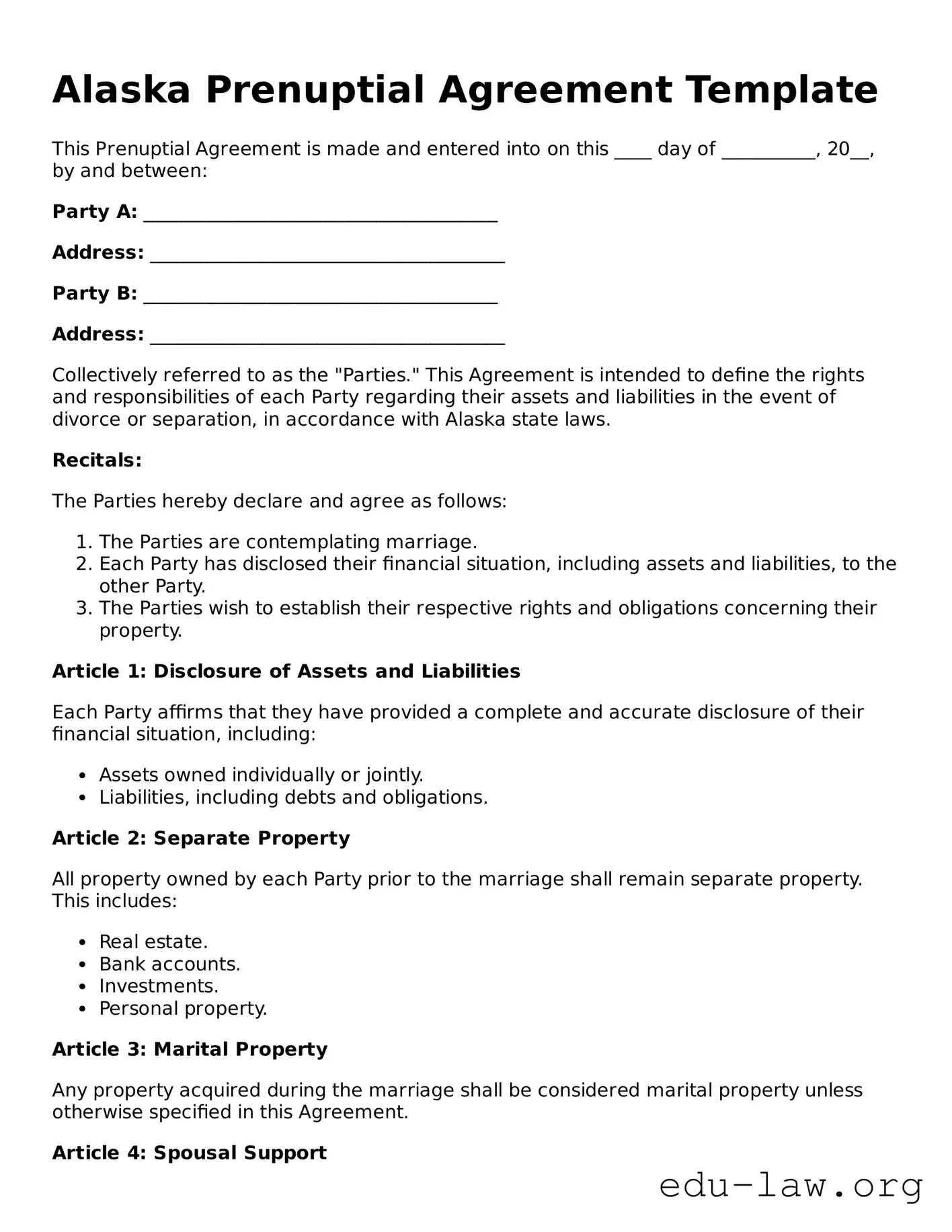
When considering marriage in Alaska, couples may find it beneficial to explore the Alaska Prenuptial Agreement form. This legal document serves as a proactive measure to address financial matters and property rights before entering into a marital union. It can outline how assets will be divided in the event of a divorce or separation, providing clarity and reducing potential conflicts. Couples can also use the agreement to establish individual responsibilities for debts and financial obligations. While it is often associated with wealthy individuals, a prenuptial agreement can be advantageous for anyone wishing to protect their interests. Furthermore, both parties must fully disclose their assets and liabilities for the agreement to be valid. Understanding the key components of this form can help couples make informed decisions as they prepare for their future together.
Alaska Prenuptial Agreement Template
This Prenuptial Agreement is made and entered into on this ____ day of __________, 20__, by and between:
Party A: ______________________________________
Address: ______________________________________
Party B: ______________________________________
Address: ______________________________________
Collectively referred to as the "Parties." This Agreement is intended to define the rights and responsibilities of each Party regarding their assets and liabilities in the event of divorce or separation, in accordance with Alaska state laws.
Recitals:
The Parties hereby declare and agree as follows:
Article 1: Disclosure of Assets and Liabilities
Each Party affirms that they have provided a complete and accurate disclosure of their financial situation, including:
Article 2: Separate Property
All property owned by each Party prior to the marriage shall remain separate property. This includes:
Article 3: Marital Property
Any property acquired during the marriage shall be considered marital property unless otherwise specified in this Agreement.
Article 4: Spousal Support
In the event of divorce or separation, the Parties agree to the following regarding spousal support:
Article 5: Amendments
This Agreement may be amended only by a written document signed by both Parties.
Article 6: Governing Law
This Agreement shall be governed by and construed in accordance with the laws of the State of Alaska.
Signatures:
IN WITNESS WHEREOF, the Parties have executed this Prenuptial Agreement as of the date first above written.
Party A Signature: ____________________________
Date: ____________________________
Party B Signature: ____________________________
Date: ____________________________
Witness Signature: ____________________________
Date: ____________________________
| Fact Name | Details |
|---|---|
| Governing Law | The Alaska Prenuptial Agreement is governed by Alaska Statutes, specifically Title 25, Chapter 24. |
| Purpose | This agreement allows couples to outline the distribution of assets and debts in the event of divorce or separation. |
| Enforceability | For a prenuptial agreement to be enforceable, it must be in writing and signed by both parties. |
| Full Disclosure | Both parties are required to provide a full and fair disclosure of their financial situations before signing the agreement. |
| Legal Counsel | While not mandatory, it is highly recommended that each party consults with their own attorney to ensure understanding and fairness. |
Completing the Alaska Prenuptial Agreement form requires careful attention to detail. This document will outline the financial rights and responsibilities of each party entering into marriage. Once you have filled out the form, it will be ready for both parties to review and sign, ensuring mutual understanding and agreement.
What is a prenuptial agreement in Alaska?
A prenuptial agreement, often referred to as a prenup, is a legal contract created by two individuals before they marry. In Alaska, this agreement outlines the distribution of assets and liabilities in the event of divorce or death. It can also address spousal support and other financial matters. The primary purpose of a prenup is to provide clarity and protect the interests of both parties.
What should be included in an Alaska prenuptial agreement?
An Alaska prenuptial agreement can include various elements. Common provisions include the identification of separate and marital property, the division of assets and debts, spousal support arrangements, and any other financial matters the couple wishes to address. It is important for both parties to disclose their financial situations fully to ensure the agreement is fair and enforceable.
Is a prenuptial agreement enforceable in Alaska?
Yes, a prenuptial agreement is generally enforceable in Alaska, provided it meets certain legal requirements. Both parties must enter into the agreement voluntarily, and it should be in writing and signed by both individuals. Additionally, the agreement must be fair and not unconscionable at the time of enforcement. Courts will also consider whether both parties had adequate legal representation when the agreement was created.
Can a prenuptial agreement be modified after marriage?
Yes, a prenuptial agreement can be modified or revoked after marriage. Both parties must agree to any changes, and the modifications should be made in writing and signed by both individuals. It is advisable to consult with legal counsel when making changes to ensure that the updated agreement is valid and enforceable.
How does one create a prenuptial agreement in Alaska?
To create a prenuptial agreement in Alaska, the couple should first discuss their financial situations and what they wish to include in the agreement. It is recommended to work with an attorney experienced in family law to draft the document. The attorney can help ensure that the agreement complies with Alaska law and addresses the couple's specific needs. Both parties should have their own legal representation to avoid conflicts of interest.
What happens if there is no prenuptial agreement?
If a couple does not have a prenuptial agreement in place, Alaska's laws regarding property division and spousal support will govern the outcome in the event of divorce. This means that the court will determine how to divide marital property and whether spousal support is appropriate, based on the circumstances of the marriage and the applicable state laws.
Can a prenuptial agreement address child custody and support?
While a prenuptial agreement can address many financial matters, it cannot dictate child custody or child support arrangements. In Alaska, these issues are determined based on the best interests of the child at the time of divorce or separation. Courts will not enforce any provisions regarding child custody or support that are included in a prenup, as they must prioritize the child's welfare above all else.
How can one ensure a prenuptial agreement is fair?
To ensure fairness in a prenuptial agreement, both parties should fully disclose their financial situations, including assets, debts, and income. Consulting with separate legal counsel can help each party understand their rights and obligations. Additionally, the agreement should be reviewed periodically and updated as necessary, especially if there are significant changes in financial circumstances or family dynamics.
Incomplete Information: Many individuals fail to provide all necessary details. It’s crucial to include full names, addresses, and other personal information for both parties. Omitting even one detail can lead to complications later.
Not Disclosing Assets: Full transparency is essential. Some people neglect to list all their assets and debts. This lack of disclosure can result in the agreement being contested in the future.
Failure to Have Witnesses: A common oversight is not having the agreement signed in front of witnesses. In Alaska, having at least one witness present during the signing is necessary to ensure the agreement’s validity.
Ignoring Legal Advice: Some couples choose to fill out the form without consulting a legal professional. This can lead to misunderstandings about rights and obligations, which may affect the enforceability of the agreement.
When preparing for a marriage, it is essential to consider various legal documents that can help protect both partners' interests. Along with the Alaska Prenuptial Agreement form, several other forms and documents may be relevant. Understanding these documents can facilitate a smoother process and ensure that both parties feel secure in their commitments.
Each of these documents serves a specific purpose and can be vital in ensuring that both partners feel secure in their marriage. Taking the time to understand and prepare these forms can lead to a healthier and more transparent relationship.
The Alaska Prenuptial Agreement is similar to a Cohabitation Agreement. Both documents outline the financial and property rights of individuals in a relationship. A Cohabitation Agreement is often used by couples who live together but are not married. It serves to clarify expectations and responsibilities, much like a prenuptial agreement does for married couples. This can help prevent disputes should the relationship end, providing a clear framework for asset division.
Another document that shares similarities is the Postnuptial Agreement. While a prenuptial agreement is signed before marriage, a postnuptial agreement is executed after the wedding. Both agreements serve the same purpose: to define how assets and debts will be managed and divided. They can address issues that may arise during the marriage, allowing couples to adapt their financial arrangements as their circumstances change.
A Separation Agreement also bears resemblance to a prenuptial agreement. This document is typically used when a couple decides to live apart but is not yet divorced. It outlines the terms of the separation, including property division and financial responsibilities. Like a prenuptial agreement, it aims to minimize conflict by providing clear guidelines for both parties.
The Marital Settlement Agreement is another similar document. This is often created during divorce proceedings to outline how assets, debts, and responsibilities will be divided. While a prenuptial agreement is established before marriage, a marital settlement agreement is negotiated after the relationship has ended. Both documents share the goal of protecting individual interests and ensuring a fair distribution of marital assets.
A Business Partnership Agreement can also be compared to a prenuptial agreement. If one or both partners own a business, this agreement outlines how business assets will be handled in the event of a separation or divorce. Like a prenuptial agreement, it helps to clarify ownership and financial responsibilities, ensuring that both partners are on the same page regarding their business interests.
Similarly, a Will can be likened to a prenuptial agreement in that both documents address the distribution of assets. A Will specifies how a person's property will be distributed upon their death, while a prenuptial agreement outlines how assets will be managed during the marriage and in the event of divorce. Both documents serve to protect individual interests and provide clarity for loved ones.
A Trust Agreement also shares characteristics with a prenuptial agreement. Trusts are used to manage and distribute assets according to specific terms set by the grantor. In the context of marriage, a prenuptial agreement can specify how assets placed in a trust will be treated, ensuring that they are protected from division during a divorce.
The Durable Power of Attorney is another document that can be compared to a prenuptial agreement. While a prenuptial agreement focuses on financial arrangements, a Durable Power of Attorney designates someone to make decisions on behalf of another individual if they become incapacitated. Both documents are essential for planning and protecting interests, particularly in the context of a marriage.
Finally, an Estate Plan can be seen as similar to a prenuptial agreement. An estate plan encompasses various documents, including a Will, Trust, and Powers of Attorney, to manage an individual's assets and wishes after their death. Just as a prenuptial agreement prepares couples for potential future changes, an estate plan ensures that individuals have a clear strategy for their assets and responsibilities throughout their lives.
When filling out the Alaska Prenuptial Agreement form, it is essential to approach the process with care. Here are some important dos and don'ts to consider:
Misconception 1: Prenuptial agreements are only for the wealthy.
This is a common belief, but prenuptial agreements can benefit couples of all income levels. They help clarify financial responsibilities and protect individual assets, regardless of wealth. Many couples find that discussing finances openly before marriage strengthens their relationship.
Misconception 2: Prenuptial agreements are unromantic and imply distrust.
While it may seem that discussing a prenuptial agreement suggests a lack of faith in the relationship, it can actually foster open communication. By discussing financial matters before tying the knot, couples can set a solid foundation for their future together.
Misconception 3: A prenuptial agreement is difficult to enforce in court.
When properly drafted, prenuptial agreements are generally enforceable in court. Courts typically uphold these agreements as long as they are fair, entered into voluntarily, and both parties had the opportunity to seek legal advice. Clarity and fairness are key components.
Misconception 4: Prenuptial agreements can cover anything and everything.
While prenuptial agreements can address many financial issues, they cannot dictate matters like child custody or child support. Courts will not enforce provisions that violate public policy or the best interests of children. It’s essential to understand the limitations of what a prenuptial agreement can include.
When considering a prenuptial agreement in Alaska, it’s essential to understand the key aspects of the process. Here are some important takeaways:
Understanding these points can help ensure that the prenuptial agreement serves its intended purpose effectively.