The Alaska Power of Attorney form is an essential legal document that allows individuals to appoint someone else to make decisions on their behalf. This form can be particularly useful in situations where a person is unable to manage their own affairs due to illness, absence, or incapacity. It grants the designated agent the authority to handle various matters, including financial transactions, property management, and healthcare decisions. The form can be tailored to meet specific needs, offering options for general or limited powers. It is important to understand the responsibilities and limitations that come with this authority, as well as the legal requirements for executing the document in Alaska. Properly completing and notarizing the Power of Attorney form ensures that it is valid and enforceable, providing peace of mind to both the principal and the agent. Additionally, individuals should consider discussing their wishes and expectations with their chosen agent to ensure that their best interests are upheld.
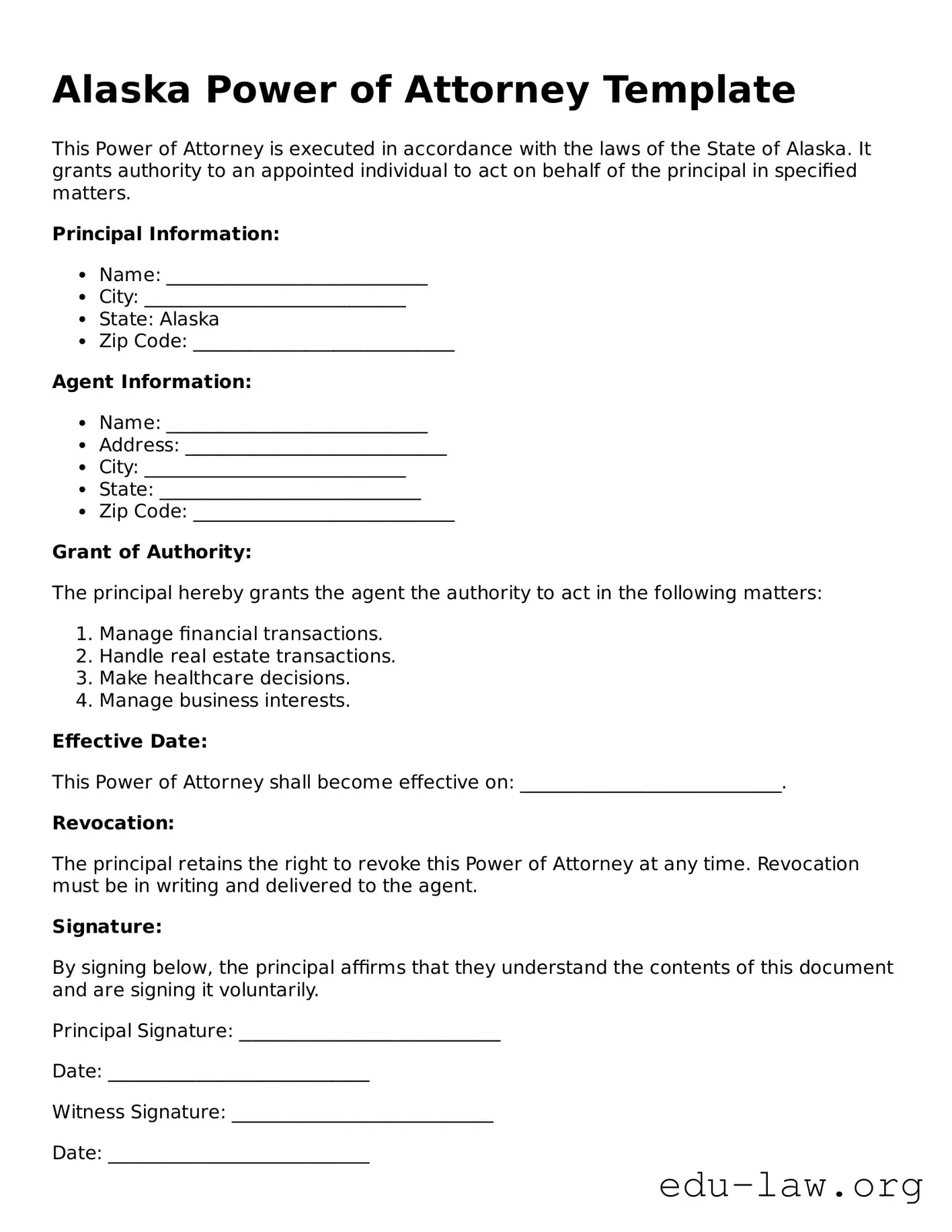
Alaska Power of Attorney Template
This Power of Attorney is executed in accordance with the laws of the State of Alaska. It grants authority to an appointed individual to act on behalf of the principal in specified matters.
Principal Information:
Agent Information:
Grant of Authority:
The principal hereby grants the agent the authority to act in the following matters:
Effective Date:
This Power of Attorney shall become effective on: ____________________________.
Revocation:
The principal retains the right to revoke this Power of Attorney at any time. Revocation must be in writing and delivered to the agent.
Signature:
By signing below, the principal affirms that they understand the contents of this document and are signing it voluntarily.
Principal Signature: ____________________________
Date: ____________________________
Witness Signature: ____________________________
Date: ____________________________
| Fact Name | Description |
|---|---|
| Definition | The Alaska Power of Attorney form allows an individual to appoint someone else to act on their behalf in legal and financial matters. |
| Governing Law | The form is governed by Alaska Statutes, specifically Title 13, Chapter 12. |
| Types | There are different types of Power of Attorney in Alaska, including general, limited, and durable. |
| Durability | A durable Power of Attorney remains effective even if the principal becomes incapacitated. |
| Signature Requirements | The form must be signed by the principal and witnessed by two individuals or notarized. |
| Revocation | The principal can revoke the Power of Attorney at any time, provided they are mentally competent. |
| Filing | While it is not mandatory to file the Power of Attorney with the state, doing so may help prevent disputes in the future. |
Filling out the Alaska Power of Attorney form is a straightforward process. Once you complete the form, you will need to sign it in front of a notary public. This ensures that your document is legally valid and recognized. Follow the steps below to complete the form accurately.
What is a Power of Attorney in Alaska?
A Power of Attorney (POA) in Alaska is a legal document that allows one person (the principal) to authorize another person (the agent) to act on their behalf. This can include making financial decisions, handling real estate transactions, or managing personal affairs. The POA can be tailored to be effective immediately or only in certain circumstances, such as when the principal becomes incapacitated.
Who can be appointed as an agent in Alaska?
In Alaska, any competent adult can be appointed as an agent under a Power of Attorney. This can be a family member, friend, or even a professional such as an attorney. It is important to choose someone trustworthy, as they will have significant control over your financial and legal matters.
What types of Power of Attorney are available in Alaska?
Alaska recognizes several types of Power of Attorney forms, including general, limited, durable, and medical. A general POA grants broad powers, while a limited POA restricts the agent's authority to specific tasks. A durable POA remains effective even if the principal becomes incapacitated, and a medical POA specifically allows the agent to make healthcare decisions on behalf of the principal.
Do I need to have my Power of Attorney document notarized?
Yes, in Alaska, a Power of Attorney must be notarized to be valid. This means that you will need to sign the document in front of a notary public, who will then verify your identity and witness your signature. This step helps ensure that the document is legally binding and recognized by financial institutions and other entities.
Can I revoke a Power of Attorney in Alaska?
Absolutely. You can revoke a Power of Attorney at any time as long as you are mentally competent. To do this, you should create a written revocation document and notify your agent and any institutions that may have relied on the original POA. It is advisable to keep a copy of the revocation for your records.
What happens if my agent misuses their authority?
If your agent misuses their authority, you have the right to take legal action against them. This could involve filing a complaint with the court or seeking damages for any losses incurred due to their actions. It is crucial to monitor your agent's activities and ensure they are acting in your best interest.
Is a Power of Attorney valid in other states?
A Power of Attorney created in Alaska is generally recognized in other states, but there may be variations in laws and requirements. It is a good idea to check the specific laws of the state where you intend to use the POA to ensure it meets their requirements. Some states may require additional forms or notarization.
Can I use a Power of Attorney for healthcare decisions?
Yes, you can use a specific type of Power of Attorney known as a medical or healthcare POA to appoint someone to make medical decisions on your behalf. This document allows your agent to make choices about your healthcare if you are unable to do so yourself, ensuring your wishes are respected in medical situations.
How do I create a Power of Attorney in Alaska?
To create a Power of Attorney in Alaska, you need to fill out the appropriate form, clearly outline the powers you wish to grant, and have it notarized. It is often helpful to consult with an attorney to ensure that the document meets your needs and complies with state laws. After completing the form, provide copies to your agent and any relevant institutions.
Not specifying the powers granted: Many people fail to clearly outline the specific powers they are granting. It's crucial to be explicit about what the agent can and cannot do on your behalf.
Forgetting to date the form: A common oversight is neglecting to include the date when the form is signed. This can lead to confusion about when the authority begins.
Not having witnesses or notarization: Some individuals overlook the requirement for witnesses or a notary. Without these, the document may not be valid.
Using outdated forms: It's important to use the most current version of the Power of Attorney form. Using an outdated form can result in legal complications.
Failing to communicate with the agent: People often fill out the form without discussing it with their chosen agent. This can lead to misunderstandings about the agent's role and responsibilities.
When establishing a Power of Attorney in Alaska, several additional forms and documents may be necessary to ensure comprehensive legal coverage. Each of these documents serves a unique purpose and can help clarify the authority granted to an agent or provide additional protections for the principal.
By utilizing these documents in conjunction with the Alaska Power of Attorney form, individuals can create a more robust framework for managing their affairs. It is advisable to consult with a legal professional to ensure that all documents are completed correctly and reflect the principal's intentions accurately.
The Alaska Power of Attorney form shares similarities with the Health Care Proxy. Both documents allow individuals to designate someone to make decisions on their behalf. While the Power of Attorney typically covers financial and legal matters, the Health Care Proxy specifically addresses medical decisions. In both cases, the appointed person, known as an agent, acts in the best interest of the principal, ensuring that their wishes are respected when they are unable to communicate them directly.
Another document comparable to the Alaska Power of Attorney is the Living Will. A Living Will outlines an individual’s preferences regarding medical treatment in situations where they cannot express their wishes. Like the Power of Attorney, it serves to guide decision-making. However, the key difference lies in the scope; the Living Will focuses solely on health care decisions, while the Power of Attorney can encompass a broader range of legal and financial matters.
The Durable Power of Attorney is closely related to the Alaska Power of Attorney. Both documents allow a person to appoint an agent to manage their affairs. However, the Durable Power of Attorney remains effective even if the principal becomes incapacitated. This characteristic ensures that the agent can continue to act on behalf of the principal without interruption, providing a crucial safety net in times of need.
The Financial Power of Attorney is another document that bears resemblance to the Alaska Power of Attorney. It specifically grants authority to an agent to handle financial transactions, such as managing bank accounts or making investments. While the Alaska Power of Attorney can also include financial powers, the Financial Power of Attorney is more focused on monetary matters, making it particularly useful for individuals who want to delegate their financial responsibilities without addressing other types of decisions.
Lastly, the Guardianship Petition is similar in that it involves appointing someone to make decisions for another person. This document is often used when an individual is unable to care for themselves due to incapacity. Unlike the Power of Attorney, which is created voluntarily by the principal, a Guardianship Petition typically requires court approval. Both processes aim to protect individuals who cannot advocate for themselves, but the Guardianship Petition is a more formal legal procedure.
When filling out the Alaska Power of Attorney form, it is crucial to approach the task with care and attention to detail. Below are ten important considerations to keep in mind, divided into what you should do and what you should avoid.
Things You Should Do:
Things You Shouldn't Do:
By adhering to these guidelines, you can help ensure that your Power of Attorney form is completed correctly and serves your intended purpose effectively.
Many people have misunderstandings about the Alaska Power of Attorney form. Here are six common misconceptions, along with clarifications for each.
Misconception 1: A Power of Attorney is only for financial matters.
This is not true. While many use it for financial decisions, a Power of Attorney can also cover health care decisions and other personal matters. The specific powers granted depend on how the document is drafted.
Misconception 2: A Power of Attorney is permanent and cannot be revoked.
This is incorrect. A person can revoke a Power of Attorney at any time, as long as they are mentally competent. It is important to follow the proper procedures to ensure the revocation is valid.
Misconception 3: Only lawyers can create a Power of Attorney.
This is a common belief, but it is not necessary to have a lawyer draft the document. Individuals can create their own Power of Attorney, provided they follow state laws and requirements.
Misconception 4: A Power of Attorney can be used after the principal passes away.
This is false. A Power of Attorney becomes invalid upon the death of the principal. After death, the estate must be handled through probate or according to the will.
Misconception 5: All Powers of Attorney are the same.
This is misleading. There are different types of Powers of Attorney, including general, limited, and durable. Each type serves different purposes and has different implications.
Misconception 6: A Power of Attorney can only be used in Alaska.
This is not accurate. While the Alaska Power of Attorney form is specific to Alaska, similar documents exist in other states. A Power of Attorney can be recognized across state lines, but it’s essential to check the laws in each state.
When dealing with the Alaska Power of Attorney form, it is essential to understand several key points to ensure that the document is filled out correctly and used effectively. Here are some important takeaways:
By keeping these points in mind, individuals can navigate the process of creating and using a Power of Attorney in Alaska with greater confidence and clarity.