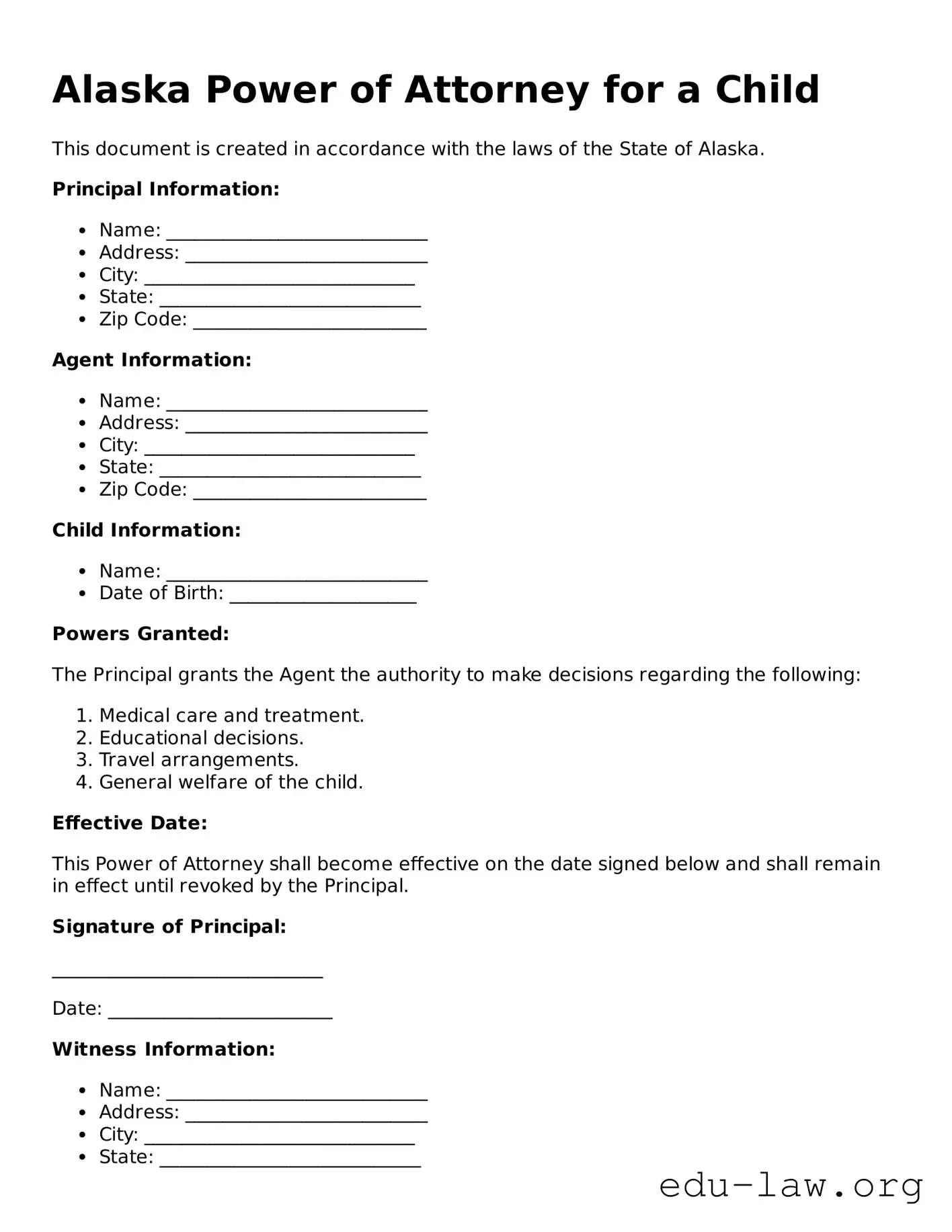
The Alaska Power of Attorney for a Child form is an important legal document that allows a parent or legal guardian to grant authority to another adult to make decisions on behalf of their child. This arrangement is particularly useful in situations where the parent is temporarily unavailable, such as during travel or medical emergencies. The form outlines the specific powers being granted, which may include making educational, medical, and other significant decisions. It is essential to specify the duration of the authority, ensuring that the appointed person has the necessary time to act in the child's best interest. Additionally, the form requires signatures from both the parent and the agent, as well as a witness or notary public, to validate the agreement. Understanding the purpose and requirements of this form can help ensure that a child's needs are met when a parent cannot be present.
Alaska Power of Attorney for a Child
This document is created in accordance with the laws of the State of Alaska.
Principal Information:
Agent Information:
Child Information:
Powers Granted:
The Principal grants the Agent the authority to make decisions regarding the following:
Effective Date:
This Power of Attorney shall become effective on the date signed below and shall remain in effect until revoked by the Principal.
Signature of Principal:
_____________________________
Date: ________________________
Witness Information:
Signature of Witness:
_____________________________
Date: ________________________
| Fact Name | Description |
|---|---|
| Purpose | The Alaska Power of Attorney for a Child form allows a parent or legal guardian to designate another adult to make decisions on behalf of their child. |
| Governing Law | This form is governed by Alaska Statutes Title 13, Chapter 26, which outlines the laws related to powers of attorney in the state. |
| Duration | The authority granted under this form can be temporary or indefinite, depending on the preferences of the parent or guardian. |
| Signatures Required | The form must be signed by the parent or legal guardian, and it is advisable to have the signature notarized for additional legal validity. |
| Revocation | A parent or guardian can revoke the power of attorney at any time, as long as they provide written notice to the designated agent. |
| Limitations | The designated agent cannot make decisions regarding the child's medical treatment unless specifically authorized in the form. |
Filling out the Alaska Power of Attorney for a Child form is a straightforward process that allows you to designate someone to make decisions on behalf of your child. Once you have completed the form, you will need to sign it in front of a notary public. This ensures that the document is legally binding and recognized by authorities.
What is a Power of Attorney for a Child in Alaska?
A Power of Attorney for a Child in Alaska is a legal document that allows a parent or guardian to designate another adult to make decisions on behalf of their child. This can include decisions related to education, healthcare, and general welfare. It is particularly useful when parents are unable to care for their child temporarily due to travel, illness, or other circumstances. This document grants specific powers to the designated person, known as the agent or attorney-in-fact, ensuring that the child’s needs are met in the parent's absence.
Who can be designated as an agent in the Power of Attorney for a Child?
The agent designated in the Power of Attorney for a Child must be an adult, typically someone the parent trusts, such as a relative, friend, or neighbor. It is important that the chosen agent is responsible and capable of making decisions in the best interest of the child. While there are no strict requirements regarding the relationship between the parent and the agent, selecting someone familiar with the child’s needs and preferences is advisable.
How long is the Power of Attorney for a Child valid?
The duration of the Power of Attorney for a Child can vary based on the terms specified in the document. Generally, it remains effective until the parent revokes it, the child reaches the age of majority, or a specified time period elapses. Parents should clearly state the intended duration in the document to avoid any confusion. If circumstances change and the parent wishes to terminate the Power of Attorney, they can do so by providing written notice to the agent.
Do I need to have the Power of Attorney for a Child notarized?
In Alaska, it is recommended, though not always required, to have the Power of Attorney for a Child notarized. Notarization adds an extra layer of legitimacy and can help prevent disputes regarding the document’s validity. If the form is notarized, it may also be more readily accepted by schools, healthcare providers, and other institutions. Parents should check with specific organizations to understand their requirements regarding notarization.
Can the Power of Attorney for a Child be revoked?
Yes, parents can revoke the Power of Attorney for a Child at any time. To do this, they must provide written notice to the agent and any relevant institutions that may be relying on the document. It is also advisable to formally document the revocation to ensure clarity. Once revoked, the agent no longer has the authority to act on behalf of the child, and the parent should take steps to inform any parties that were previously involved.
What happens if the agent is unable to fulfill their duties?
If the designated agent is unable to fulfill their responsibilities due to illness, relocation, or other reasons, it is essential for the parent to have a backup plan. The Power of Attorney can include provisions for an alternate agent, ensuring that someone else can step in if needed. If no alternate agent is designated, the parent should take immediate steps to appoint a new agent and inform all relevant parties to avoid any disruption in care for the child.
Not specifying the child's full name. Ensure that you include the complete name of the child for whom the power of attorney is being granted. Omitting this detail can lead to confusion or legal issues.
Failing to include the dates of authority. Clearly indicate the start and end dates for the power of attorney. Without this information, the document may be considered invalid.
Neglecting to sign the document. Both the parent or guardian and the agent must sign the form. A missing signature can render the document ineffective.
Not having the form notarized. In Alaska, notarization is often required for the power of attorney to be legally binding. Failing to do so can create complications.
Choosing an inappropriate agent. It is crucial to select someone trustworthy and responsible. An unsuitable choice can lead to issues regarding the child’s welfare.
Leaving out specific powers granted. Clearly outline the powers you are granting to the agent. General statements may lead to misunderstandings about what the agent can and cannot do.
Not reviewing the form for errors. Before submitting, carefully check for any mistakes or omissions. Small errors can have significant consequences.
When considering the Alaska Power of Attorney for a Child form, it’s important to understand that several other documents may be required or beneficial in conjunction with it. These documents help ensure that the child's needs are met and that the authority granted is clear and comprehensive. Below is a list of commonly used forms and documents.
Understanding these documents can help ensure that the rights and needs of the child are fully protected. It is advisable to consult with a legal professional to determine which forms are necessary for your specific situation. Taking these steps can provide peace of mind and clarity in times of need.
The Alaska Power of Attorney for a Child form is similar to a General Power of Attorney. Both documents allow one person to grant authority to another, enabling the appointed individual to make decisions on their behalf. However, while a General Power of Attorney can cover a wide range of decisions, including financial and legal matters, the Power of Attorney for a Child specifically focuses on the care and welfare of a minor. This makes it particularly useful for parents who need to delegate responsibilities temporarily, such as during travel or medical emergencies.
Another document that shares similarities is the Medical Power of Attorney. This form specifically allows someone to make medical decisions for another person. In the case of the Power of Attorney for a Child, it can include medical decisions for a minor. Parents may choose to use both forms together to ensure that their child receives the necessary medical care when they are unable to provide consent themselves.
The Temporary Guardianship Agreement is also comparable. This document allows a parent to appoint a temporary guardian for their child, granting the guardian specific rights and responsibilities. Like the Power of Attorney for a Child, it is often used in situations where parents are unavailable. The key difference lies in the duration of authority; a guardianship may last longer and can be more formal, whereas a Power of Attorney is often intended for short-term situations.
A Child Custody Agreement is another related document. While the Power of Attorney for a Child focuses on decision-making authority, a Child Custody Agreement establishes the legal custody arrangements for a child, including where the child will live and who will make decisions about their upbringing. Both documents aim to protect the child's best interests but serve different purposes in legal terms.
The Authorization for Release of Medical Records is similar in that it allows a parent or guardian to grant permission for medical providers to share a child's health information with designated individuals. This form is often used in conjunction with the Power of Attorney for a Child to ensure that the designated person can access necessary medical information and make informed decisions regarding the child's care.
A Child Travel Consent Form also bears similarities to the Power of Attorney for a Child. This document allows a parent to give permission for their child to travel with another adult, which can be essential for trips, vacations, or school events. While the Power of Attorney provides broader authority for decision-making, the Travel Consent Form is specifically focused on travel-related permissions.
Lastly, the School Authorization Form is comparable. This document allows parents to authorize someone else to act on their behalf regarding school-related matters, such as attending meetings or signing documents. Like the Power of Attorney for a Child, it is designed to ensure that someone can step in and handle responsibilities when parents are unable to do so, particularly in educational settings.
When filling out the Alaska Power of Attorney for a Child form, it's important to follow certain guidelines to ensure the document is valid and effective. Here are nine things to keep in mind:
By following these guidelines, you can help ensure that the Power of Attorney for a Child is properly executed and serves its intended purpose.
Many people have misunderstandings about the Alaska Power of Attorney for a Child form. Here are five common misconceptions and explanations to clarify them:
Understanding these misconceptions can help parents make informed decisions about their child's care and legal arrangements.
When considering the Alaska Power of Attorney for a Child form, there are several important factors to keep in mind. This document allows a parent or guardian to designate another individual to make decisions on behalf of a child. Here are key takeaways to ensure effective use of this form:
By keeping these points in mind, individuals can effectively utilize the Alaska Power of Attorney for a Child form, ensuring that the child’s needs are met when the parent or guardian is unavailable.