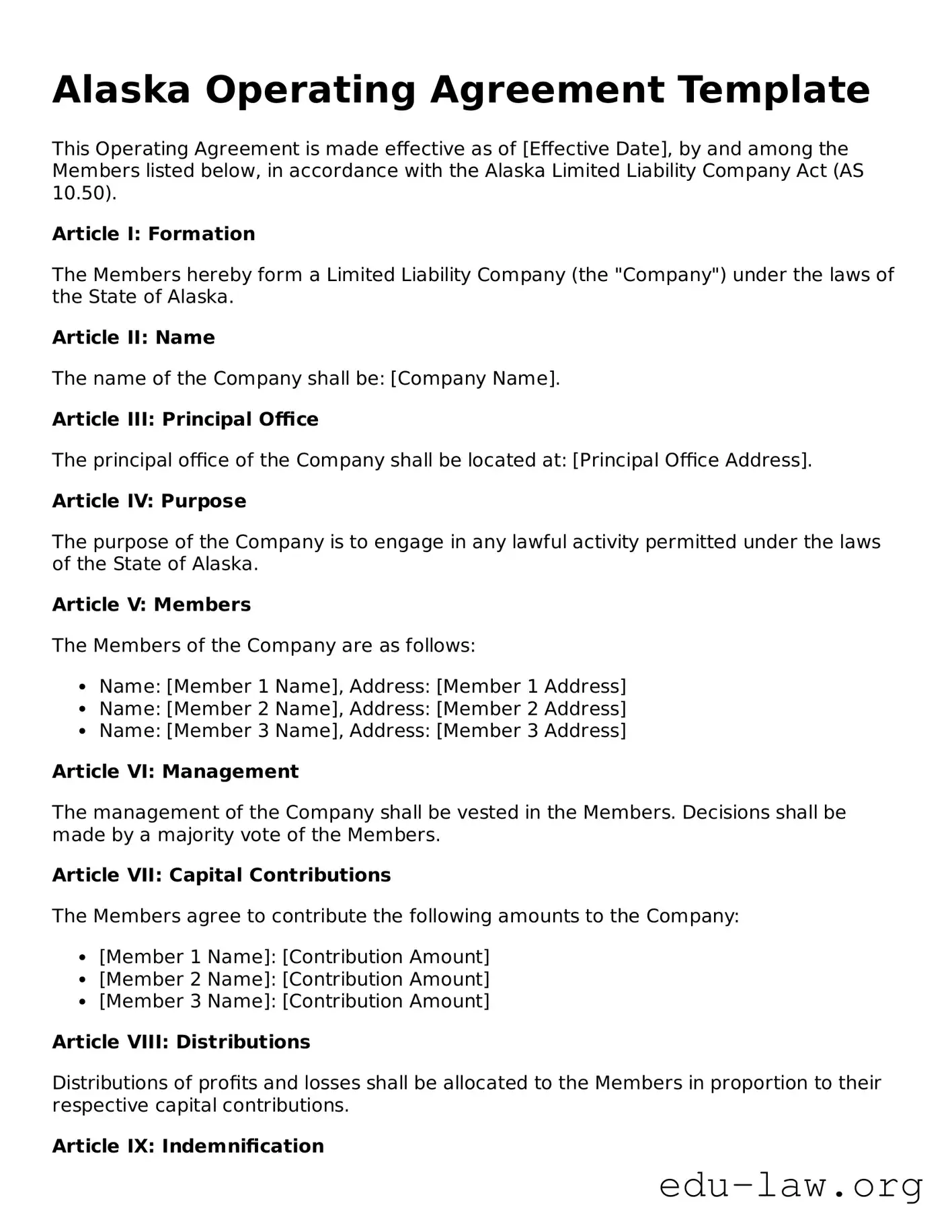
The Alaska Operating Agreement form serves as a vital document for individuals and businesses looking to establish a clear framework for their operations in the state. This agreement outlines the roles, responsibilities, and rights of each member involved in a business venture, ensuring that everyone is on the same page from the outset. It typically includes important details such as the purpose of the business, the management structure, and the distribution of profits and losses. Additionally, the agreement addresses decision-making processes, member contributions, and procedures for resolving disputes. By setting these expectations in writing, the Operating Agreement fosters transparency and cooperation among members, ultimately contributing to the long-term success of the business. Whether you are forming a limited liability company (LLC) or a partnership, understanding the components of the Alaska Operating Agreement is essential for navigating the complexities of business ownership in the Last Frontier.
Alaska Operating Agreement Template
This Operating Agreement is made effective as of [Effective Date], by and among the Members listed below, in accordance with the Alaska Limited Liability Company Act (AS 10.50).
Article I: Formation
The Members hereby form a Limited Liability Company (the "Company") under the laws of the State of Alaska.
Article II: Name
The name of the Company shall be: [Company Name].
Article III: Principal Office
The principal office of the Company shall be located at: [Principal Office Address].
Article IV: Purpose
The purpose of the Company is to engage in any lawful activity permitted under the laws of the State of Alaska.
Article V: Members
The Members of the Company are as follows:
Article VI: Management
The management of the Company shall be vested in the Members. Decisions shall be made by a majority vote of the Members.
Article VII: Capital Contributions
The Members agree to contribute the following amounts to the Company:
Article VIII: Distributions
Distributions of profits and losses shall be allocated to the Members in proportion to their respective capital contributions.
Article IX: Indemnification
The Company shall indemnify any Member or Manager against any losses or expenses incurred in connection with the Company, to the fullest extent permitted by Alaska law.
Article X: Amendments
This Operating Agreement may be amended only by a written agreement signed by all Members.
IN WITNESS WHEREOF, the Members have executed this Operating Agreement as of the date first above written.
Signatures:
| Fact Name | Details |
|---|---|
| Purpose | The Alaska Operating Agreement outlines the management and operational procedures of a limited liability company (LLC) in Alaska. |
| Governing Law | This agreement is governed by Alaska Statutes, specifically Title 10, Chapter 50. |
| Members | The agreement defines the rights and responsibilities of the members involved in the LLC. |
| Management Structure | It specifies whether the LLC will be member-managed or manager-managed. |
| Capital Contributions | The document details the capital contributions made by each member and how profits and losses will be distributed. |
| Amendments | It outlines the process for making amendments to the Operating Agreement in the future. |
| Dispute Resolution | The agreement may include provisions for resolving disputes among members, such as mediation or arbitration. |
| Duration | The Operating Agreement can specify the duration of the LLC's existence, whether it is perpetual or for a defined term. |
Filling out the Alaska Operating Agreement form is a straightforward process. Make sure you have all necessary information at hand before you begin. This will help ensure accuracy and efficiency.
After completing the form, you will need to submit it to the appropriate state office. Be sure to keep a copy for your records.
What is an Alaska Operating Agreement?
An Alaska Operating Agreement is a legal document that outlines the management structure and operational guidelines for a Limited Liability Company (LLC) in Alaska. This agreement serves as an internal document for the members of the LLC, detailing how the company will be run, how profits and losses will be distributed, and the responsibilities of each member. It is not filed with the state but is crucial for the smooth operation of the business.
Why is an Operating Agreement important?
An Operating Agreement is essential for several reasons. First, it helps to clarify the roles and responsibilities of each member, reducing the potential for disputes. Second, it provides a clear framework for decision-making and profit distribution. Third, having this agreement in place can help protect the members’ personal assets by reinforcing the limited liability status of the LLC. Without it, state default rules may apply, which might not align with the members' intentions.
Who should draft the Operating Agreement?
Can the Operating Agreement be changed after it is created?
Incomplete Information: Many individuals fail to provide all required details. This includes missing names, addresses, or the purpose of the business. Double-check all sections to ensure nothing is overlooked.
Incorrect Member Designation: People often mislabel members as managers or vice versa. It's crucial to clearly identify each person's role within the organization.
Failure to Specify Voting Rights: Some forget to outline how decisions will be made. Specify voting rights for each member to avoid confusion in the future.
Ignoring State Requirements: Each state has specific rules for operating agreements. Not adhering to Alaska’s regulations can lead to complications. Research state requirements before submission.
Not Reviewing the Agreement: Rushing through the form without a thorough review can lead to errors. Take the time to read everything carefully, ensuring clarity and accuracy.
When creating an Alaska Operating Agreement, several other documents may be useful. Each of these documents plays a role in establishing and managing a business effectively. Here are a few commonly used forms and documents that often accompany the Operating Agreement.
Having these documents in place can help clarify roles, responsibilities, and procedures within the business. They contribute to a smoother operation and can protect the interests of all members involved.
The Alaska Operating Agreement form is comparable to the Limited Liability Company (LLC) Operating Agreement, which outlines the management structure and operational guidelines for an LLC. Both documents serve a similar purpose in defining the roles and responsibilities of members, as well as the distribution of profits and losses. They provide clarity and prevent misunderstandings among members, ensuring that everyone is on the same page regarding the company's operations.
Another document that shares similarities is the Partnership Agreement. This agreement is crucial for partnerships, as it details the terms of the partnership, including the contributions of each partner, profit-sharing arrangements, and procedures for resolving disputes. Like the Alaska Operating Agreement, it aims to establish clear expectations and responsibilities among the partners involved.
The Corporate Bylaws are also akin to the Alaska Operating Agreement. Bylaws govern the internal affairs of a corporation, specifying how the corporation will be managed and outlining the rights and responsibilities of shareholders and directors. Both documents provide a framework for governance, helping to ensure that the organization operates smoothly and in compliance with applicable laws.
In addition, the Shareholder Agreement bears resemblance to the Alaska Operating Agreement. This document is used by corporations to define the relationship between shareholders, covering topics such as voting rights, share transfers, and management roles. Both agreements aim to protect the interests of their respective members or shareholders while promoting effective management and decision-making.
The Joint Venture Agreement is another document that aligns with the Alaska Operating Agreement. This agreement is formed when two or more parties come together for a specific business purpose. It outlines the contributions, responsibilities, and profit-sharing arrangements of each party involved. Like the Operating Agreement, it establishes a clear framework for collaboration and helps prevent conflicts between the parties.
The Franchise Agreement also shares common ground with the Alaska Operating Agreement. This document governs the relationship between a franchisor and franchisee, detailing the rights and obligations of both parties. It includes operational guidelines, fees, and performance expectations. Both agreements serve to create a structured environment where parties can work together effectively while adhering to established standards.
Additionally, the Non-Disclosure Agreement (NDA) is somewhat similar in its intent to protect sensitive information. While not directly related to operational structure, both documents aim to safeguard the interests of the parties involved. An NDA ensures that confidential information shared between parties remains protected, just as the Operating Agreement protects the rights and responsibilities of its members.
Finally, the Employment Agreement can be compared to the Alaska Operating Agreement in terms of establishing clear expectations. This document outlines the terms of employment for individuals within a company, including job responsibilities, compensation, and termination procedures. Both agreements aim to create a clear understanding of roles and expectations, which is essential for the smooth functioning of any organization.
When filling out the Alaska Operating Agreement form, it’s essential to approach the task with care. Here’s a helpful list of dos and don’ts to guide you through the process.
By following these guidelines, you can fill out the Alaska Operating Agreement form confidently and accurately. Taking these steps will help pave the way for a smoother business operation.
Many people have misunderstandings about the Alaska Operating Agreement form. Here are nine common misconceptions, along with clarifications for each.
Understanding these misconceptions can help ensure that business owners in Alaska make informed decisions about their Operating Agreements.
When it comes to filling out and using the Alaska Operating Agreement form, there are several important points to keep in mind. Here are some key takeaways: