The Alaska Notice to Quit form is an essential document for landlords and tenants navigating the complexities of rental agreements in the state. This form serves as a formal notification to a tenant, indicating the need to vacate the rental property, usually due to non-payment of rent or violation of lease terms. It outlines the specific reasons for termination and provides a timeline for the tenant to respond or remedy the situation. By clearly stating the obligations and rights of both parties, the Notice to Quit helps to prevent misunderstandings and potential disputes. Understanding this form is crucial for both landlords seeking to protect their property and tenants wanting to ensure their rights are respected. Whether you are a seasoned property owner or a first-time renter, familiarity with the Notice to Quit can facilitate smoother communication and a more harmonious rental experience.
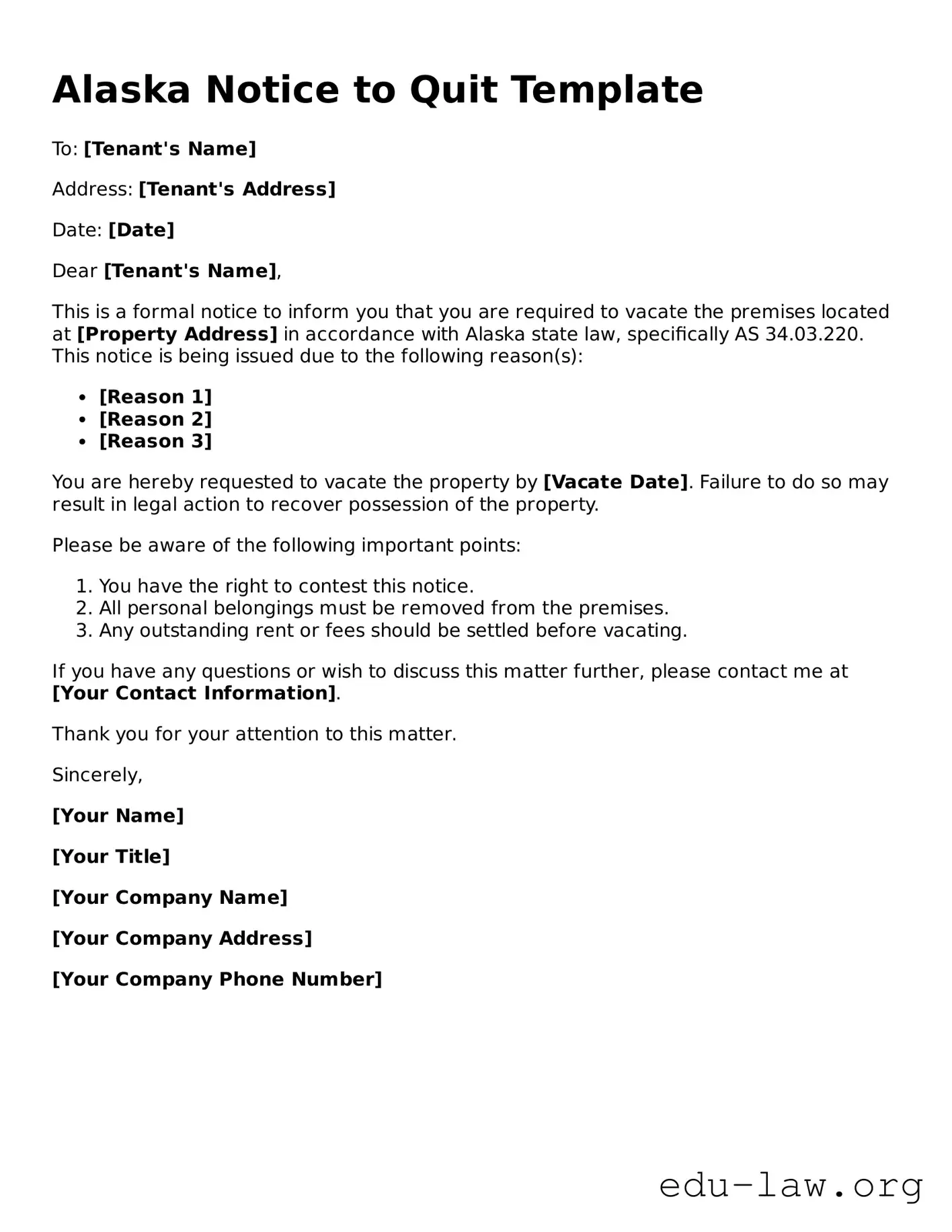
Alaska Notice to Quit Template
To: [Tenant's Name]
Address: [Tenant's Address]
Date: [Date]
Dear [Tenant's Name],
This is a formal notice to inform you that you are required to vacate the premises located at [Property Address] in accordance with Alaska state law, specifically AS 34.03.220. This notice is being issued due to the following reason(s):
You are hereby requested to vacate the property by [Vacate Date]. Failure to do so may result in legal action to recover possession of the property.
Please be aware of the following important points:
If you have any questions or wish to discuss this matter further, please contact me at [Your Contact Information].
Thank you for your attention to this matter.
Sincerely,
[Your Name]
[Your Title]
[Your Company Name]
[Your Company Address]
[Your Company Phone Number]
| Fact Name | Details |
|---|---|
| Purpose | The Alaska Notice to Quit form is used to inform a tenant that they must vacate the rental property. |
| Governing Law | This form is governed by Alaska Statutes, specifically under AS 34.03.220. |
| Notice Period | Generally, a tenant is given a minimum of 10 days to vacate the premises after receiving the notice. |
| Delivery Methods | The notice can be delivered in person, mailed, or posted on the property. |
| Required Information | The form must include the tenant's name, address of the rental property, and the reason for termination. |
| Consequences of Non-compliance | If the tenant does not comply, the landlord may proceed with eviction proceedings. |
After you have gathered all necessary information, you are ready to fill out the Alaska Notice to Quit form. This document is essential for notifying a tenant of the need to vacate the premises. Follow these steps carefully to ensure that you complete the form accurately.
Once the form is filled out and delivered, keep track of any responses from the tenant. This will be important for any future actions you may need to take.
What is an Alaska Notice to Quit form?
The Alaska Notice to Quit form is a legal document used by landlords to notify tenants that they must vacate the rental property. This notice is typically issued when a tenant has violated the terms of the lease agreement or has not paid rent. It serves as a formal request for the tenant to leave the premises within a specified timeframe.
When should a landlord use the Notice to Quit?
A landlord should use the Notice to Quit when a tenant fails to comply with the lease terms, such as not paying rent, causing damage to the property, or engaging in illegal activities. It is an essential step before initiating eviction proceedings.
How much notice must be given to the tenant?
The required notice period can vary depending on the reason for the Notice to Quit. For non-payment of rent, landlords typically must provide a 14-day notice. For lease violations, the notice period can be as short as 10 days. Always check current local laws for any updates or changes.
Can a tenant respond to a Notice to Quit?
Yes, a tenant can respond to a Notice to Quit. They may choose to address the issues raised in the notice, such as paying overdue rent or correcting lease violations. Communication between the landlord and tenant can sometimes resolve the situation without further action.
What happens if the tenant does not comply with the Notice to Quit?
If the tenant does not comply with the Notice to Quit by the specified deadline, the landlord may begin eviction proceedings. This involves filing a lawsuit in court to obtain a formal eviction order.
Is the Notice to Quit required for all evictions?
Can the Notice to Quit be served electronically?
In Alaska, the Notice to Quit can be served in person or by mail. However, serving it electronically is not typically accepted unless both parties have agreed to such methods in the lease agreement. Always check local regulations for specific requirements.
What should be included in the Notice to Quit?
The Notice to Quit should include the tenant's name, the address of the rental property, the reason for the notice, and the deadline for vacating the premises. It should be clear and concise to avoid any confusion.
Not providing the correct tenant information. Always ensure that the names of all tenants are accurately listed. Missing or incorrect names can lead to complications.
Failing to specify the reason for the notice. Clearly stating the reason for the eviction is essential. Whether it's for non-payment of rent or lease violations, clarity is key.
Neglecting to include the date. It's important to include the date the notice is served. This helps establish a timeline for any potential legal proceedings.
Using vague language. Avoid ambiguous terms and phrases. Be straightforward and specific to prevent misunderstandings.
Not following the required notice period. Each situation has a specific timeframe that must be adhered to. Ensure that you are aware of the legal requirements for notice periods in Alaska.
Forgetting to sign the notice. A signature is necessary to validate the notice. Without it, the document may be considered invalid.
Not keeping a copy of the notice. Always retain a copy for your records. This can be crucial if any disputes arise later.
When dealing with rental agreements in Alaska, the Notice to Quit form is often accompanied by several other important documents. These forms help clarify the responsibilities of both landlords and tenants, ensuring that the eviction process is handled legally and fairly. Below are some key documents that are commonly used alongside the Notice to Quit.
Understanding these documents is essential for both landlords and tenants to navigate the rental landscape in Alaska effectively. Each form plays a critical role in ensuring that the rights of both parties are respected during the eviction process.
The Alaska Notice to Quit form shares similarities with the Eviction Notice, which is commonly used in many states. An Eviction Notice serves as a formal communication from a landlord to a tenant, indicating that the tenant must vacate the premises within a specified time frame. Just like the Notice to Quit, the Eviction Notice outlines the reasons for the eviction, such as failure to pay rent or violation of lease terms. Both documents aim to inform tenants of their obligations and the potential consequences of non-compliance, fostering a clearer understanding of the situation for all parties involved.
Another document comparable to the Alaska Notice to Quit is the Lease Termination Notice. This notice is typically issued when a landlord or tenant wishes to end a rental agreement at the conclusion of its term. Similar to the Notice to Quit, it provides a formal declaration of intent to terminate the lease, specifying the date by which the tenant must vacate the property. Both documents serve as a means to facilitate communication regarding the end of a tenancy, ensuring that both parties are aware of their rights and responsibilities during the transition.
The Three-Day Notice to Pay Rent or Quit is also akin to the Alaska Notice to Quit. This notice is issued when a tenant has failed to pay rent on time, giving them a short window to either pay the overdue rent or vacate the property. Like the Notice to Quit, it emphasizes the urgency of the situation and outlines the consequences of inaction. Both documents are designed to prompt timely responses from tenants, encouraging them to address any issues before facing further legal action.
Lastly, the Notice of Non-Renewal is another document that bears resemblance to the Alaska Notice to Quit. This notice is given when a landlord does not intend to renew a lease agreement, informing the tenant that they must vacate the property once the lease expires. Similar to the Notice to Quit, it establishes a clear timeline for the tenant to prepare for their departure. Both documents aim to ensure that tenants have adequate notice and time to make arrangements, thus promoting a smoother transition for everyone involved.
When filling out the Alaska Notice to Quit form, there are important steps to follow. Here’s a helpful list of what you should and shouldn't do.
When it comes to the Alaska Notice to Quit form, there are several misconceptions that can lead to confusion for both landlords and tenants. Understanding the facts can help ensure that everyone is on the same page regarding their rights and responsibilities.
Many people believe that a Notice to Quit is an official eviction notice. In reality, it is a preliminary step that informs the tenant that they must vacate the property. An eviction process follows if the tenant does not comply.
Some assume that landlords can issue a Notice to Quit at any time for any reason. However, the law requires specific grounds, such as non-payment of rent or lease violations, to justify this notice.
It's a common belief that tenants can ignore a Notice to Quit. In fact, tenants should take this notice seriously and respond appropriately, as failure to do so may lead to eviction proceedings.
Some think that the only way to deliver a Notice to Quit is in person. However, Alaska law allows for other methods of delivery, such as mailing or posting on the property, as long as they comply with legal requirements.
When dealing with the Alaska Notice to Quit form, it’s important to understand the key points to ensure proper use. Here are some essential takeaways:
Taking these steps can help ensure that the Notice to Quit is filled out correctly and used effectively.