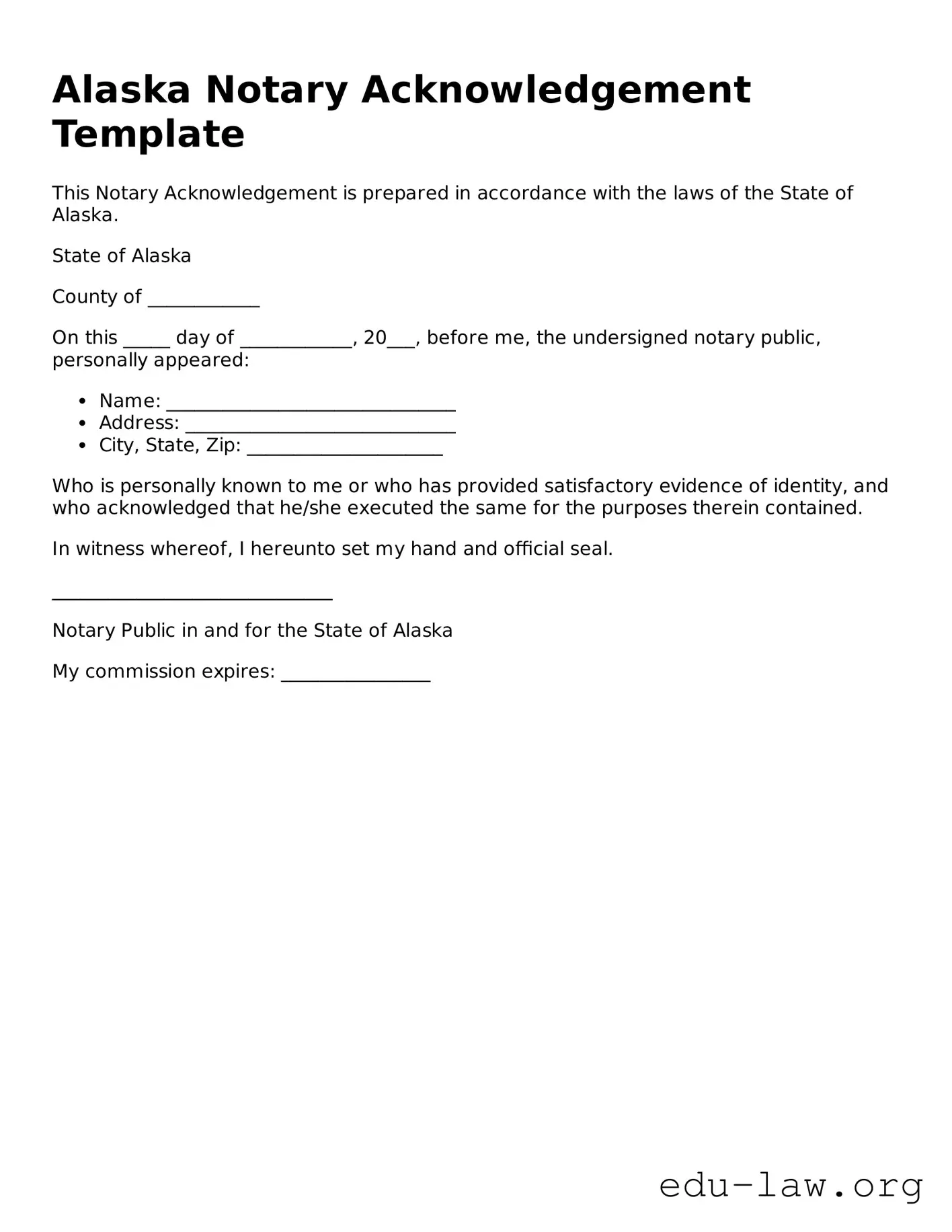
The Alaska Notary Acknowledgement form plays a crucial role in the legal process, serving as a verification tool for various documents. This form is typically used when a signer needs to confirm their identity and affirm that they willingly signed a document. It helps ensure the authenticity of signatures, which is vital in legal and financial transactions. The form includes essential details such as the name of the signer, the type of document being acknowledged, and the notary's information. Additionally, it requires the notary's signature and seal, providing an official stamp of approval. By using this form, individuals can enhance the credibility of their documents, making it easier to navigate legal requirements in Alaska. Understanding how to properly fill out and use the Notary Acknowledgement form can save time and prevent potential issues down the line.
Alaska Notary Acknowledgement Template
This Notary Acknowledgement is prepared in accordance with the laws of the State of Alaska.
State of Alaska
County of ____________
On this _____ day of ____________, 20___, before me, the undersigned notary public, personally appeared:
Who is personally known to me or who has provided satisfactory evidence of identity, and who acknowledged that he/she executed the same for the purposes therein contained.
In witness whereof, I hereunto set my hand and official seal.
______________________________
Notary Public in and for the State of Alaska
My commission expires: ________________
| Fact Name | Description |
|---|---|
| Governing Law | The Alaska Notary Acknowledgment form is governed by Alaska Statutes Title 44, Chapter 50. |
| Purpose | This form is used to verify the identity of the signer and to confirm that the signature was made voluntarily. |
| Signature Requirement | The signer must personally appear before the notary public to sign the document. |
| Notary's Role | The notary public is responsible for completing the acknowledgment and affixing their seal. |
| Form Availability | The form can typically be obtained from notary public offices, legal stationery stores, or online resources. |
| Expiration | There is no specific expiration date for the acknowledgment; however, it must be completed at the time of signing. |
| Record Keeping | Notaries are required to keep a record of all acknowledgments performed, including details about the signer and the document. |
After obtaining the Alaska Notary Acknowledgement form, you'll need to fill it out accurately to ensure it meets the requirements. Follow these steps to complete the form correctly.
What is an Alaska Notary Acknowledgement form?
The Alaska Notary Acknowledgement form is a document that verifies the identity of a signer and confirms that they willingly signed a specific document. This form is essential for ensuring the authenticity of signatures in legal and official matters in Alaska.
Who can serve as a notary in Alaska?
In Alaska, a notary public must be at least 18 years old, a resident of the state, and must have completed the required training and application process. Notaries are authorized to perform notarial acts, including acknowledgments, oaths, and affirmations.
When is a Notary Acknowledgement form required?
A Notary Acknowledgement is often required for documents such as deeds, mortgages, and contracts. It is particularly important when the document needs to be filed with a government agency or when it involves significant legal obligations.
How do I complete the Alaska Notary Acknowledgement form?
To complete the form, the signer must appear before the notary and provide valid identification. The notary will then fill out the form, including details such as the date, the type of document being acknowledged, and the signer's name. The notary will also sign and stamp the form to finalize the acknowledgment.
Is there a fee for notary services in Alaska?
Yes, notaries in Alaska may charge a fee for their services. The maximum fee is set by state law, and it is advisable to confirm the fee with the notary before the service is rendered. Fees can vary based on the type of document and the complexity of the notarial act.
Can a Notary Acknowledgement form be used for documents signed outside of Alaska?
While an Alaska Notary Acknowledgement form is primarily for use within Alaska, it may be accepted in other jurisdictions. However, it is essential to check the requirements of the specific state or country where the document will be used, as rules may vary.
How long is a Notary Acknowledgement valid?
The validity of a Notary Acknowledgement form does not have a specific expiration date. However, the document it accompanies may have its own time constraints. It is advisable to use the acknowledgment in a timely manner to ensure its effectiveness.
What should I do if my Notary Acknowledgement form is rejected?
If a Notary Acknowledgement form is rejected, review the reasons for the rejection. Common issues include incomplete information or improper notarization. Address the concerns, and if necessary, seek assistance from a qualified notary to complete the acknowledgment correctly.
Incorrect Date: One common mistake is writing the wrong date. Always ensure that the date matches the day you are signing the document.
Missing Signatures: Forgetting to have the signer’s signature is a frequent oversight. Ensure that all necessary parties have signed before submitting the form.
Improper Identification: Not providing adequate identification can lead to delays. Always check that the signer has valid ID that meets the notary requirements.
Omitting the Notary Seal: Failing to affix the notary seal is a critical error. This seal validates the acknowledgment, so don’t forget it!
Incorrect Notary Information: Filling in the notary's name or commission number incorrectly can invalidate the form. Double-check your details.
Inaccurate Venue Information: Listing the wrong location can cause confusion. Make sure to accurately state where the acknowledgment took place.
Not Completing All Sections: Leaving sections blank can lead to complications. Fill out every part of the form to ensure it is complete.
Using Incorrect Language: Some people mistakenly use jargon or legal terms. Stick to clear and straightforward language to avoid misunderstandings.
Not Following State Guidelines: Each state has its own rules. Familiarize yourself with Alaska’s specific requirements to avoid pitfalls.
Rushing the Process: Taking your time is essential. Rushing can lead to mistakes, so be thorough and methodical when completing the form.
The Alaska Notary Acknowledgement form is commonly used in various legal and business transactions. It serves as a verification that a document has been signed in the presence of a notary public. Alongside this form, several other documents may be required to ensure that all legal requirements are met. Below is a list of forms and documents that are often used in conjunction with the Alaska Notary Acknowledgement form.
These documents work together with the Alaska Notary Acknowledgement form to facilitate various legal processes. Ensuring that all necessary forms are properly executed and notarized can help prevent legal issues in the future.
The Jurat is a document that serves a similar purpose to the Alaska Notary Acknowledgment form. Both documents are used in the context of notarization, but they differ in their specific applications. A Jurat requires the signer to appear before the notary and take an oath or affirmation regarding the truthfulness of the content of the document. In contrast, the Notary Acknowledgment merely verifies the identity of the signer and their intent to sign the document. While both documents confirm that a signature is genuine, the Jurat emphasizes the truthfulness of the statements made in the document.
The Affidavit is another document closely related to the Notary Acknowledgment form. An affidavit is a written statement made under oath, and it often requires notarization to enhance its credibility. Like the Notary Acknowledgment, the notarization process for an affidavit involves confirming the identity of the signer. However, an affidavit typically contains factual assertions that the signer swears to be true, whereas the Notary Acknowledgment focuses solely on the act of signing a document without delving into its content.
The Deed is another document that bears similarities to the Notary Acknowledgment form. A deed, which is used to transfer ownership of real property, often requires notarization to be legally effective. Like the Notary Acknowledgment, the notarization process for a deed verifies the identity of the individuals involved. However, a deed typically contains detailed information about the property and the terms of the transfer, whereas the Notary Acknowledgment simply confirms the act of signing.
The Certificate of Acknowledgment is akin to the Notary Acknowledgment form in that it serves to verify the authenticity of a signature. This certificate is often attached to a document to confirm that the signer appeared before a notary and acknowledged their signature. Both documents aim to provide assurance regarding the legitimacy of the signing process, but the Certificate of Acknowledgment may be used in a broader range of contexts and can be a separate document from the one being signed.
The Living Will is another document that may require notarization, similar to the Notary Acknowledgment form. A Living Will outlines an individual's wishes regarding medical treatment in the event that they become unable to communicate those wishes. Notarization helps ensure that the document is executed properly and that the signer's identity is confirmed. While the Notary Acknowledgment focuses solely on the act of signing, a Living Will encompasses significant personal and legal decisions regarding healthcare.
Lastly, the Bill of Sale is a document that often requires notarization, much like the Notary Acknowledgment form. A Bill of Sale serves as a record of the transfer of ownership of personal property from one party to another. Notarization of this document helps validate the transaction and confirms the identities of the parties involved. While the Notary Acknowledgment merely verifies the signature, the Bill of Sale contains specific details about the property being sold and the terms of the sale, making it a more comprehensive document.
When filling out the Alaska Notary Acknowledgement form, it is important to follow specific guidelines to ensure accuracy and compliance. Below is a list of things you should and shouldn't do:
By following these guidelines, you can help ensure that the Alaska Notary Acknowledgement form is filled out correctly and efficiently.
When it comes to the Alaska Notary Acknowledgement form, several misconceptions can lead to confusion. Understanding the truth behind these misconceptions is essential for anyone involved in notarization. Below are some common misunderstandings:
By clarifying these misconceptions, individuals can better navigate the notarization process and ensure their documents are handled correctly.
When using the Alaska Notary Acknowledgement form, it is essential to understand its purpose and how to fill it out correctly. Here are some key takeaways to keep in mind: