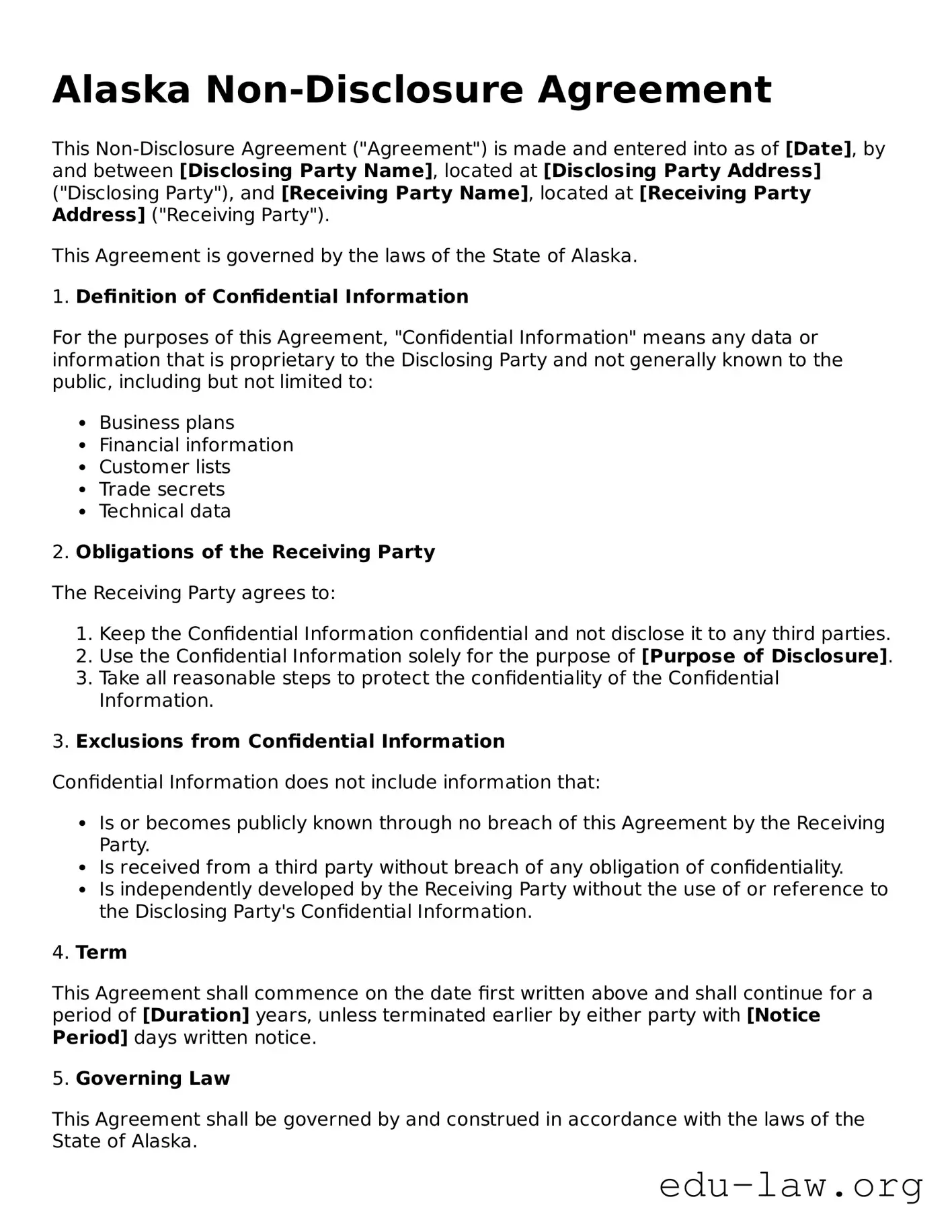
In Alaska, a Non-disclosure Agreement (NDA) serves as a crucial tool for protecting sensitive information shared between parties. This legal document ensures that confidential information remains private, safeguarding trade secrets, business strategies, and other proprietary data from unauthorized disclosure. The NDA outlines the specific information considered confidential, the obligations of the parties involved, and the duration of the confidentiality obligation. By clearly defining the terms of confidentiality, it helps establish trust between individuals or businesses engaging in negotiations or collaborations. Whether you are a startup looking to protect your innovative ideas or an established company seeking to maintain a competitive edge, understanding the key components of an Alaska NDA is essential for ensuring your information stays secure.
Alaska Non-Disclosure Agreement
This Non-Disclosure Agreement ("Agreement") is made and entered into as of [Date], by and between [Disclosing Party Name], located at [Disclosing Party Address] ("Disclosing Party"), and [Receiving Party Name], located at [Receiving Party Address] ("Receiving Party").
This Agreement is governed by the laws of the State of Alaska.
1. Definition of Confidential Information
For the purposes of this Agreement, "Confidential Information" means any data or information that is proprietary to the Disclosing Party and not generally known to the public, including but not limited to:
2. Obligations of the Receiving Party
The Receiving Party agrees to:
3. Exclusions from Confidential Information
Confidential Information does not include information that:
4. Term
This Agreement shall commence on the date first written above and shall continue for a period of [Duration] years, unless terminated earlier by either party with [Notice Period] days written notice.
5. Governing Law
This Agreement shall be governed by and construed in accordance with the laws of the State of Alaska.
6. Signatures
By signing below, both parties agree to the terms outlined in this Non-Disclosure Agreement.
Disclosing Party: [Disclosing Party Name]
Signature: ___________________________ Date: _______________
Receiving Party: [Receiving Party Name]
Signature: ___________________________ Date: _______________
| Fact Name | Description |
|---|---|
| Definition | An Alaska Non-disclosure Agreement (NDA) is a legally binding contract that protects confidential information shared between parties. |
| Purpose | Its primary purpose is to prevent the unauthorized disclosure of sensitive information. |
| Parties Involved | Typically, there are two parties: the disclosing party and the receiving party. |
| Governing Law | The NDA is governed by the laws of the State of Alaska. |
| Duration | The duration of confidentiality obligations can vary but is often specified in the agreement. |
| Exclusions | Information that is public knowledge or independently developed is usually excluded from confidentiality obligations. |
| Enforcement | If breached, the disclosing party may seek legal remedies, including damages or injunctive relief. |
| Written Agreement | While verbal NDAs can exist, a written agreement is highly recommended for clarity and enforceability. |
| Common Uses | NDAs are often used in business transactions, employment relationships, and partnerships. |
| Signature Requirement | For the NDA to be valid, it typically requires signatures from both parties involved. |
Once you have the Alaska Non-disclosure Agreement form, you will need to complete it accurately to ensure its effectiveness. Follow these steps carefully to fill out the form correctly.
After completing these steps, ensure that both parties retain a copy of the signed agreement for their records. This will help protect the interests of all involved.
What is an Alaska Non-disclosure Agreement (NDA)?
An Alaska Non-disclosure Agreement is a legal contract that protects confidential information shared between parties. It ensures that sensitive information remains private and is not disclosed to unauthorized individuals or entities. This agreement is commonly used in business settings to safeguard trade secrets, proprietary information, and other sensitive data.
Who should use an NDA in Alaska?
Any individual or business that needs to share confidential information should consider using an NDA. This includes startups sharing business plans with investors, employers discussing sensitive company information with employees, and companies collaborating on joint ventures. An NDA helps establish trust and sets clear expectations regarding confidentiality.
What information can be protected by an NDA?
An NDA can protect a wide range of information, including business strategies, customer lists, financial data, product designs, and marketing plans. Essentially, any information that is not publicly available and gives a competitive edge can be covered under the agreement. It’s important to clearly define what constitutes confidential information in the NDA.
How long does an NDA last in Alaska?
The duration of an NDA can vary based on the agreement between the parties. Typically, NDAs specify a time frame during which the information must remain confidential. This period can range from a few years to indefinitely, depending on the nature of the information. It’s crucial to discuss and agree upon the duration before signing.
What happens if someone breaches an NDA?
If a party breaches an NDA, the other party may have the right to seek legal remedies. This can include monetary damages, injunctions to prevent further disclosure, or specific performance to enforce the terms of the agreement. It’s essential to understand the consequences of a breach and to include them in the NDA to deter violations.
Can an NDA be modified after it is signed?
Yes, an NDA can be modified after it is signed, but both parties must agree to the changes. It’s advisable to document any modifications in writing to avoid misunderstandings. This ensures that all parties are on the same page regarding the updated terms and conditions of the agreement.
Is it necessary to have a lawyer review an NDA?
While it’s not legally required, having a lawyer review an NDA is highly recommended. A legal expert can ensure that the agreement is comprehensive, enforceable, and tailored to your specific needs. This step can save you from potential disputes and ensure that your confidential information is adequately protected.
Failing to identify all parties involved. It’s crucial to list everyone who will be bound by the agreement. Missing a party can lead to misunderstandings.
Not specifying the confidential information clearly. The agreement should define what constitutes confidential information. Vague descriptions can create confusion.
Leaving out the duration of confidentiality. The agreement should state how long the information must remain confidential. Without this, the terms can be unclear.
Neglecting to include the purpose of the disclosure. Clearly outlining why the information is being shared helps to limit its use.
Not having the agreement signed by all parties. An unsigned agreement may not hold up in court. Ensure that everyone involved provides their signature.
Overlooking the consequences of breach. The agreement should outline what happens if someone violates the terms. This encourages compliance.
Failing to consult a legal professional. It’s wise to have a lawyer review the agreement. This can prevent mistakes and ensure the document is enforceable.
The Alaska Non-disclosure Agreement (NDA) is an important document for protecting sensitive information shared between parties. When using an NDA, several other forms and documents may be necessary to ensure comprehensive protection and clarity in business dealings. Below is a list of commonly associated documents that complement the NDA.
Using these documents in conjunction with the Alaska Non-disclosure Agreement can help ensure that all parties understand their rights and obligations. This can lead to more secure and effective business relationships.
The Confidentiality Agreement is similar to the Alaska Non-disclosure Agreement in that both documents aim to protect sensitive information shared between parties. This agreement establishes a legal framework for maintaining confidentiality, ensuring that proprietary information is not disclosed to unauthorized individuals. Both documents typically outline the definition of confidential information, the obligations of the receiving party, and the duration of confidentiality. They serve as a safeguard for businesses looking to share critical data without the risk of it being misused.
The Mutual Non-disclosure Agreement (MNDA) shares similarities with the Alaska Non-disclosure Agreement by allowing both parties to disclose information while protecting each other's interests. Unlike a one-sided NDA, an MNDA ensures that both sides are bound by confidentiality obligations. This document is particularly useful in negotiations where both parties are exchanging sensitive information, fostering a balanced approach to information sharing and protection.
The Proprietary Information Agreement (PIA) is another document akin to the Alaska Non-disclosure Agreement. It focuses specifically on protecting proprietary information, which can include trade secrets, business strategies, and product designs. Like the Alaska NDA, the PIA outlines what constitutes proprietary information and the responsibilities of the parties involved. This agreement emphasizes the importance of safeguarding intellectual property and ensuring that sensitive business information remains confidential.
The Employment Non-disclosure Agreement is similar in purpose to the Alaska Non-disclosure Agreement, as it protects a company's confidential information from being disclosed by employees. This agreement is typically signed by employees at the start of their employment. It outlines the types of information considered confidential and the consequences of unauthorized disclosure. This document helps maintain the integrity of a company's sensitive data throughout the employment relationship.
The Non-circumvention Agreement is also comparable to the Alaska Non-disclosure Agreement, as it prevents one party from bypassing the other to engage directly with a third party. This document is often used in business partnerships or negotiations where one party introduces another to potential clients or vendors. By signing this agreement, parties commit to not exploiting the relationship for personal gain without consent, thereby protecting the interests of all involved.
Finally, the Data Protection Agreement (DPA) shares similarities with the Alaska Non-disclosure Agreement by focusing on the protection of personal data. This agreement outlines how personal information should be handled, processed, and stored to comply with relevant privacy laws. Like the NDA, the DPA ensures that parties understand their obligations regarding confidentiality and data security, promoting trust and accountability in the handling of sensitive information.
When filling out the Alaska Non-disclosure Agreement form, it’s essential to approach the task with care and attention to detail. Here are some important dos and don’ts to consider.
By following these guidelines, you can help ensure that your Non-disclosure Agreement is completed correctly and effectively protects your interests.
Many people have misunderstandings about the Alaska Non-disclosure Agreement (NDA). Here are four common misconceptions:
When dealing with sensitive information in Alaska, a Non-disclosure Agreement (NDA) can be a vital tool. Here are some key takeaways to consider when filling out and using the Alaska NDA form:
By following these guidelines, parties can effectively use the Alaska Non-disclosure Agreement to protect their sensitive information.