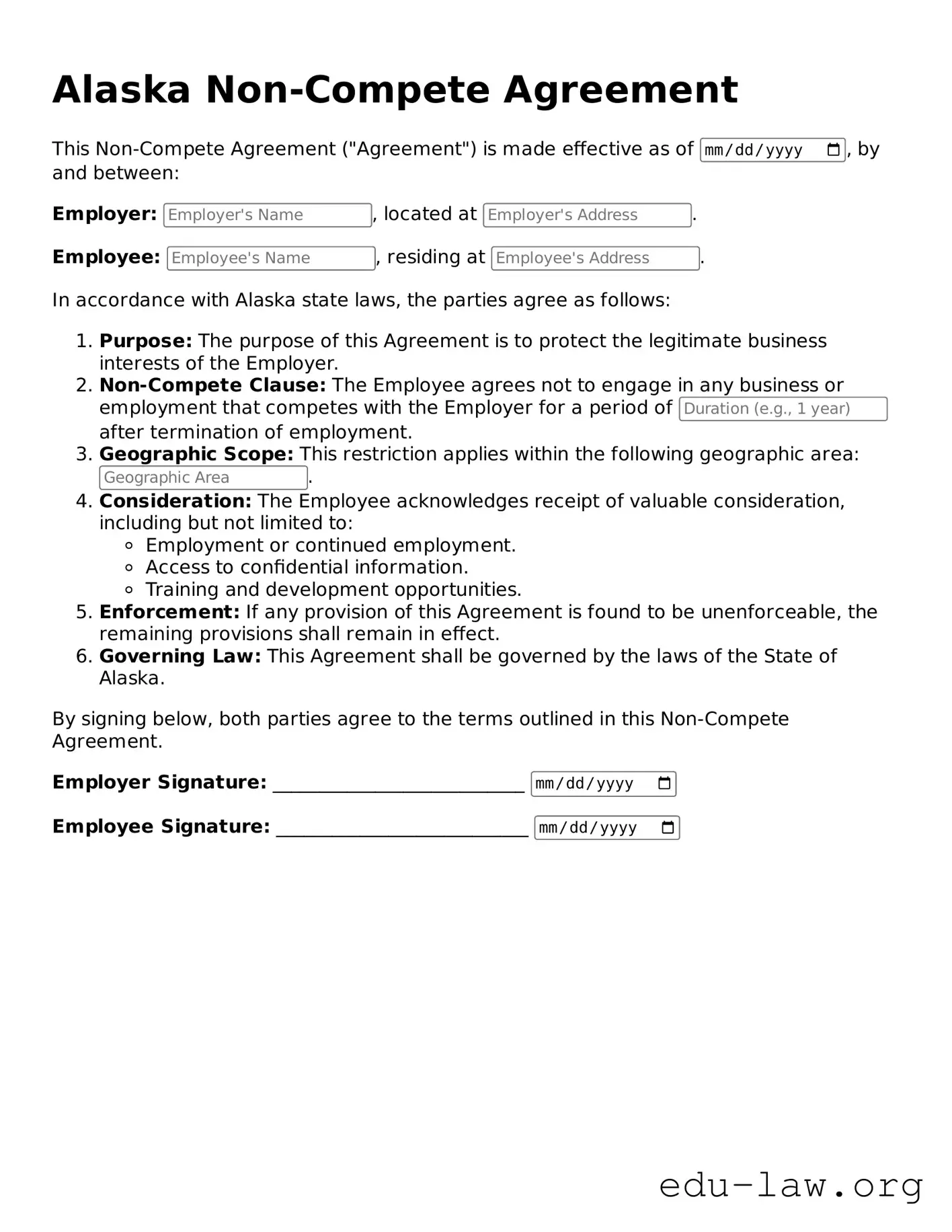
The Alaska Non-compete Agreement form serves as a critical tool in the realm of employment law, designed to protect the legitimate business interests of employers while balancing the rights of employees. This form typically outlines specific terms that restrict an employee's ability to engage in similar work within a defined geographical area for a certain period after leaving the company. It addresses key components such as the duration of the non-compete clause, the geographic scope, and the nature of the restricted activities. Furthermore, the form often includes provisions for consideration, ensuring that employees receive something of value in exchange for agreeing to these restrictions. The enforceability of such agreements in Alaska hinges on their reasonableness, which courts evaluate based on factors like the interests of both parties and the potential impact on the employee’s ability to earn a livelihood. Understanding these elements is essential for both employers seeking to safeguard their business interests and employees contemplating the implications of signing such an agreement.
Alaska Non-Compete Agreement
This Non-Compete Agreement ("Agreement") is made effective as of , by and between:
Employer: , located at .
Employee: , residing at .
In accordance with Alaska state laws, the parties agree as follows:
By signing below, both parties agree to the terms outlined in this Non-Compete Agreement.
Employer Signature: ___________________________
Employee Signature: ___________________________
| Fact Name | Description |
|---|---|
| Definition | An Alaska Non-compete Agreement is a contract that restricts an employee from working for competitors after leaving a job. |
| Governing Law | The agreement is governed by Alaska state law, specifically under Alaska Statutes § 45.50.500 - § 45.50.599. |
| Enforceability | Non-compete agreements in Alaska are enforceable if they are reasonable in duration, geographic area, and scope. |
| Duration | Typically, a duration of six months to two years is considered reasonable, depending on the circumstances. |
| Geographic Limitations | The agreement must specify a reasonable geographic area where the restrictions apply. |
| Consideration | For a non-compete agreement to be valid, there must be consideration, such as a job offer or promotion. |
| Exceptions | Alaska law may not enforce non-compete agreements against certain professionals, like doctors or lawyers. |
| Modification | Courts in Alaska may modify overly broad non-compete agreements to make them enforceable. |
| Legal Advice | It is advisable to seek legal counsel before signing or drafting a non-compete agreement to ensure compliance with state laws. |
Once you have gathered the necessary information, you can begin filling out the Alaska Non-compete Agreement form. This document will require specific details about the parties involved and the terms of the agreement. Careful attention to each section will ensure clarity and compliance with applicable regulations.
After completing the form, review all entries for accuracy. Both parties should retain a copy for their records. It is advisable to consult with a legal professional if there are any uncertainties regarding the terms of the agreement.
What is a Non-compete Agreement in Alaska?
A Non-compete Agreement is a contract between an employer and an employee that restricts the employee from working for competitors or starting a competing business for a certain period after leaving the company. In Alaska, these agreements must be reasonable in scope and duration to be enforceable. They aim to protect legitimate business interests, such as trade secrets and customer relationships.
Are Non-compete Agreements enforceable in Alaska?
Yes, Non-compete Agreements can be enforceable in Alaska, but they must meet specific criteria. The agreement must be reasonable in geographic scope and duration. Courts in Alaska will assess whether the restrictions are necessary to protect the employer's interests without unduly limiting the employee's ability to find work. If an agreement is too broad or restrictive, it may be deemed unenforceable.
How long can a Non-compete Agreement last in Alaska?
The duration of a Non-compete Agreement in Alaska should be reasonable. While there is no set time limit, most agreements range from six months to two years. Factors such as the nature of the business and the employee's role will influence what is considered reasonable. Always consider consulting a legal expert to determine an appropriate duration for your specific situation.
What should be included in a Non-compete Agreement?
A well-drafted Non-compete Agreement should include several key elements: the duration of the restriction, the geographic area it covers, the specific activities that are restricted, and the legitimate business interests that the employer seeks to protect. Clear language helps ensure that both parties understand their rights and obligations under the agreement.
Can I negotiate the terms of a Non-compete Agreement?
Yes, employees can negotiate the terms of a Non-compete Agreement. It is important to discuss any concerns about the restrictions with the employer before signing. Negotiating terms can lead to a more balanced agreement that protects the employer's interests while allowing the employee reasonable freedom to work in their field. Always document any changes made during negotiations.
Failing to read the entire agreement. Many people skim through the document, missing important clauses.
Not providing accurate personal information. It's crucial to ensure that names, addresses, and contact details are correct.
Overlooking the duration of the non-compete. Some individuals forget to check how long the restrictions will last.
Ignoring the geographical scope. Understanding where the non-compete applies is essential to avoid future conflicts.
Not considering the specific activities restricted. People often overlook which actions are prohibited under the agreement.
Failing to consult with a legal professional. Many sign the agreement without seeking advice, which can lead to misunderstandings.
Assuming the agreement is unenforceable. Some believe that non-compete clauses are not valid, which is not always true.
Not negotiating terms. Individuals may accept the agreement as is, missing the chance to negotiate more favorable conditions.
Signing without a copy. It's important to keep a signed copy for personal records, yet many forget to do this.
When drafting an Alaska Non-compete Agreement, several other forms and documents may be necessary to ensure clarity and enforceability. Each of these documents serves a specific purpose and can help both parties understand their rights and obligations. Below is a list of commonly used forms that accompany a Non-compete Agreement.
These documents collectively help define the parameters of the working relationship and protect the interests of all parties involved. It is essential to consider each one carefully to ensure comprehensive coverage of rights and responsibilities.
A Non-Disclosure Agreement (NDA) serves a similar purpose to a Non-compete Agreement by protecting sensitive information. While a Non-compete Agreement restricts an employee from working for competitors after leaving a job, an NDA prevents them from sharing confidential information during and after their employment. Both documents aim to safeguard a business’s interests, though the focus of an NDA is on information rather than employment opportunities.
A Non-Solicitation Agreement is another document that shares similarities with a Non-compete Agreement. This type of agreement prohibits an employee from soliciting clients or customers of the employer after leaving the company. While a Non-compete Agreement restricts the employee from working for competitors, a Non-Solicitation Agreement specifically targets the employee's interactions with the employer’s clients, helping to maintain business relationships and client confidentiality.
An Employment Agreement may also resemble a Non-compete Agreement. This document outlines the terms and conditions of employment, including job responsibilities, compensation, and duration of employment. Often, Employment Agreements include clauses related to non-compete terms, meaning they can serve as a comprehensive document that encompasses various aspects of the employment relationship, including restrictions on future employment with competitors.
Lastly, a Confidentiality Agreement can be seen as similar to a Non-compete Agreement, as both aim to protect a business's interests. A Confidentiality Agreement ensures that employees do not disclose sensitive information about the company, its operations, or its clients. While a Non-compete Agreement restricts future employment with competitors, a Confidentiality Agreement focuses on maintaining the secrecy of proprietary information, which can indirectly support the goals of a Non-compete Agreement by protecting the company’s competitive edge.
When filling out the Alaska Non-compete Agreement form, it’s important to follow certain guidelines to ensure the process goes smoothly. Here are some dos and don’ts to keep in mind:
Many people have misunderstandings about non-compete agreements, particularly those specific to Alaska. Here are some common misconceptions:
Understanding these misconceptions can help employees and employers navigate the complexities of non-compete agreements in Alaska more effectively.
When utilizing the Alaska Non-compete Agreement form, it is essential to understand the implications and requirements associated with it. Here are some key takeaways:
Understanding these aspects can help both employers and employees navigate the complexities of non-compete agreements in Alaska effectively.