When it comes to managing your vehicle-related affairs in Alaska, having the right legal tools at your disposal can make all the difference. The Alaska Motor Vehicle Power of Attorney form empowers individuals to designate someone else to act on their behalf in matters related to their vehicle. This form is especially useful when you cannot be present for important transactions, such as registering a vehicle, transferring ownership, or obtaining necessary documentation. By granting this authority, you ensure that a trusted person can handle these tasks efficiently and in accordance with your wishes. Whether you're out of state, busy with work, or simply prefer to delegate these responsibilities, understanding how to effectively use this form is essential. It’s designed to be straightforward, yet it carries significant weight in legal terms, so knowing the details can help you navigate the process smoothly.
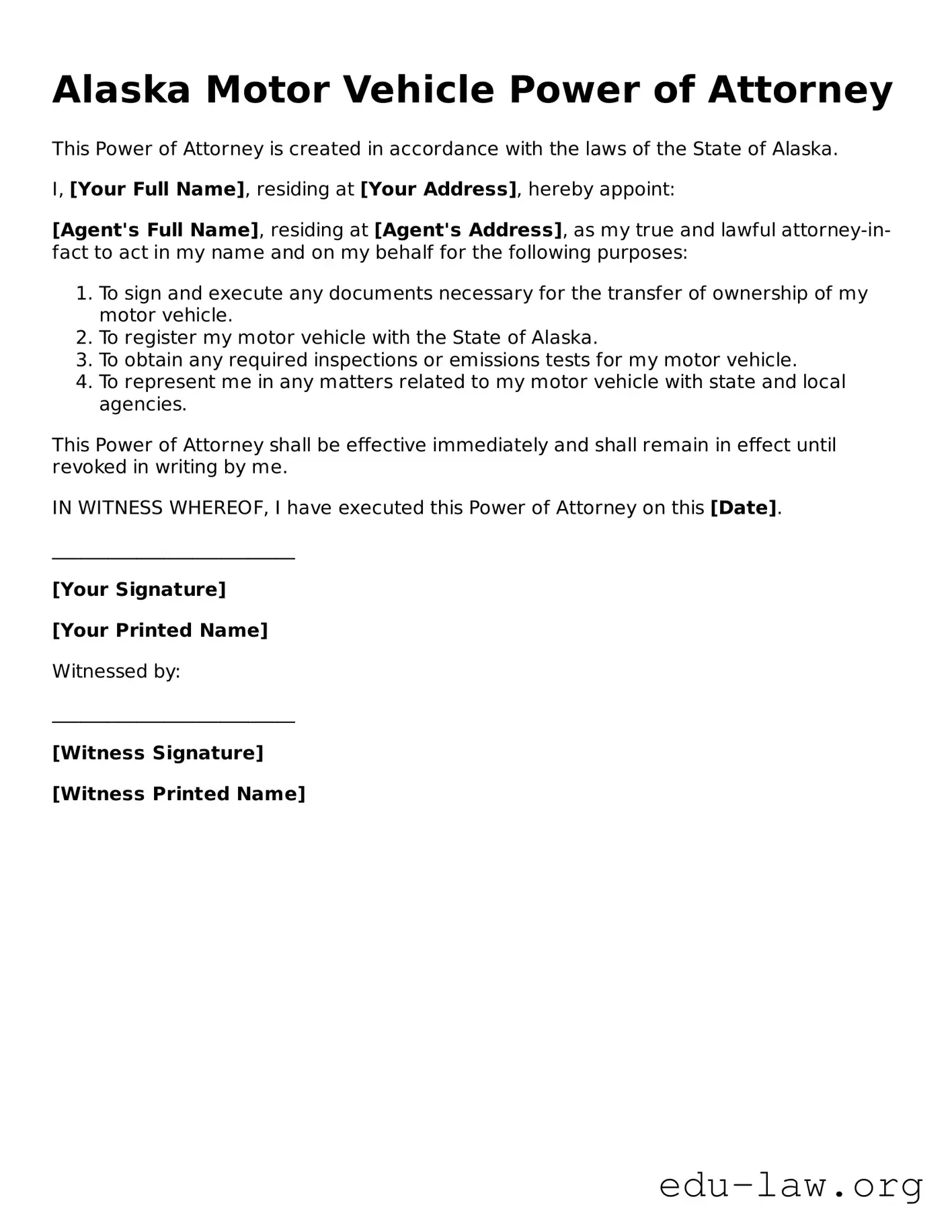
Alaska Motor Vehicle Power of Attorney
This Power of Attorney is created in accordance with the laws of the State of Alaska.
I, [Your Full Name], residing at [Your Address], hereby appoint:
[Agent's Full Name], residing at [Agent's Address], as my true and lawful attorney-in-fact to act in my name and on my behalf for the following purposes:
This Power of Attorney shall be effective immediately and shall remain in effect until revoked in writing by me.
IN WITNESS WHEREOF, I have executed this Power of Attorney on this [Date].
__________________________
[Your Signature]
[Your Printed Name]
Witnessed by:
__________________________
[Witness Signature]
[Witness Printed Name]
| Fact Name | Description |
|---|---|
| Purpose | The Alaska Motor Vehicle Power of Attorney form allows an individual to designate another person to act on their behalf regarding motor vehicle transactions. |
| Governing Law | This form is governed by Alaska Statutes, specifically AS 13.26.330, which outlines the powers granted through a power of attorney. |
| Signature Requirement | The form must be signed by the principal, the individual granting the authority, in the presence of a notary public. |
| Revocation | The principal can revoke the power of attorney at any time, as long as they provide written notice to the agent. |
| Agent's Authority | The agent can handle tasks such as transferring vehicle titles, registering vehicles, and obtaining license plates. |
| Duration | The power of attorney remains in effect until revoked by the principal or until a specified expiration date is reached. |
| Notarization | Notarization is essential for the validity of the form, ensuring that the principal's identity is verified. |
After obtaining the Alaska Motor Vehicle Power of Attorney form, you'll need to complete it accurately to ensure it serves its intended purpose. Follow the steps below to fill out the form correctly.
Once the form is completed and signed, it should be kept in a safe place or given to the Agent for their records. Ensure that all information is accurate to avoid any issues in the future.
What is the Alaska Motor Vehicle Power of Attorney form?
The Alaska Motor Vehicle Power of Attorney form allows an individual (the principal) to designate another person (the agent) to handle specific motor vehicle-related transactions on their behalf. This can include tasks like signing documents for vehicle registration, titling, or transferring ownership.
Who can be appointed as an agent?
Any competent adult can be appointed as an agent. This can be a family member, friend, or even a professional, such as a lawyer or a notary. It's important to choose someone you trust to act in your best interest.
Do I need to notarize the form?
Yes, the Alaska Motor Vehicle Power of Attorney form must be notarized to be valid. This means that you will need to sign the form in front of a notary public, who will then verify your identity and witness your signature.
What specific powers can I grant to my agent?
You can grant your agent various powers related to motor vehicle transactions. This typically includes the ability to sign documents for vehicle registration, title transfers, and other necessary paperwork. Be sure to specify any limitations or specific tasks you want your agent to handle.
Is there a specific format for the form?
The form must meet Alaska's legal requirements, which means it should include your name, the name of your agent, and a clear statement of the powers being granted. While there may not be a strict template, using the official form from the Alaska Department of Motor Vehicles is recommended to ensure compliance.
How long is the Power of Attorney valid?
The validity of the Power of Attorney can vary based on your preferences. You can set a specific duration for the authority granted, or it can remain in effect until you revoke it. If you decide to revoke it, you should do so in writing and inform your agent and any relevant parties.
Can I revoke the Power of Attorney?
Yes, you can revoke the Power of Attorney at any time as long as you are mentally competent. To do so, you should provide a written notice of revocation to your agent and any institutions or individuals that may have relied on the original Power of Attorney.
What happens if my agent cannot fulfill their duties?
If your appointed agent is unable or unwilling to fulfill their duties, the Power of Attorney may become ineffective. You may then need to appoint a new agent or handle the transactions yourself, depending on your situation.
Where can I obtain the Alaska Motor Vehicle Power of Attorney form?
You can obtain the Alaska Motor Vehicle Power of Attorney form from the Alaska Department of Motor Vehicles website or your local DMV office. It's important to ensure you have the most current version of the form to avoid any issues.
Incomplete Information: One common mistake is failing to provide all necessary information. This includes not filling in the names, addresses, or other identifying details of both the principal and the agent. Omitting this information can lead to confusion or disputes later on.
Incorrect Signatures: The form requires signatures from both the principal and the agent. Sometimes, individuals forget to sign or mistakenly sign in the wrong place. This oversight can render the document invalid.
Not Specifying Powers: People often neglect to clearly specify the powers granted to the agent. A vague description can lead to misunderstandings about what the agent is authorized to do on behalf of the principal.
Failure to Notarize: In Alaska, the Motor Vehicle Power of Attorney form typically needs to be notarized. Some individuals forget this step, which can invalidate the document. Ensuring that a notary public witnesses the signing is crucial for the form’s legal standing.
When dealing with vehicle transactions in Alaska, it's essential to have the right documents in place. The Alaska Motor Vehicle Power of Attorney form allows someone to act on your behalf regarding vehicle matters. However, it often works best in conjunction with several other forms and documents. Here’s a list of commonly used documents that may accompany the Power of Attorney form.
Having these documents ready can streamline the process and help ensure that everything goes smoothly. Whether you are buying, selling, or transferring ownership of a vehicle, being prepared with the right paperwork is key to avoiding complications down the road.
The General Power of Attorney is a legal document that grants someone the authority to act on your behalf in various matters, including financial decisions and property management. Like the Alaska Motor Vehicle Power of Attorney, it allows for the delegation of authority, but it covers a broader range of responsibilities. This document can be used for any legal transactions, making it versatile for various situations where you may need assistance.
The Limited Power of Attorney is similar in that it allows you to appoint someone to act on your behalf, but its scope is restricted to specific tasks or time periods. For instance, if you need someone to handle a particular transaction, such as selling a vehicle, this document can be tailored to that need. It shares the same fundamental purpose as the Alaska Motor Vehicle Power of Attorney but is more focused and temporary.
The Durable Power of Attorney is another related document. It remains effective even if you become incapacitated, unlike a regular power of attorney that may become void in such circumstances. This is particularly important for individuals who want to ensure their affairs, including vehicle-related matters, are managed even if they are unable to do so themselves. The Alaska Motor Vehicle Power of Attorney typically does not address incapacity, making the durable version more comprehensive in certain situations.
The Medical Power of Attorney allows you to designate someone to make healthcare decisions on your behalf. While this document is focused on medical issues, it shares the concept of delegating authority. Like the Alaska Motor Vehicle Power of Attorney, it requires trust in the appointed individual to act in your best interest. Both documents empower someone to make decisions when you cannot.
The Real Estate Power of Attorney is specifically designed for transactions involving real property. Similar to the Alaska Motor Vehicle Power of Attorney, it allows you to authorize someone to handle specific real estate matters on your behalf. Both documents facilitate the management of assets, whether they are vehicles or properties, ensuring that important transactions can proceed smoothly even if you are unavailable.
The Financial Power of Attorney focuses on financial matters, granting authority to manage bank accounts, investments, and other financial transactions. Like the Alaska Motor Vehicle Power of Attorney, it enables someone to act in your best interest, ensuring that your financial affairs are handled properly. Both documents are crucial for effective management of your assets when you cannot manage them yourself.
The Trust is a legal arrangement where a trustee manages assets for the benefit of beneficiaries. While it is a more complex document than the Alaska Motor Vehicle Power of Attorney, both serve to manage assets and delegate authority. A trust can include vehicles as part of its assets, and it provides a way to ensure that your wishes are carried out regarding your property, similar to how the power of attorney allows for vehicle management.
The Bill of Sale is a document used to transfer ownership of a vehicle from one party to another. While it is not a power of attorney, it is often used in conjunction with one. If you have granted someone the authority to sell your vehicle through the Alaska Motor Vehicle Power of Attorney, they will likely need to complete a Bill of Sale to finalize the transaction. Both documents are essential for the legal transfer of vehicle ownership.
The Vehicle Registration Application is a form required to register a vehicle with the state. While it does not delegate authority like the Alaska Motor Vehicle Power of Attorney, it is closely related in that it involves the legal handling of a vehicle. Both documents are necessary for ensuring that vehicle transactions comply with state regulations, making them essential in the process of vehicle ownership and management.
When filling out the Alaska Motor Vehicle Power of Attorney form, it's crucial to follow specific guidelines to ensure the document is valid and effective. Below are seven things you should and shouldn't do.
Understanding the Alaska Motor Vehicle Power of Attorney form can be challenging due to several misconceptions. Here are six common misunderstandings:
This form can be used by anyone who needs to designate someone else to handle vehicle-related transactions on their behalf, regardless of their driving ability.
While notarization can enhance the credibility of the document, it is not a strict requirement for the form to be legally effective in Alaska.
The Power of Attorney can grant authority for multiple transactions, allowing the designated person to manage various vehicle-related matters as needed.
Any competent adult can be appointed as an agent, including friends or business associates, as long as the principal trusts them to act in their best interest.
The Power of Attorney can be revoked at any time by the principal, provided that they are of sound mind and able to communicate their decision.
While it can be useful in emergencies, having a Power of Attorney in place can facilitate smoother transactions even during routine vehicle-related activities.
When filling out and using the Alaska Motor Vehicle Power of Attorney form, keep the following key takeaways in mind: