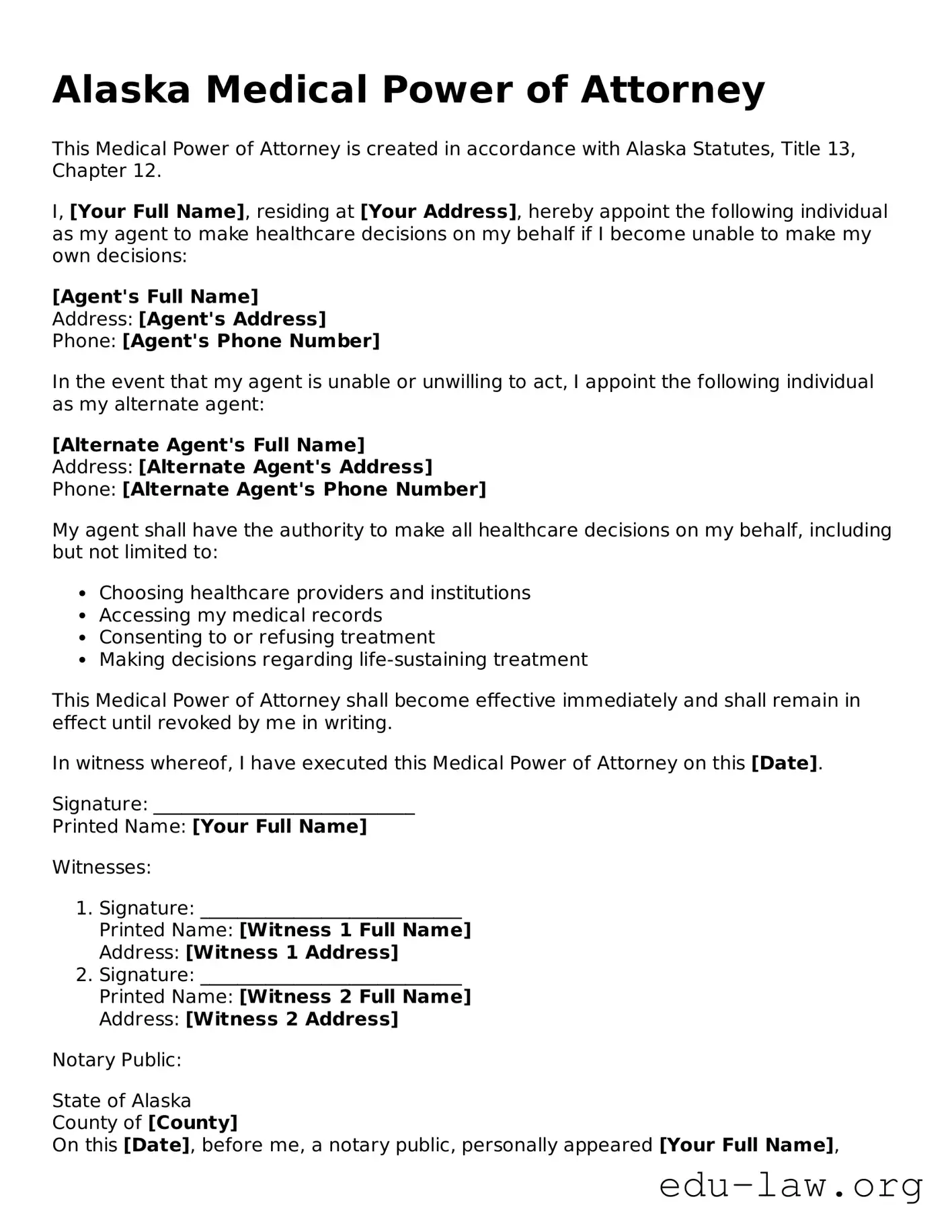
The Alaska Medical Power of Attorney form is an essential legal document that allows individuals to designate a trusted person to make healthcare decisions on their behalf if they become unable to do so. This form plays a crucial role in ensuring that a person's medical preferences are honored, especially in critical situations where they may not be able to communicate their wishes. It outlines the powers granted to the appointed agent, covering a range of medical decisions, from routine care to life-sustaining treatments. In Alaska, this form must be signed in the presence of a witness or a notary to ensure its validity. Additionally, it is important for individuals to discuss their healthcare preferences with their chosen agent, fostering a clear understanding of their values and desires. By preparing this document, individuals can gain peace of mind, knowing that their healthcare choices will be respected even when they cannot advocate for themselves.
Alaska Medical Power of Attorney
This Medical Power of Attorney is created in accordance with Alaska Statutes, Title 13, Chapter 12.
I, [Your Full Name], residing at [Your Address], hereby appoint the following individual as my agent to make healthcare decisions on my behalf if I become unable to make my own decisions:
[Agent's Full Name]
Address: [Agent's Address]
Phone: [Agent's Phone Number]
In the event that my agent is unable or unwilling to act, I appoint the following individual as my alternate agent:
[Alternate Agent's Full Name]
Address: [Alternate Agent's Address]
Phone: [Alternate Agent's Phone Number]
My agent shall have the authority to make all healthcare decisions on my behalf, including but not limited to:
This Medical Power of Attorney shall become effective immediately and shall remain in effect until revoked by me in writing.
In witness whereof, I have executed this Medical Power of Attorney on this [Date].
Signature: ____________________________
Printed Name: [Your Full Name]
Witnesses:
Notary Public:
State of Alaska
County of [County]
On this [Date], before me, a notary public, personally appeared [Your Full Name], known to me to be the person whose name is subscribed to this document, and acknowledged that he/she executed the same for the purposes therein contained.
Notary Signature: ____________________________
My commission expires: [Expiration Date]
| Fact Name | Description |
|---|---|
| Definition | The Alaska Medical Power of Attorney form allows an individual to designate someone to make medical decisions on their behalf if they become unable to do so. |
| Governing Law | This form is governed by Alaska Statutes Title 13, Chapter 26, which outlines the laws regarding advance health care directives. |
| Eligibility | Any adult resident of Alaska can create a Medical Power of Attorney. The principal must be of sound mind when signing the document. |
| Agent Requirements | The appointed agent must be at least 18 years old and should not be the principal's healthcare provider or an employee of the healthcare provider. |
| Durability | The Medical Power of Attorney remains effective even if the principal becomes incapacitated, ensuring continuous representation. |
| Revocation | The principal can revoke the Medical Power of Attorney at any time, provided they are still of sound mind. A written notice is recommended. |
| Witness Requirements | The form must be signed in the presence of two witnesses or notarized to be considered valid under Alaska law. |
Filling out the Alaska Medical Power of Attorney form is an important step in ensuring your healthcare wishes are honored. This form allows you to designate someone to make medical decisions on your behalf if you are unable to do so. Follow the steps below to complete the form correctly.
What is a Medical Power of Attorney in Alaska?
A Medical Power of Attorney (MPOA) in Alaska is a legal document that allows you to appoint someone to make healthcare decisions on your behalf if you become unable to do so. This person, known as your agent or proxy, can make choices about your medical treatment based on your wishes and best interests.
Who can be appointed as an agent in an Alaska Medical Power of Attorney?
You can appoint any competent adult as your agent. This can be a family member, friend, or trusted individual. However, it's important to choose someone who understands your values and preferences regarding medical care.
Is it necessary to have a Medical Power of Attorney in Alaska?
While it's not legally required, having a Medical Power of Attorney is highly recommended. It ensures that your healthcare wishes are honored and provides guidance to your loved ones during difficult times when you may be unable to communicate your preferences.
How do I create a Medical Power of Attorney in Alaska?
To create an MPOA, you need to fill out a specific form that complies with Alaska state laws. You must sign the document in the presence of a notary public or two witnesses who are not related to you or beneficiaries of your estate. This helps to ensure that the document is valid and enforceable.
Can I revoke or change my Medical Power of Attorney?
Yes, you can revoke or change your MPOA at any time as long as you are mentally competent. To do this, you should create a new MPOA or provide a written notice to your agent and any healthcare providers involved in your care. Make sure to destroy any previous versions of the document to avoid confusion.
What happens if I don’t have a Medical Power of Attorney?
If you do not have an MPOA and become incapacitated, medical professionals will typically follow the state laws regarding decision-making. This may involve family members or guardians, but it can lead to disagreements and delays in care. Having an MPOA helps avoid these complications by clearly designating your preferences.
Can my agent make any medical decision I would make?
Your agent can make a wide range of medical decisions, including choices about treatments, surgeries, and end-of-life care. However, they must act in accordance with your wishes and values as outlined in the MPOA. If your wishes are not clear, the agent should make decisions based on what they believe you would want.
Are there any limitations on what my agent can decide?
Yes, there may be limitations based on your preferences or specific instructions included in the MPOA. Additionally, your agent cannot make decisions that are contrary to your expressed wishes or that would violate laws. It's crucial to communicate your values and preferences clearly to your agent.
Do I need a lawyer to create a Medical Power of Attorney in Alaska?
You do not necessarily need a lawyer to create an MPOA, as the forms are often available online and can be completed independently. However, consulting with a legal professional can provide peace of mind and ensure that your document meets all legal requirements and accurately reflects your wishes.
Failing to clearly identify the agent and any alternate agents. It is crucial to specify who will make medical decisions on your behalf if you are unable to do so. Without clear identification, there may be confusion or disputes later.
Not providing sufficient information about the agent's authority. The form should clearly outline what medical decisions the agent is authorized to make. Omitting this information can lead to misunderstandings regarding the scope of their power.
Overlooking the need for witness signatures. In Alaska, the form typically requires the signatures of at least two witnesses. Failing to have these signatures can invalidate the document.
Neglecting to date the form. A date is essential for determining when the power of attorney becomes effective. Without a date, it may be difficult to establish the timeline of authority.
Not reviewing the form for accuracy before submission. Errors in personal information or agent details can lead to complications. It is important to double-check all entries to ensure they are correct.
The Alaska Medical Power of Attorney form is an important document that allows individuals to designate someone to make medical decisions on their behalf if they become unable to do so. Along with this form, several other documents are commonly used to ensure comprehensive health care planning and decision-making. Below is a list of these documents, each serving a specific purpose in the realm of health care and legal authority.
These documents work together to provide a clear understanding of an individual's health care preferences and ensure that their wishes are honored. It is advisable to review and update these forms regularly to reflect any changes in health status or personal preferences.
The Alaska Medical Power of Attorney (MPOA) form shares similarities with the General Power of Attorney (GPOA). Both documents allow individuals to designate someone to act on their behalf. However, while the GPOA covers a wide range of financial and legal decisions, the MPOA specifically focuses on healthcare decisions. This distinction is crucial for individuals who want to ensure their medical preferences are honored without granting authority over other personal affairs.
Another document that resembles the MPOA is the Advance Healthcare Directive (AHD). The AHD combines elements of the MPOA and living will, allowing individuals to appoint a healthcare agent and outline their wishes regarding medical treatment. Like the MPOA, it empowers someone to make healthcare decisions, but it also provides specific instructions on what types of treatments one would or would not want, ensuring that personal values are respected even when one cannot communicate them.
The Living Will is also similar to the MPOA. While the MPOA allows someone to make decisions on your behalf, the Living Will provides guidance on your preferences regarding end-of-life care. It expresses your wishes concerning life-sustaining treatments, such as resuscitation and artificial nutrition. In this way, both documents serve to protect your healthcare choices, but they operate in slightly different contexts.
A Durable Power of Attorney (DPOA) can be compared to the MPOA as well. Like the MPOA, the DPOA designates someone to make decisions for you. However, the DPOA typically focuses on financial matters rather than healthcare. This means that while both documents are about delegation of authority, they apply to different areas of your life, with the DPOA ensuring your financial interests are managed, even if you become incapacitated.
The Healthcare Proxy is another document similar to the MPOA. A healthcare proxy specifically appoints an individual to make medical decisions on your behalf when you are unable to do so. This document, like the MPOA, emphasizes the importance of having someone you trust in charge of your healthcare decisions, ensuring that your wishes are respected in times of need.
The Do Not Resuscitate (DNR) order is also related to the MPOA. While the MPOA allows someone to make broad healthcare decisions, a DNR specifically addresses your wishes regarding resuscitation efforts in the event of cardiac arrest. Both documents aim to ensure that your medical preferences are honored, but the DNR is much more focused on a specific medical scenario.
The Physician Orders for Life-Sustaining Treatment (POLST) form is similar in purpose to the MPOA. Like the MPOA, the POLST allows individuals to express their wishes about medical treatment in a clear and actionable way. However, the POLST is designed for those with serious illnesses and focuses on immediate medical decisions, while the MPOA is broader and can be used for general healthcare decisions.
The Mental Health Power of Attorney (MHPOA) is another document that shares characteristics with the MPOA. The MHPOA allows individuals to designate someone to make decisions regarding mental health treatment. While the MPOA covers physical health, the MHPOA specifically addresses mental health care, ensuring that your preferences in both areas are respected by trusted individuals.
Lastly, the Consent to Treatment form bears some resemblance to the MPOA. This document is used to grant permission for specific medical treatments or procedures. While the MPOA gives broader authority to an agent to make healthcare decisions, the Consent to Treatment form is often used in specific situations to ensure that healthcare providers have the necessary approval to proceed with care, reflecting the importance of informed consent in medical practice.
When filling out the Alaska Medical Power of Attorney form, it is essential to approach the task with care. Here are six important things to keep in mind:
Taking these steps can help ensure that your medical decisions are made according to your wishes. Being thorough and clear in this process is crucial for your peace of mind and for your loved ones.
Understanding the Alaska Medical Power of Attorney form is essential for making informed decisions about healthcare. However, several misconceptions can lead to confusion. Here are eight common misconceptions:
Clarifying these misconceptions can help individuals make better decisions regarding their healthcare preferences and ensure that their wishes are respected.
When filling out and using the Alaska Medical Power of Attorney form, consider the following key takeaways: