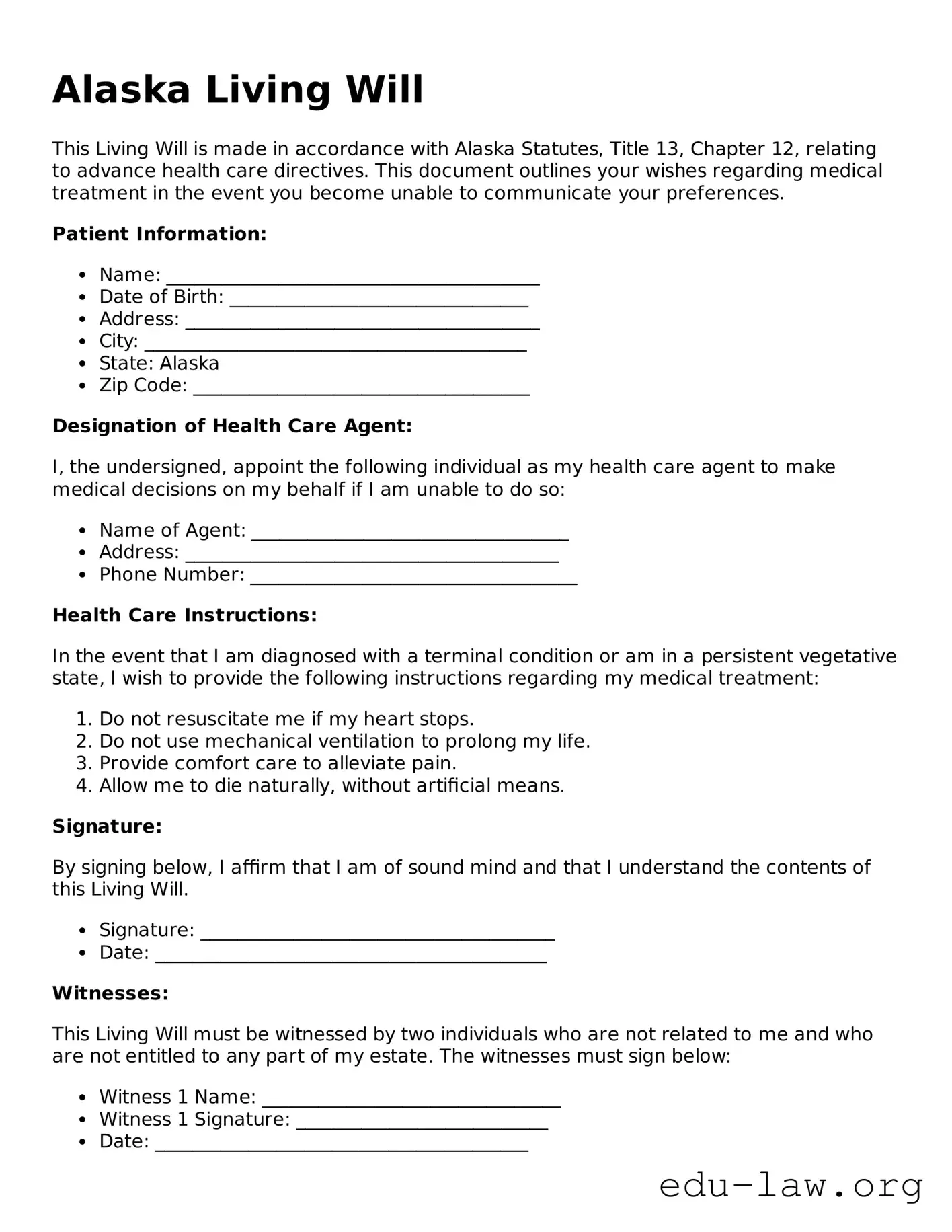
The Alaska Living Will form serves as a crucial document for individuals wishing to outline their medical treatment preferences in the event they become unable to communicate their wishes. This form allows individuals to specify their desires regarding life-sustaining treatments, such as resuscitation efforts, artificial nutrition, and hydration. By completing this document, a person can ensure that their healthcare providers and loved ones understand their values and choices concerning end-of-life care. The form is designed to be straightforward, allowing for clear communication of one’s intentions. In Alaska, the Living Will can be combined with a Durable Power of Attorney for Health Care, providing a comprehensive approach to medical decision-making. It is essential for individuals to consider their options carefully and discuss their wishes with family members and healthcare professionals to ensure that their preferences are honored when it matters most.
Alaska Living Will
This Living Will is made in accordance with Alaska Statutes, Title 13, Chapter 12, relating to advance health care directives. This document outlines your wishes regarding medical treatment in the event you become unable to communicate your preferences.
Patient Information:
Designation of Health Care Agent:
I, the undersigned, appoint the following individual as my health care agent to make medical decisions on my behalf if I am unable to do so:
Health Care Instructions:
In the event that I am diagnosed with a terminal condition or am in a persistent vegetative state, I wish to provide the following instructions regarding my medical treatment:
Signature:
By signing below, I affirm that I am of sound mind and that I understand the contents of this Living Will.
Witnesses:
This Living Will must be witnessed by two individuals who are not related to me and who are not entitled to any part of my estate. The witnesses must sign below:
| Fact Name | Description |
|---|---|
| Definition | An Alaska Living Will is a legal document that outlines a person's wishes regarding medical treatment in the event they become unable to communicate their preferences. |
| Governing Laws | The Alaska Living Will is governed by Alaska Statutes Title 13, Chapter 63. |
| Eligibility | Any adult who is 18 years or older can create a Living Will in Alaska. |
| Witness Requirements | The document must be signed in the presence of two witnesses who are not related to the individual and do not stand to gain from the estate. |
| Revocation | A Living Will can be revoked at any time by the individual, either verbally or in writing. |
| Healthcare Proxy | While a Living Will outlines treatment preferences, individuals may also appoint a healthcare proxy to make decisions on their behalf. |
| Storage and Accessibility | It is important to keep the Living Will in an accessible location and to inform family members and healthcare providers of its existence. |
| Legal Effect | The Living Will takes effect when a person is diagnosed with a terminal condition or is in a persistent vegetative state. |
Filling out the Alaska Living Will form is an important step in ensuring your healthcare preferences are known. This document allows you to express your wishes regarding medical treatment in case you are unable to communicate them yourself. Below are the steps to complete the form effectively.
Once the form is filled out and distributed, it is advisable to review it periodically. Changes in your health or personal circumstances may necessitate updates to your wishes.
What is a Living Will in Alaska?
A Living Will in Alaska is a legal document that allows individuals to outline their preferences for medical treatment in the event they become unable to communicate their wishes. It specifically addresses situations where a person is terminally ill or in a persistent vegetative state, providing guidance to healthcare providers and loved ones about the types of medical interventions the individual would or would not want to receive.
Who can create a Living Will in Alaska?
Any adult who is at least 18 years old and of sound mind can create a Living Will in Alaska. It is important that the individual understands the implications of their decisions regarding medical treatment. This document can be prepared without the assistance of an attorney, although legal guidance may be beneficial to ensure that it meets all necessary requirements.
How does one complete a Living Will in Alaska?
To complete a Living Will in Alaska, the individual should clearly state their wishes regarding medical treatment. This includes specifying preferences about life-sustaining measures, resuscitation, and other critical health care decisions. Once the document is written, it must be signed by the individual and witnessed by two adults who are not related to the individual or beneficiaries of their estate. It is advisable to keep the original document in a safe place and provide copies to family members and healthcare providers.
Can a Living Will be changed or revoked in Alaska?
Yes, a Living Will can be changed or revoked at any time by the individual who created it, as long as they are mentally competent. To revoke a Living Will, the individual may simply destroy the document or create a new one that clearly states their updated wishes. It is important to inform all relevant parties, including healthcare providers and family members, about any changes to ensure that the most current wishes are followed.
Is a Living Will the same as a Durable Power of Attorney for Healthcare?
No, a Living Will and a Durable Power of Attorney for Healthcare are not the same, although they serve complementary purposes. A Living Will focuses specifically on an individual’s preferences for medical treatment in certain situations. In contrast, a Durable Power of Attorney for Healthcare designates a person to make healthcare decisions on behalf of the individual if they are unable to do so. It is advisable to consider both documents to ensure comprehensive healthcare planning.
Where should I keep my Living Will in Alaska?
The original Living Will should be kept in a secure location where it can be easily accessed when needed, such as a safe or a locked drawer. It is also beneficial to provide copies to family members, close friends, and healthcare providers. Additionally, some individuals choose to register their Living Will with their healthcare provider or local hospital to ensure that it is readily available in case of an emergency.
Failing to clearly state medical preferences. It's crucial to specify what types of medical treatment you do or do not want.
Not signing the document. Without your signature, the Living Will is not legally valid.
Neglecting to date the form. A date is essential to determine the document's validity and relevance.
Forgetting to have witnesses sign. In Alaska, having two witnesses is required for the Living Will to be enforceable.
Using unclear language. Ambiguous terms can lead to confusion about your wishes, so clarity is key.
Not discussing your wishes with family. Open conversations can help ensure your loved ones understand your preferences.
Overlooking updates. Life circumstances change, and it’s important to revisit and revise your Living Will as needed.
Choosing inappropriate witnesses. Witnesses should not be related to you or have any financial interest in your estate.
Ignoring state-specific requirements. Each state has unique laws governing Living Wills, and Alaska is no exception.
Assuming verbal instructions are enough. A written document is necessary to ensure your wishes are honored.
When preparing a Living Will in Alaska, it's important to consider other related documents that can complement your advance healthcare planning. These documents help ensure that your healthcare wishes are respected and provide clarity to your loved ones and healthcare providers. Below are five forms that are often used alongside the Alaska Living Will.
Incorporating these documents into your advance healthcare planning can provide peace of mind. They work together to create a clear and comprehensive plan that reflects your wishes and helps guide your loved ones during difficult times.
The Alaska Living Will form is similar to the Advance Directive. Both documents allow individuals to outline their medical preferences in case they become unable to communicate their wishes. An Advance Directive can include a Living Will and a Durable Power of Attorney for Health Care, providing a comprehensive approach to medical decision-making. This ensures that a person’s healthcare preferences are honored even if they cannot express them at the moment.
Another document that shares similarities is the Durable Power of Attorney for Health Care. This document designates someone to make medical decisions on behalf of an individual if they are incapacitated. Like the Living Will, it addresses healthcare choices but focuses more on appointing a trusted person to act on behalf of the individual. This can provide peace of mind knowing that someone familiar with their wishes is making decisions.
The Health Care Proxy is also comparable to the Alaska Living Will. This document allows a person to appoint a proxy to make healthcare decisions if they are unable to do so. While the Living Will specifies what treatments an individual does or does not want, the Health Care Proxy focuses on who will make those choices. This can be particularly useful in complex medical situations where immediate decisions are necessary.
Similar to these documents is the Do Not Resuscitate (DNR) order. A DNR order specifically instructs medical personnel not to perform CPR if a person's heart stops or they stop breathing. While the Living Will covers a broader range of medical treatments, a DNR is a specific directive that can be crucial in emergency situations. Both documents aim to respect the individual's wishes regarding end-of-life care.
The Physician Orders for Life-Sustaining Treatment (POLST) form is another important document. It translates a person's healthcare wishes into actionable medical orders. While the Living Will provides guidance, the POLST is a medical order that healthcare providers must follow. This ensures that a person's preferences regarding life-sustaining treatments are respected in a clinical setting.
The Five Wishes document is also similar in that it covers medical, personal, and emotional wishes for end-of-life care. It goes beyond just medical decisions by addressing how individuals want to be treated, what they want loved ones to know, and how they want to be remembered. This holistic approach complements the Living Will by adding depth to the individual's wishes.
The Advance Care Plan is another relevant document. This plan outlines an individual’s preferences for medical treatment and appoints a healthcare proxy. Like the Living Will, it is designed to guide healthcare providers and family members in making decisions that align with the person’s values and desires. It serves as a roadmap for healthcare choices during critical moments.
The Medical Power of Attorney is similar as it grants authority to someone to make healthcare decisions on behalf of an individual. This document is often used in conjunction with a Living Will. While the Living Will specifies the individual's wishes, the Medical Power of Attorney ensures that someone is empowered to act on those wishes when necessary.
Finally, the Declaration for Mental Health Treatment is akin to the Living Will, but it focuses specifically on mental health care decisions. This document allows individuals to express their preferences regarding mental health treatment in the event they become unable to communicate. It complements the Living Will by addressing a different aspect of healthcare, ensuring that all areas of an individual's health are considered.
When filling out the Alaska Living Will form, it's important to approach the process with care. Here are some key dos and don'ts to keep in mind:
Understanding the Alaska Living Will form is essential for individuals who want to ensure their healthcare preferences are honored. However, several misconceptions can lead to confusion about its purpose and use. Here are five common misconceptions:
Addressing these misconceptions can help individuals make informed decisions about their healthcare preferences and ensure their wishes are respected.
Filling out and using the Alaska Living Will form is an important step in ensuring your healthcare preferences are respected. Here are some key takeaways to keep in mind:
By taking these steps, you can help ensure that your healthcare decisions align with your values and desires, providing peace of mind for both you and your loved ones.