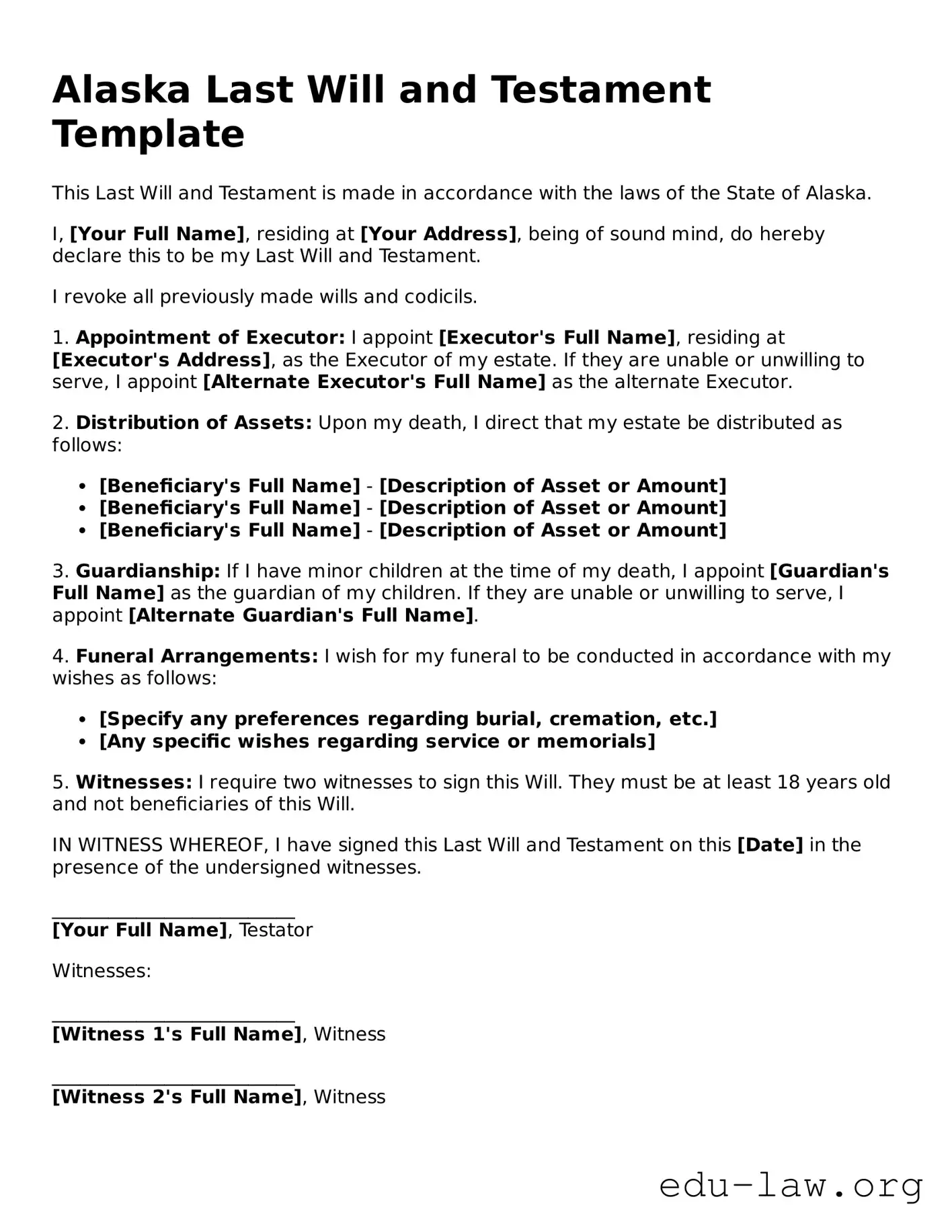
Creating a Last Will and Testament is an essential step in ensuring that your wishes are honored after your passing. In Alaska, the Last Will and Testament form serves as a legal document that outlines how your assets should be distributed, who will manage your estate, and any specific wishes you may have regarding your dependents. This form allows you to name an executor, the individual responsible for carrying out your instructions. It also provides space to designate guardians for minor children, ensuring their care aligns with your preferences. Additionally, the form must meet certain requirements to be valid, including your signature and, in some cases, the signatures of witnesses. By understanding the key components of the Alaska Last Will and Testament form, you can take important steps toward securing peace of mind for yourself and your loved ones.
Alaska Last Will and Testament Template
This Last Will and Testament is made in accordance with the laws of the State of Alaska.
I, [Your Full Name], residing at [Your Address], being of sound mind, do hereby declare this to be my Last Will and Testament.
I revoke all previously made wills and codicils.
1. Appointment of Executor: I appoint [Executor's Full Name], residing at [Executor's Address], as the Executor of my estate. If they are unable or unwilling to serve, I appoint [Alternate Executor's Full Name] as the alternate Executor.
2. Distribution of Assets: Upon my death, I direct that my estate be distributed as follows:
3. Guardianship: If I have minor children at the time of my death, I appoint [Guardian's Full Name] as the guardian of my children. If they are unable or unwilling to serve, I appoint [Alternate Guardian's Full Name].
4. Funeral Arrangements: I wish for my funeral to be conducted in accordance with my wishes as follows:
5. Witnesses: I require two witnesses to sign this Will. They must be at least 18 years old and not beneficiaries of this Will.
IN WITNESS WHEREOF, I have signed this Last Will and Testament on this [Date] in the presence of the undersigned witnesses.
__________________________
[Your Full Name], Testator
Witnesses:
__________________________
[Witness 1's Full Name], Witness
__________________________
[Witness 2's Full Name], Witness
| Fact Name | Details |
|---|---|
| Governing Law | The Alaska Last Will and Testament is governed by Alaska Statutes Title 13, Chapter 12. |
| Age Requirement | Individuals must be at least 18 years old to create a valid will in Alaska. |
| Witness Requirement | The will must be signed by at least two witnesses who are present at the same time. |
| Revocation | A will can be revoked by creating a new will or by physically destroying the original document. |
| Holographic Wills | Alaska recognizes holographic wills, which are handwritten and do not require witnesses if signed by the testator. |
Once you have the Alaska Last Will and Testament form in front of you, it's time to fill it out carefully. This document will outline your wishes regarding the distribution of your assets after your passing. Take your time to ensure that all information is accurate and complete.
After completing the form, store it in a safe place where your executor can easily access it. It's also wise to inform your loved ones about the location of your will, ensuring that your wishes are honored when the time comes.
What is a Last Will and Testament in Alaska?
A Last Will and Testament is a legal document that outlines how you want your assets and property distributed after your death. In Alaska, this document also allows you to name guardians for your minor children and specify your wishes regarding funeral arrangements. It is an essential tool for ensuring that your wishes are honored and can help avoid disputes among family members.
Who can create a Last Will and Testament in Alaska?
In Alaska, any adult who is at least 18 years old and of sound mind can create a Last Will and Testament. Being of sound mind means that you understand the nature of making a will and the effects it will have. If you are not of sound mind, the will may be contested later.
What are the requirements for a valid will in Alaska?
To be valid in Alaska, a will must be written, signed by the person making the will (the testator), and witnessed by at least two people. The witnesses must be present at the same time when the testator signs the will. It’s important that the witnesses are not beneficiaries of the will to avoid any potential conflicts.
Can I change my will after it has been created?
Yes, you can change your will at any time while you are still alive. This is done by creating a new will or making a codicil, which is an amendment to the existing will. Just remember that any changes must meet the same legal requirements as the original will to be valid.
What happens if I die without a will in Alaska?
If you die without a will, you are considered to have died "intestate." In this case, Alaska's intestacy laws will determine how your assets are distributed. Generally, your estate will go to your closest relatives, such as your spouse, children, or parents. However, this may not reflect your wishes, which is why having a will is so important.
How can I ensure my will is properly executed?
To ensure your will is properly executed, follow the legal requirements for signing and witnessing. It’s also a good idea to store your will in a safe place and inform your loved ones about its location. Consulting with an attorney or a legal document preparer can also help ensure that your will is valid and meets your needs.
Not Being Specific with Bequests: One common mistake is failing to clearly specify what assets are being left to whom. Vague language can lead to confusion and disputes among heirs. For instance, instead of saying "my car," it's better to provide details like "my 2015 Honda Accord, VIN 123456789." This clarity helps ensure your wishes are followed.
Overlooking Witness Requirements: In Alaska, a will must be signed in the presence of two witnesses. Some people forget to include witnesses altogether or don’t ensure that their witnesses are disinterested parties—those who won’t inherit anything from the will. This oversight can render the will invalid, leading to unintended outcomes.
Failing to Update the Will: Life changes, such as marriage, divorce, or the birth of children, necessitate updates to your will. Many individuals neglect to revise their documents accordingly. As a result, outdated information can create complications when it comes time to execute the will.
Not Signing the Will Properly: A will must be signed at the end by the testator (the person making the will). Some people mistakenly sign in the wrong place or forget to sign altogether. This small error can invalidate the entire document, leaving your estate to be distributed according to state laws rather than your wishes.
When creating a Last Will and Testament in Alaska, several other documents may be needed to ensure that your wishes are carried out effectively. Each of these documents serves a unique purpose and can help clarify your intentions regarding your estate and other important matters.
Having these documents in place can help create a comprehensive estate plan that reflects your wishes and protects your loved ones. It’s important to consider each one carefully to ensure that all aspects of your life and legacy are addressed.
The Alaska Last Will and Testament form shares similarities with a Living Will, which outlines an individual's preferences regarding medical treatment in the event they become incapacitated. While a Last Will deals with the distribution of assets after death, a Living Will focuses on health care decisions. Both documents reflect personal wishes and ensure that an individual's desires are respected, even when they can no longer communicate them. This makes both documents essential for comprehensive end-of-life planning.
Another document akin to the Last Will is the Durable Power of Attorney. This legal instrument allows a person to appoint someone else to make financial or legal decisions on their behalf if they become unable to do so. Like a Last Will, the Durable Power of Attorney is designed to protect an individual’s interests. However, it operates during the person's lifetime, whereas the Last Will only takes effect after death. Together, these documents provide a robust framework for managing both personal and financial affairs.
The Revocable Trust, often compared to a Last Will, serves a similar purpose of asset distribution. However, a Revocable Trust allows for the transfer of assets during a person’s lifetime and can help avoid probate, a legal process that can be lengthy and costly. This document can be altered or revoked as circumstances change. Both a Last Will and a Revocable Trust ensure that a person's wishes regarding their estate are honored, but they do so in different ways.
A Healthcare Proxy is another document that aligns closely with the Last Will. This document designates someone to make medical decisions on behalf of an individual if they are unable to do so themselves. While a Last Will governs the distribution of assets after death, a Healthcare Proxy ensures that an individual's healthcare preferences are followed during their lifetime. Both documents emphasize the importance of having trusted individuals in place to carry out one's wishes.
Similar to the Last Will is the Codicil, which serves as an amendment to an existing will. This document allows individuals to make changes or updates without drafting an entirely new will. Codicils can clarify, add, or revoke specific provisions, ensuring that a person's Last Will remains current and reflective of their intentions. This flexibility is crucial for adapting to life changes, such as marriage, divorce, or the birth of a child.
The Letter of Instruction is another document that complements the Last Will. While it is not legally binding, this letter provides personal guidance and additional information to loved ones about one’s wishes, funeral arrangements, or the location of important documents. It serves as a roadmap, making it easier for family members to navigate the complexities of loss. While a Last Will dictates the distribution of assets, the Letter of Instruction offers context and clarity.
A Trust Agreement also shares similarities with the Last Will, as it outlines how assets should be managed and distributed. Unlike a Last Will, a Trust Agreement can take effect during the grantor's lifetime and can provide benefits such as avoiding probate and maintaining privacy. This document allows for greater control over how and when assets are distributed, making it a valuable tool for estate planning alongside a Last Will.
Lastly, the Prenuptial Agreement can be viewed as a document that intersects with the Last Will in terms of asset management and distribution. While primarily used to outline the division of assets in the event of divorce, it can also address what happens to those assets upon death. Both documents are vital for protecting individual interests and ensuring that personal wishes regarding property and assets are clearly stated and legally recognized.
When filling out the Alaska Last Will and Testament form, it is important to follow certain guidelines. Here is a list of things you should and shouldn't do:
When it comes to creating a Last Will and Testament in Alaska, there are several misconceptions that can lead to confusion. Here are seven common myths and the truths behind them:
Many people believe that a will is only necessary for those with significant wealth. However, a will can help ensure that your wishes are followed regarding how your possessions, no matter how small, should be distributed.
While it’s true that formal requirements exist, a handwritten will, also known as a holographic will, can be valid in Alaska if it meets specific criteria. Just be sure it’s clear and signed by you.
While it’s possible to create a will on your own, consulting a legal expert can help avoid mistakes. Legal guidance ensures your will complies with state laws and accurately reflects your wishes.
This is not true. You can change your will at any time as long as you are of sound mind. It’s important to update your will as your circumstances change, such as after a marriage or the birth of a child.
While debts do need to be settled, not all debts must be paid before any distribution of assets occurs. The executor will manage this process according to the law, ensuring fair treatment of creditors and beneficiaries.
While you have the freedom to choose your executor, it’s wise to select someone who is responsible and trustworthy. Alaska law does have some restrictions on who can serve in this role, particularly if they are not residents of the state.
A will is an important part of estate planning, but it’s not the only document you may need. Consider additional documents like trusts, powers of attorney, and healthcare directives to create a comprehensive plan.
Filling out and using the Alaska Last Will and Testament form is an important step in ensuring that your wishes regarding your estate are honored after your passing. Here are some key takeaways to consider:
Understanding these key points can help ensure that your will is valid and that your wishes are carried out effectively. Proper preparation can prevent disputes and provide peace of mind for you and your loved ones.