In Alaska, families who choose to homeschool their children have a unique opportunity to tailor education to their child's needs and interests. To begin this journey, parents must submit a Homeschool Letter of Intent form, which serves as a formal notification to the state that they will be taking on the responsibility of educating their child at home. This form requires essential information, including the names and ages of the children being homeschooled, as well as the educational plans that parents intend to implement. It’s a straightforward process, but it’s important to ensure that all details are accurate and complete. By submitting this letter, parents not only comply with state regulations but also affirm their commitment to providing a quality education. Understanding the requirements and implications of this form can help parents navigate the homeschooling landscape with confidence and clarity.
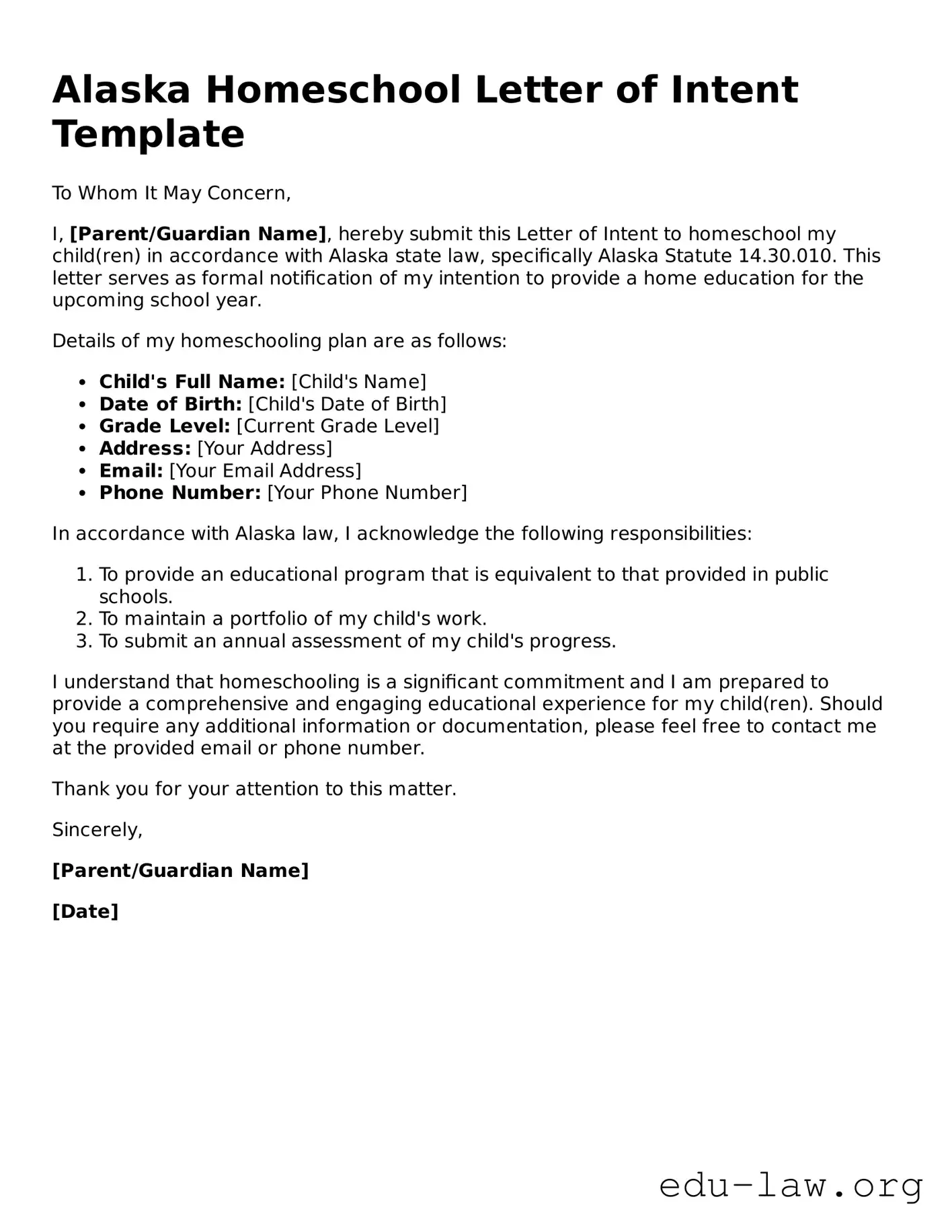
Alaska Homeschool Letter of Intent Template
To Whom It May Concern,
I, [Parent/Guardian Name], hereby submit this Letter of Intent to homeschool my child(ren) in accordance with Alaska state law, specifically Alaska Statute 14.30.010. This letter serves as formal notification of my intention to provide a home education for the upcoming school year.
Details of my homeschooling plan are as follows:
In accordance with Alaska law, I acknowledge the following responsibilities:
I understand that homeschooling is a significant commitment and I am prepared to provide a comprehensive and engaging educational experience for my child(ren). Should you require any additional information or documentation, please feel free to contact me at the provided email or phone number.
Thank you for your attention to this matter.
Sincerely,
[Parent/Guardian Name]
[Date]
| Fact Name | Details |
|---|---|
| Governing Law | The Alaska Homeschool Letter of Intent is governed by Alaska Statute 14.30.010, which outlines the requirements for homeschooling in the state. |
| Submission Timeline | Parents must submit the Letter of Intent to their local school district at least 30 days before starting their homeschool program. |
| Required Information | The form requires basic information such as the names and ages of the children being homeschooled, as well as the address of the home. |
| Annual Renewal | Families must renew their Letter of Intent each year, ensuring that the school district is informed of their ongoing homeschooling status. |
Once you have gathered the necessary information, you can begin filling out the Alaska Homeschool Letter of Intent form. This form is essential for notifying the state of your intent to homeschool your child. Completing it accurately will help ensure a smooth process moving forward.
What is the Alaska Homeschool Letter of Intent form?
The Alaska Homeschool Letter of Intent form is a document that parents or guardians must submit to officially declare their intent to homeschool their children. This form is a requirement in Alaska and serves to notify the local school district of the parents' decision to educate their children at home. It is important to complete this form to ensure compliance with state education laws.
Who needs to submit the Letter of Intent?
Any parent or guardian who wishes to homeschool their child in Alaska must submit the Letter of Intent. This includes families who are starting homeschooling for the first time, as well as those who are transitioning from a public or private school setting. The form must be submitted for each child being homeschooled.
When should the Letter of Intent be submitted?
The Letter of Intent should be submitted at least 14 days before the start of the homeschooling program. This allows the local school district sufficient time to process the form and confirm that the family is in compliance with state regulations. If you are starting homeschooling mid-year, you should submit the form as soon as you decide to homeschool.
What happens after I submit the Letter of Intent?
After you submit the Letter of Intent, the local school district will review the form. They may contact you for additional information or clarification if needed. Once the form is processed, you will receive confirmation from the district. This confirmation is important, as it serves as proof that you have officially notified the district of your intent to homeschool.
Failing to include all required personal information. This includes the names of the parents or guardians, the address, and the name of the child or children being homeschooled. Missing any of this information can lead to delays or complications.
Not providing the correct date. It’s essential to clearly indicate the date when the homeschooling will begin. An incorrect or missing date can create confusion about your intentions.
Omitting the educational plan. The form often requires a brief outline of the curriculum or educational approach you plan to use. Skipping this section can result in questions from the school district.
Using vague language. Be specific about your educational goals and methods. General statements may not provide enough clarity for the authorities reviewing your intent.
Neglecting to sign the form. A signature is a crucial part of the document. Without it, the form is considered incomplete and cannot be processed.
Ignoring submission deadlines. Each school district may have different deadlines for submitting the Letter of Intent. Missing these deadlines can lead to complications in your homeschooling plans.
Not keeping a copy of the submitted form. It’s important to retain a copy for your records. This can be helpful if there are any follow-up questions or issues.
Failing to check for updates or changes in requirements. Regulations can change, so it’s wise to verify that you have the most current version of the form and understand any new requirements.
When you decide to homeschool in Alaska, there are several important documents that may accompany the Homeschool Letter of Intent form. Each document serves a specific purpose in the homeschooling process, ensuring that you meet state requirements while providing a structured education for your child. Below is a list of commonly used forms and documents that you may find helpful.
Gathering and organizing these documents can help streamline your homeschooling experience. By being prepared and informed, you can create a nurturing and effective educational environment for your child.
The Alaska Homeschool Letter of Intent form shares similarities with the Affidavit of Homeschooling form. Both documents serve as official notifications to the local education authorities about a family's intention to educate their children at home. In essence, they establish a record that the parents are taking on the responsibility of their children's education. Just as the Letter of Intent outlines the educational approach and curriculum, the Affidavit also typically requires parents to affirm their commitment to provide a suitable learning environment. This helps ensure that families are transparent about their homeschooling plans and intentions.
Another document that resembles the Alaska Homeschool Letter of Intent is the Notice of Intent to Withdraw from Public School form. This form is used by parents who wish to formally remove their children from a public school setting to begin homeschooling. Similar to the Letter of Intent, this notice is a way for parents to communicate their decision to the school district. It often includes information about the child’s current educational status and the reason for withdrawal, ensuring that the transition to homeschooling is clear and documented.
The Individualized Education Plan (IEP) also shares some characteristics with the Alaska Homeschool Letter of Intent. While an IEP is specifically designed for children with special needs, it outlines the educational goals and services that will be provided. Like the Letter of Intent, it requires parents to actively engage in the educational planning process. Both documents emphasize the importance of tailored education and the family's role in facilitating a supportive learning environment, ensuring that each child receives the attention and resources they need to thrive.
The Educational Plan for Homeschooling is another document that aligns closely with the Alaska Homeschool Letter of Intent. This plan details the curriculum, teaching methods, and learning objectives that parents intend to implement during their homeschooling journey. Much like the Letter of Intent, it serves as a roadmap for the educational experience, helping parents to stay organized and focused. It also provides a framework for evaluating the child's progress, ensuring that educational goals are met throughout the homeschooling year.
Lastly, the Annual Assessment form is similar to the Alaska Homeschool Letter of Intent in that it involves documentation of a child's educational progress. This form is often required by state regulations to verify that homeschooled children are meeting academic standards. Just as the Letter of Intent lays the groundwork for homeschooling, the Annual Assessment serves as a checkpoint to ensure that the educational plan is effective and that the child is advancing in their studies. Both documents reflect the commitment of parents to provide a quality education and maintain accountability in their homeschooling efforts.
When filling out the Alaska Homeschool Letter of Intent form, it’s important to follow certain guidelines to ensure a smooth process. Here are some dos and don’ts to keep in mind:
Many people have misconceptions about the Alaska Homeschool Letter of Intent form. Understanding the facts can help clarify the process of homeschooling in Alaska. Below is a list of common misconceptions along with explanations to provide clarity.
By dispelling these misconceptions, families can make informed decisions about homeschooling in Alaska. Understanding the process and requirements can lead to a successful educational experience.
Filling out and using the Alaska Homeschool Letter of Intent form is an important step for families choosing to homeschool their children. Here are key takeaways to keep in mind:
Understanding these key points can help ensure a smooth homeschooling experience in Alaska.