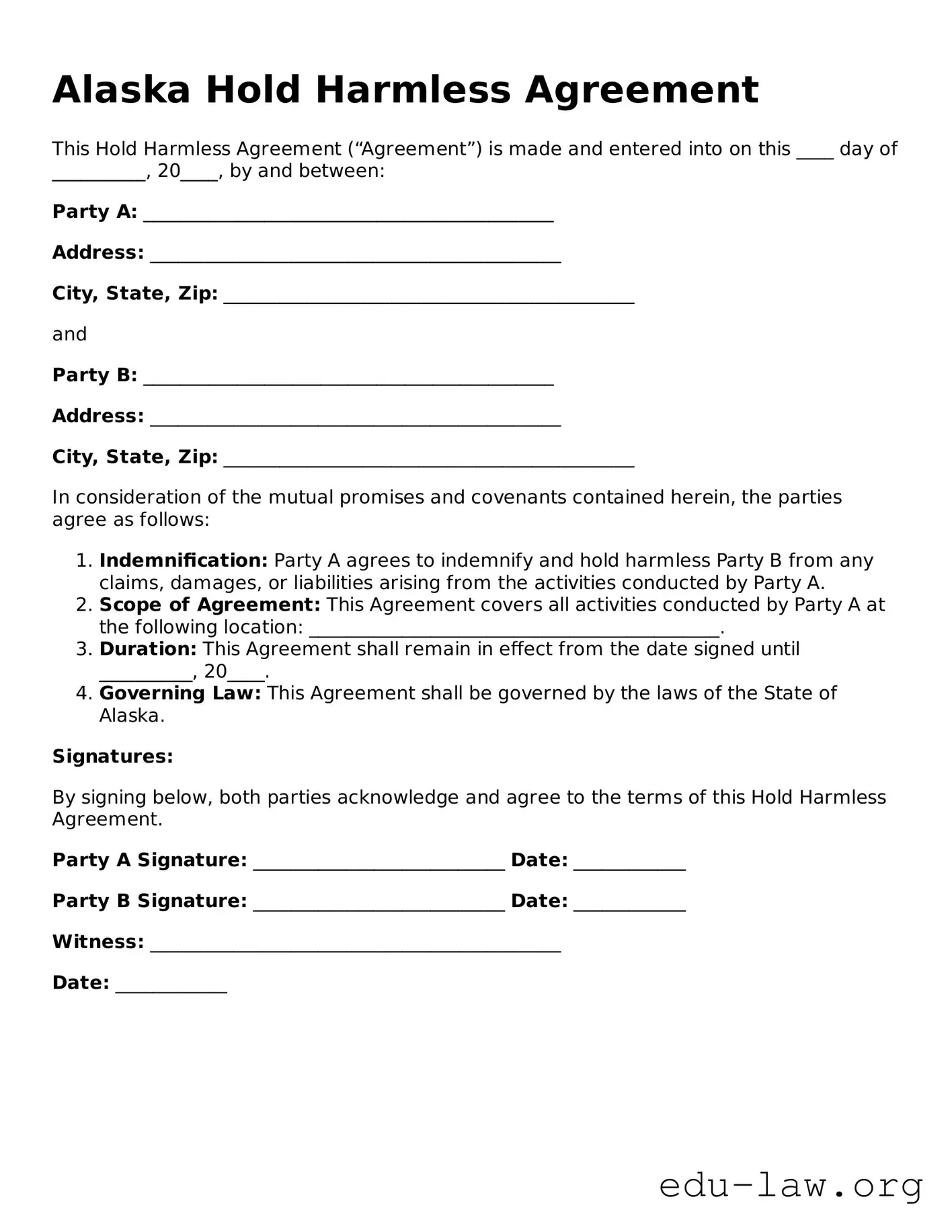
The Alaska Hold Harmless Agreement form serves as an important legal tool for individuals and organizations seeking to mitigate liability in various situations. This form is often utilized in contexts such as events, activities, or services where there may be a risk of injury or damage. By signing this agreement, one party agrees to assume responsibility for any claims, damages, or losses that may arise, thereby protecting the other party from potential legal repercussions. The document typically outlines the specific activities covered, the responsibilities of each party, and any limitations on liability. It is designed to ensure that both parties understand their rights and obligations, fostering a clearer relationship and reducing the likelihood of disputes. Additionally, the form may include provisions related to indemnification, which further clarifies the responsibilities involved. Overall, the Alaska Hold Harmless Agreement form is a crucial instrument for managing risk and establishing accountability in various interactions.
Alaska Hold Harmless Agreement
This Hold Harmless Agreement (“Agreement”) is made and entered into on this ____ day of __________, 20____, by and between:
Party A: ____________________________________________
Address: ____________________________________________
City, State, Zip: ____________________________________________
and
Party B: ____________________________________________
Address: ____________________________________________
City, State, Zip: ____________________________________________
In consideration of the mutual promises and covenants contained herein, the parties agree as follows:
Signatures:
By signing below, both parties acknowledge and agree to the terms of this Hold Harmless Agreement.
Party A Signature: ___________________________ Date: ____________
Party B Signature: ___________________________ Date: ____________
Witness: ____________________________________________
Date: ____________
| Fact Name | Details |
|---|---|
| Purpose | The Alaska Hold Harmless Agreement is designed to protect one party from legal liability for damages or injuries incurred by another party during an event or activity. |
| Governing Law | This agreement is governed by the laws of the State of Alaska. |
| Parties Involved | Typically, the agreement involves at least two parties: the indemnitor (the party providing protection) and the indemnitee (the party being protected). |
| Common Uses | It is often used in situations involving events, recreational activities, or contracts where one party may be exposed to risks or liabilities. |
After obtaining the Alaska Hold Harmless Agreement form, it is essential to complete it accurately to ensure all necessary information is provided. Following these steps will guide you through the process of filling out the form correctly.
Once the form is filled out, it should be submitted to the appropriate authority or organization as specified in the instructions. Ensure that all required documents accompany the submission, if necessary.
What is an Alaska Hold Harmless Agreement?
An Alaska Hold Harmless Agreement is a legal document that protects one party from liability for any injuries or damages that may occur during a specific activity or event. This agreement is often used in situations where one party may be exposed to risks, such as when renting property, organizing events, or engaging in recreational activities. By signing this agreement, the party agrees to take responsibility for any claims that arise, ensuring that the other party is not held liable.
Who should use a Hold Harmless Agreement in Alaska?
This agreement is suitable for individuals and organizations that want to mitigate their risk of liability. Common users include property owners, event organizers, and service providers. For example, if a property owner rents out their space for an event, they may require the renter to sign a Hold Harmless Agreement to protect themselves from potential lawsuits related to injuries or damages that occur during the event.
What are the key components of an Alaska Hold Harmless Agreement?
An effective Hold Harmless Agreement should include several important elements. First, it should clearly identify the parties involved. Second, it must outline the specific activities or events covered by the agreement. Third, it should state that one party agrees to hold the other harmless from any claims or liabilities. Lastly, the agreement should include a signature line for both parties, indicating their consent to the terms. Including a date and any relevant details about the event or activity is also advisable.
Is a Hold Harmless Agreement enforceable in Alaska?
Yes, a Hold Harmless Agreement is generally enforceable in Alaska, provided it is drafted correctly and meets legal standards. However, certain limitations may apply. For instance, the agreement cannot protect a party from liability for gross negligence or willful misconduct. It’s important to ensure that the language used in the agreement is clear and specific to avoid any potential disputes over its enforceability.
How can I create a Hold Harmless Agreement for use in Alaska?
Creating a Hold Harmless Agreement can be straightforward. Start by identifying the parties involved and clearly defining the scope of the agreement. You can find templates online, but it’s crucial to customize the document to fit your specific situation. Consider consulting with a legal professional to ensure that the agreement complies with Alaska law and adequately protects your interests. After drafting the agreement, both parties should review it carefully and sign it before the relevant activity or event takes place.
Inaccurate Information: One of the most common mistakes is providing incorrect personal or organizational details. This includes names, addresses, and contact information. Ensure that all entries are accurate and up-to-date.
Omitting Required Signatures: Many individuals forget to sign the agreement or fail to obtain necessary signatures from all parties involved. A missing signature can render the document invalid, so double-check that all required signatures are present.
Failing to Understand the Terms: It is crucial to fully comprehend the terms of the agreement. Some people rush through the document without reading it thoroughly, which can lead to misunderstandings about their rights and obligations.
Not Including Relevant Dates: Dates play a significant role in legal documents. Failing to include the date of signing or the effective date of the agreement can create confusion about when the terms apply.
Neglecting to Review for Completeness: Before submitting the form, individuals often overlook the importance of reviewing the entire document for completeness. Missing sections or unanswered questions can jeopardize the agreement's validity.
The Alaska Hold Harmless Agreement is a crucial document that protects one party from liability for certain actions or events. When utilizing this agreement, it is often beneficial to have additional forms and documents that complement its purpose. Below is a list of other commonly used documents that may accompany the Hold Harmless Agreement.
Having these documents in place can enhance the effectiveness of the Hold Harmless Agreement. They provide clarity and protection for all parties involved, ensuring that everyone understands their rights and responsibilities. Proper documentation is essential for minimizing risks and fostering a safe environment.
The first document that shares similarities with the Alaska Hold Harmless Agreement is the Indemnity Agreement. Both documents serve to protect one party from legal liability arising from the actions or negligence of another. In an Indemnity Agreement, one party agrees to compensate the other for any losses or damages incurred, thereby shifting the risk. This is akin to the Hold Harmless Agreement, which also seeks to absolve one party from responsibility, particularly in situations involving third-party claims. The core intent of both agreements is to allocate risk and ensure that one party does not suffer financial repercussions due to the actions of another.
Another document that resembles the Alaska Hold Harmless Agreement is the Waiver of Liability. A Waiver of Liability is often used in recreational activities, where participants agree not to hold the organization responsible for injuries sustained during the activity. Similar to the Hold Harmless Agreement, the Waiver of Liability aims to protect the entity from legal claims. Both documents require a clear understanding and acceptance of risk by the individual signing the agreement. However, while the Hold Harmless Agreement often pertains to broader contexts, the Waiver of Liability is typically more specific to certain activities or events.
The Release of Liability Agreement is also comparable to the Alaska Hold Harmless Agreement. This document is frequently employed in situations where one party releases another from any future claims or legal actions. Like the Hold Harmless Agreement, it seeks to minimize the potential for litigation by ensuring that one party cannot pursue damages against the other. Both agreements emphasize the importance of informed consent, as individuals must understand the implications of their signature. The Release of Liability often focuses on past actions, whereas the Hold Harmless Agreement may address future liabilities.
Lastly, the Consent Form bears resemblance to the Alaska Hold Harmless Agreement. Consent Forms are often utilized in medical or research settings, where individuals agree to participate in a study or procedure while acknowledging the associated risks. Both documents require participants to accept certain risks and often include language that protects the provider from liability. The primary difference lies in the context: while the Hold Harmless Agreement is broader and can apply to various situations, the Consent Form is usually specific to medical or research environments. Nevertheless, both documents serve the purpose of clarifying expectations and limiting liability.
When filling out the Alaska Hold Harmless Agreement form, it is important to be thorough and accurate. Here are some key points to keep in mind:
Here are nine common misconceptions about the Alaska Hold Harmless Agreement form, along with clarifications for each:
This form can be used by individuals, organizations, and businesses alike. Anyone engaging in activities that could pose risks may benefit from it.
The agreement does not cover all types of liabilities. It typically protects against claims arising from negligence or accidents related to specific activities.
While the agreement is generally enforceable, courts may not uphold it if it is deemed unconscionable or if it violates public policy.
Signing the agreement does not completely eliminate the right to sue. It limits liability for certain claims but does not waive all legal rights.
Notarization is not a requirement for the agreement to be valid. However, having it notarized can add an extra layer of authenticity.
The Hold Harmless Agreement is not an insurance policy. It is a legal document that shifts liability but does not provide financial coverage for damages.
Each Hold Harmless Agreement should be tailored to the specific circumstances and activities involved. A generic form may not address all necessary details.
Signing the agreement after an incident may not provide protection. It should be in place before any potentially risky activity takes place.
While it is beneficial for all parties involved to sign, the agreement can still be effective if only one party signs, depending on the context.
When dealing with the Alaska Hold Harmless Agreement form, there are several important points to keep in mind. Understanding these can help ensure that you fill it out correctly and use it effectively.