In Alaska, the General Power of Attorney (GPOA) form serves as a crucial legal document that empowers individuals to designate someone else to act on their behalf in various financial and legal matters. This form is particularly important for those who may be unable to manage their affairs due to health issues, travel, or other circumstances. By completing the GPOA, a principal can authorize an agent to handle tasks such as managing bank accounts, signing contracts, and making investment decisions. Importantly, the authority granted can be broad or limited, depending on the principal's preferences. The GPOA remains effective until it is revoked or the principal passes away, making it vital for individuals to choose a trusted agent. Additionally, understanding the requirements for executing this document, including the need for notarization and witnesses, is essential to ensure its validity. As life circumstances change, reviewing and updating the GPOA is advisable to reflect the principal's current wishes and ensure that their interests are protected.
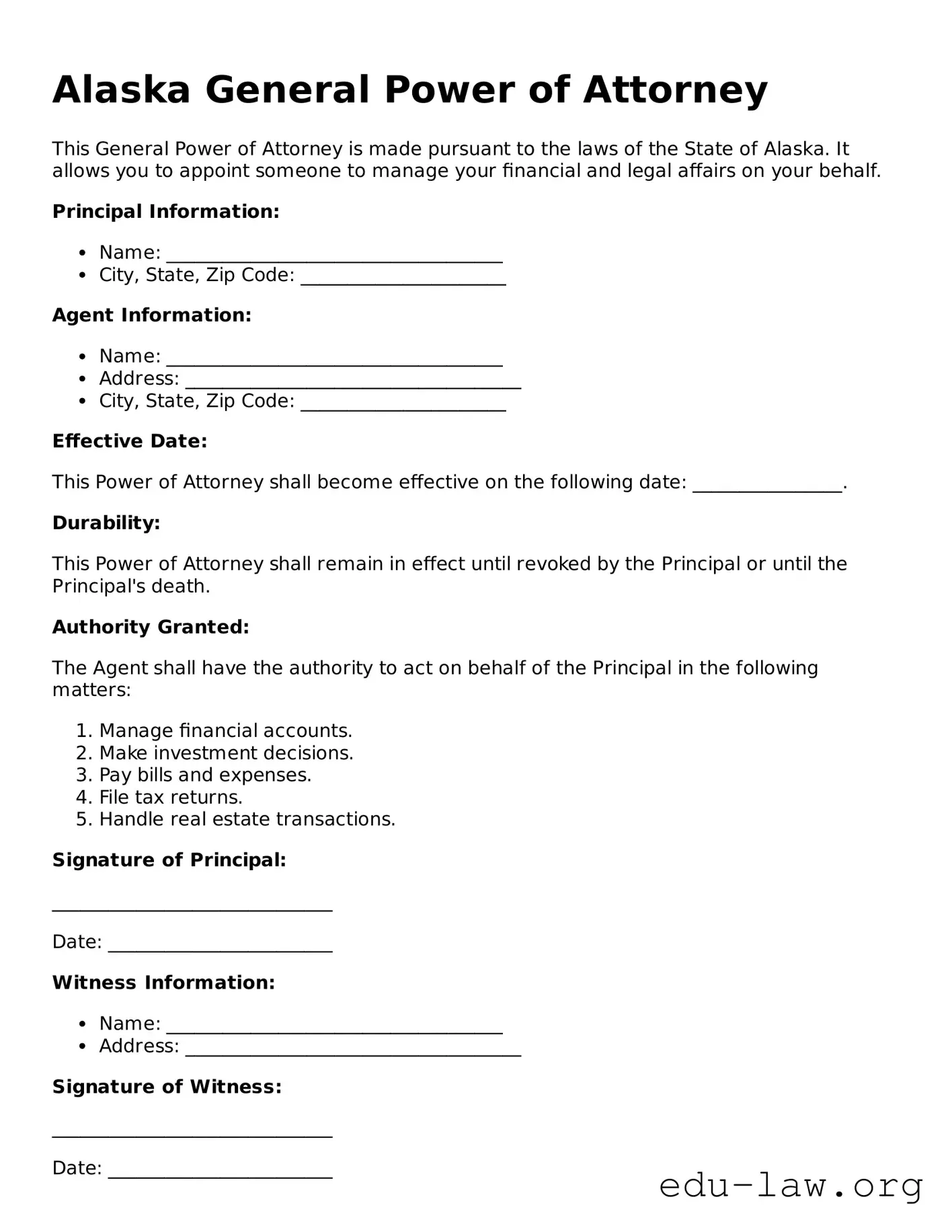
Alaska General Power of Attorney
This General Power of Attorney is made pursuant to the laws of the State of Alaska. It allows you to appoint someone to manage your financial and legal affairs on your behalf.
Principal Information:
Agent Information:
Effective Date:
This Power of Attorney shall become effective on the following date: ________________.
Durability:
This Power of Attorney shall remain in effect until revoked by the Principal or until the Principal's death.
Authority Granted:
The Agent shall have the authority to act on behalf of the Principal in the following matters:
Signature of Principal:
______________________________
Date: ________________________
Witness Information:
Signature of Witness:
______________________________
Date: ________________________
| Fact Name | Details |
|---|---|
| Definition | A General Power of Attorney allows an individual to grant authority to another person to act on their behalf in various matters. |
| Governing Law | The Alaska General Power of Attorney form is governed by Alaska Statutes, specifically AS 13.26.335. |
| Principal and Agent | The person granting authority is known as the principal, while the person receiving authority is the agent or attorney-in-fact. |
| Durability | This form can be made durable, meaning it remains effective even if the principal becomes incapacitated. |
| Scope of Authority | The agent can perform a wide range of actions, including managing finances, real estate transactions, and legal matters. |
| Revocation | The principal can revoke the General Power of Attorney at any time, provided they are mentally competent. |
| Witness Requirement | In Alaska, the form must be signed in the presence of two witnesses or a notary public. |
| Limitations | Some actions, such as making a will or certain medical decisions, cannot be granted through a General Power of Attorney. |
| Execution | The form must be signed by the principal, and the agent must also sign to acknowledge their acceptance of the role. |
| Legal Advice | It is advisable to seek legal counsel when creating a General Power of Attorney to ensure it meets all legal requirements. |
Filling out the Alaska General Power of Attorney form is an important step in designating someone to act on your behalf. This process involves providing specific information about yourself and the person you are appointing. Careful attention to detail is essential to ensure everything is completed correctly.
After completing the form, it is essential to keep a copy for your records. Ensure that your agent understands their responsibilities and the powers granted to them. This will help facilitate a smooth process in the future.
What is a General Power of Attorney in Alaska?
A General Power of Attorney in Alaska is a legal document that allows an individual, known as the principal, to appoint another person, called the agent, to act on their behalf. This authority can cover a wide range of financial and legal matters, making it a versatile tool for managing personal affairs when the principal is unable to do so themselves.
Why would someone need a General Power of Attorney?
People often create a General Power of Attorney to ensure that their financial and legal matters can be handled in their absence. This can be particularly useful for individuals who travel frequently, have health concerns, or wish to designate someone to manage their affairs during a temporary incapacity.
What powers can be granted to the agent?
The powers granted to the agent can be extensive, including managing bank accounts, signing checks, handling real estate transactions, and making investment decisions. The principal can specify which powers the agent has and may choose to limit the authority to certain areas or types of transactions.
How does one create a General Power of Attorney in Alaska?
To create a General Power of Attorney in Alaska, the principal must complete a written document that clearly states their intentions. It should include the names of both the principal and the agent, as well as a detailed description of the powers being granted. The document must be signed by the principal and, in some cases, witnessed or notarized to ensure its validity.
Can a General Power of Attorney be revoked?
Yes, a General Power of Attorney can be revoked at any time by the principal, as long as they are mentally competent. To revoke the power, the principal should create a written notice of revocation and communicate it to the agent and any relevant institutions or individuals who may rely on the authority granted in the original document.
What happens if the principal becomes incapacitated?
If the principal becomes incapacitated, the General Power of Attorney remains in effect unless it is specifically stated to terminate upon incapacity. This means the agent can continue to act on behalf of the principal, ensuring that their affairs are managed without interruption.
Is it necessary to have a lawyer to create a General Power of Attorney?
While it is not legally required to have a lawyer to create a General Power of Attorney in Alaska, seeking legal advice can be beneficial. A lawyer can help ensure that the document meets all legal requirements and accurately reflects the principal's wishes, potentially avoiding future disputes or complications.
Can the agent be held liable for their actions?
The agent has a fiduciary duty to act in the best interests of the principal. If the agent fails to do so or mismanages the principal's affairs, they may be held liable for any resulting damages. It is crucial for the agent to act with care and transparency to avoid any potential legal issues.
What should be done if the agent is no longer able to fulfill their duties?
If the agent can no longer fulfill their duties, the principal can designate a new agent by creating a new General Power of Attorney or by revoking the existing one and appointing someone else. If the principal is incapacitated and unable to make a new designation, a court may need to appoint a guardian or conservator to manage the principal's affairs.
Failing to specify the powers granted. It's crucial to clearly outline what the agent can and cannot do. Vague language can lead to confusion and potential disputes.
Not dating the document. A date is essential for determining the validity of the power of attorney. Without it, there may be questions about when the authority was granted.
Neglecting to sign in front of a notary. In Alaska, a power of attorney must be notarized to be legally binding. Skipping this step can render the document ineffective.
Choosing an untrustworthy agent. Selecting someone who may not act in your best interest can lead to serious consequences. Always choose a reliable person.
Overlooking the need for witnesses. Depending on the situation, having witnesses may be required. Check local laws to ensure compliance.
Using outdated forms. Laws can change, and using an old version of the form may lead to complications. Always use the most current version available.
Ignoring the revocation process. If you decide to revoke the power of attorney, you must follow the proper procedures. Failing to do so can leave the previous document in effect.
Not discussing the document with the agent. Open communication is vital. Ensure the agent understands their responsibilities and your wishes.
A General Power of Attorney form is often accompanied by other documents to ensure comprehensive management of financial and legal matters. Below are a few common forms that may be used alongside the Alaska General Power of Attorney form.
Using these documents together can provide clarity and ensure that all aspects of a person's affairs are handled according to their wishes. It is important to consider each document's purpose and how they work together to create a comprehensive plan.
The Alaska General Power of Attorney form shares similarities with the Durable Power of Attorney. Both documents allow an individual, known as the principal, to designate someone else, called the agent, to make decisions on their behalf. However, the key difference lies in the durability aspect. While a General Power of Attorney becomes ineffective if the principal becomes incapacitated, a Durable Power of Attorney remains in effect even if the principal is unable to make decisions due to illness or injury. This feature makes the Durable Power of Attorney particularly useful for long-term planning and ensuring that someone can manage the principal’s affairs during times of incapacity.
Another document that resembles the Alaska General Power of Attorney is the Medical Power of Attorney. This document specifically focuses on healthcare decisions. Like the General Power of Attorney, it allows the principal to appoint an agent to make decisions. However, the Medical Power of Attorney is limited to medical and health-related matters. It empowers the agent to make choices about medical treatment, access medical records, and communicate with healthcare providers, ensuring that the principal's health preferences are honored when they cannot speak for themselves.
The Alaska General Power of Attorney also has similarities with the Financial Power of Attorney. This document grants authority specifically for financial matters, allowing the agent to manage the principal's financial affairs, such as paying bills, managing investments, and handling real estate transactions. While the General Power of Attorney can cover both financial and other matters, the Financial Power of Attorney is tailored exclusively for financial decisions, making it a focused tool for those who want to ensure their financial matters are handled by a trusted individual.
Lastly, the Limited Power of Attorney is another document that bears resemblance to the Alaska General Power of Attorney. This form allows the principal to grant authority to an agent for a specific purpose or a limited time frame. Unlike the General Power of Attorney, which provides broad authority, the Limited Power of Attorney is tailored for particular tasks, such as signing documents for a real estate transaction or managing a single investment. This specificity can be beneficial when the principal wants to maintain control over their affairs while delegating certain responsibilities to someone else.
Filling out a General Power of Attorney form in Alaska is an important task that requires careful attention. Here are five essential things to keep in mind while completing the form:
By following these guidelines, you can ensure that your General Power of Attorney form is filled out correctly and serves its intended purpose. Taking the time to do it right can prevent potential issues down the road.
Understanding the Alaska General Power of Attorney form is crucial for anyone considering its use. However, several misconceptions can lead to confusion. Below are eight common misconceptions, along with clarifications for each.
Addressing these misconceptions can help individuals make informed decisions regarding the use of the Alaska General Power of Attorney form.
When filling out and using the Alaska General Power of Attorney form, consider the following key takeaways: