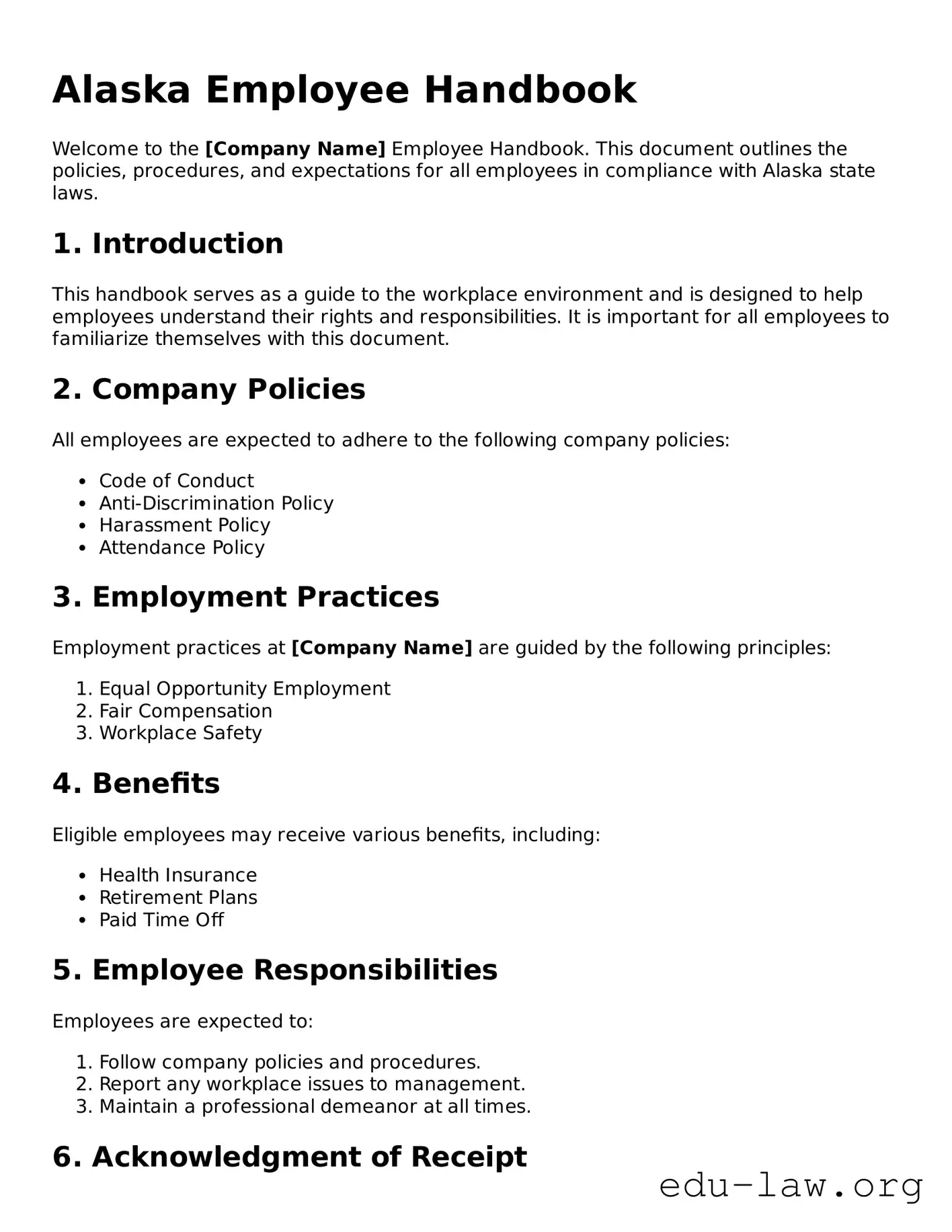
Creating a comprehensive employee handbook is a vital step for businesses in Alaska, as it sets the foundation for workplace policies and expectations. This handbook serves as a guide for employees, outlining essential information such as company culture, employee rights, and responsibilities. It typically includes sections on workplace conduct, attendance policies, and benefits, ensuring that all team members understand their roles within the organization. Additionally, the handbook addresses important legal requirements, such as anti-discrimination policies and safety protocols, which are crucial for maintaining a respectful and safe work environment. By providing clear guidelines and resources, the Alaska Employee Handbook form helps foster communication between employers and employees, ultimately contributing to a positive workplace atmosphere.
Alaska Employee Handbook
Welcome to the [Company Name] Employee Handbook. This document outlines the policies, procedures, and expectations for all employees in compliance with Alaska state laws.
1. Introduction
This handbook serves as a guide to the workplace environment and is designed to help employees understand their rights and responsibilities. It is important for all employees to familiarize themselves with this document.
2. Company Policies
All employees are expected to adhere to the following company policies:
3. Employment Practices
Employment practices at [Company Name] are guided by the following principles:
4. Benefits
Eligible employees may receive various benefits, including:
5. Employee Responsibilities
Employees are expected to:
6. Acknowledgment of Receipt
All employees must sign an acknowledgment form confirming that they have received, read, and understood this handbook.
Employee Name: [Employee Name]
Signature: [Employee Signature]
Date: [Date]
7. Contact Information
For any questions regarding this handbook or company policies, please contact:
Human Resources Department
Email: [HR Email]
Phone: [HR Phone Number]
8. Amendments
This handbook may be amended at any time. Employees will be notified of any changes.
Thank you for being a part of [Company Name]. We look forward to a successful working relationship.
| Fact Name | Description |
|---|---|
| Purpose | The Alaska Employee Handbook serves as a guide for employees, outlining company policies and procedures. |
| Compliance | This handbook helps ensure compliance with Alaska state laws and federal regulations. |
| Employee Rights | It informs employees of their rights, including workplace safety and anti-discrimination policies. |
| Governing Laws | The handbook is governed by Alaska Statutes, including Title 23, which addresses labor and workforce issues. |
| Updates | Employers are encouraged to update the handbook regularly to reflect changes in laws and company policies. |
| Employee Acknowledgment | Employees are typically required to sign an acknowledgment form after reviewing the handbook. |
| Accessibility | The handbook should be easily accessible to all employees, either in print or digital format. |
Once you have the Alaska Employee Handbook form in front of you, you will need to complete it carefully. This process will help ensure that all necessary information is accurately recorded. Follow these steps to fill out the form correctly.
What is the Alaska Employee Handbook form?
The Alaska Employee Handbook form is a document that outlines the policies, procedures, and expectations for employees working in Alaska. It serves as a guide to help employees understand their rights and responsibilities, as well as the company's standards and practices.
Who needs to complete the Alaska Employee Handbook form?
All employees working for a company in Alaska should complete the Employee Handbook form. This includes full-time, part-time, and temporary employees. It ensures that everyone is aware of the company's policies and can refer back to them as needed.
How do I obtain the Alaska Employee Handbook form?
You can typically obtain the Alaska Employee Handbook form from your employer's human resources department. Some companies may also provide it online through their employee portal. If you have trouble locating it, don't hesitate to ask your supervisor or HR representative for assistance.
What information is included in the Alaska Employee Handbook form?
The handbook generally includes information about company policies, employee benefits, workplace conduct, safety procedures, and grievance processes. It may also cover topics such as attendance, dress code, and disciplinary actions. Each section is designed to clarify expectations and promote a positive work environment.
Is the Alaska Employee Handbook form legally required?
While there is no specific law mandating an employee handbook in Alaska, having one is highly recommended. It helps protect both the employer and the employees by providing clear guidelines and reducing misunderstandings. Additionally, certain industries may have regulations that necessitate specific policies being documented.
Can the policies in the Alaska Employee Handbook be changed?
Yes, employers can update the policies in the Employee Handbook as needed. It is important for employees to stay informed about any changes. Employers should communicate updates clearly and provide employees with the revised handbook or a summary of changes.
What should I do if I have questions about the Alaska Employee Handbook?
If you have questions about the Employee Handbook, it's best to reach out to your human resources department or your supervisor. They can provide clarification on any policies or procedures you may not understand. Open communication is encouraged to ensure everyone is on the same page.
What happens if I do not follow the policies in the Alaska Employee Handbook?
Failure to follow the policies outlined in the Employee Handbook can result in disciplinary action, which may range from a verbal warning to termination, depending on the severity of the violation. It is crucial to familiarize yourself with the handbook to avoid any potential issues.
How often should I review the Alaska Employee Handbook?
Employees should review the Employee Handbook at least once a year or whenever a new version is distributed. Regularly revisiting the handbook helps ensure that you remain informed about the company's policies and any updates that may affect your employment.
What should I do if I disagree with a policy in the Alaska Employee Handbook?
If you disagree with a policy, it is important to discuss your concerns with your supervisor or HR representative. They can provide insight into the reasoning behind the policy and may be open to feedback. Constructive dialogue can lead to a better understanding and potentially even changes in the future.
When filling out the Alaska Employee Handbook form, it’s easy to overlook important details. Here are ten common mistakes that individuals often make:
Each of these errors can lead to misunderstandings or complications down the line. Taking the time to carefully review and complete the form can help ensure a smoother onboarding experience.
When developing an employee handbook in Alaska, several other documents can complement the handbook and ensure that both employers and employees understand their rights and responsibilities. These documents help establish clear guidelines and policies within the workplace.
By utilizing these documents alongside the employee handbook, employers can create a more structured and transparent workplace. Clear communication and documentation benefit both parties, fostering a positive work environment.
The Alaska Employee Handbook form is similar to the Employee Manual, which serves as a comprehensive guide for employees regarding company policies and procedures. Like the handbook, the Employee Manual outlines expectations for behavior, work hours, and benefits. Both documents aim to foster a clear understanding of workplace culture and compliance with state and federal laws. Employees can refer to the manual for guidance on various topics, ensuring consistency in application across the organization.
Another document comparable to the Alaska Employee Handbook is the Orientation Guide. This guide is typically provided during the onboarding process and offers new hires essential information about the company. While the handbook provides a broader overview of policies, the Orientation Guide focuses on immediate needs, such as introductions to team members, training schedules, and initial paperwork. Together, these documents help integrate new employees into the workplace smoothly.
The Policy and Procedure Manual also shares similarities with the Alaska Employee Handbook. This manual delves into specific policies that govern workplace conduct, safety protocols, and compliance requirements. While the employee handbook provides a general overview, the Policy and Procedure Manual offers detailed explanations and step-by-step instructions for various scenarios. Employees can reference both documents to ensure they are following company standards and legal obligations.
Lastly, the Code of Conduct is another document that aligns closely with the Alaska Employee Handbook. The Code of Conduct outlines the ethical standards and behavioral expectations for all employees. It emphasizes the importance of integrity, respect, and accountability in the workplace. While the employee handbook covers a wide range of topics, the Code of Conduct focuses specifically on ethical behavior and decision-making, reinforcing the organization's values and mission.
Filling out the Alaska Employee Handbook form is an important step in your employment journey. Here are ten essential dos and don'ts to keep in mind:
Understanding the Alaska Employee Handbook form is crucial for both employers and employees. However, several misconceptions exist regarding its purpose and usage. Here are five common misunderstandings:
Many people believe that the handbook constitutes a binding legal contract between the employer and employee. In reality, most handbooks are intended to serve as guidelines and do not create enforceable obligations.
Some assume that there is a one-size-fits-all approach to employee handbooks. However, each handbook should be tailored to reflect the specific policies, culture, and needs of the organization.
While new hires often receive a copy of the handbook, it is a resource for all employees. Regular updates and reviews of the handbook are essential to keep everyone informed about company policies and procedures.
Some employees think that if they do not sign an acknowledgment of receipt, they are not bound by the handbook. In fact, employees are still expected to adhere to the policies outlined, regardless of whether they signed an acknowledgment.
Another common belief is that once an employee handbook is distributed, it cannot be altered. Employers can and should update the handbook as needed to reflect changes in laws or company policies, provided that employees are informed of these changes.
When filling out and using the Alaska Employee Handbook form, keep these key takeaways in mind: