When planning for the future, it’s essential to consider how your financial and healthcare decisions will be made if you become unable to communicate your wishes. One effective tool for this purpose is the Alaska Durable Power of Attorney form. This legal document allows you to appoint someone you trust, known as an agent, to manage your affairs on your behalf. The form is designed to remain in effect even if you become incapacitated, ensuring that your chosen representative can make decisions regarding your finances, property, and healthcare. It covers a range of responsibilities, from handling bank transactions and paying bills to making medical decisions and managing investments. By understanding the major aspects of the Alaska Durable Power of Attorney form, you can take proactive steps to safeguard your interests and ensure that your preferences are honored, even when you are not able to express them yourself.
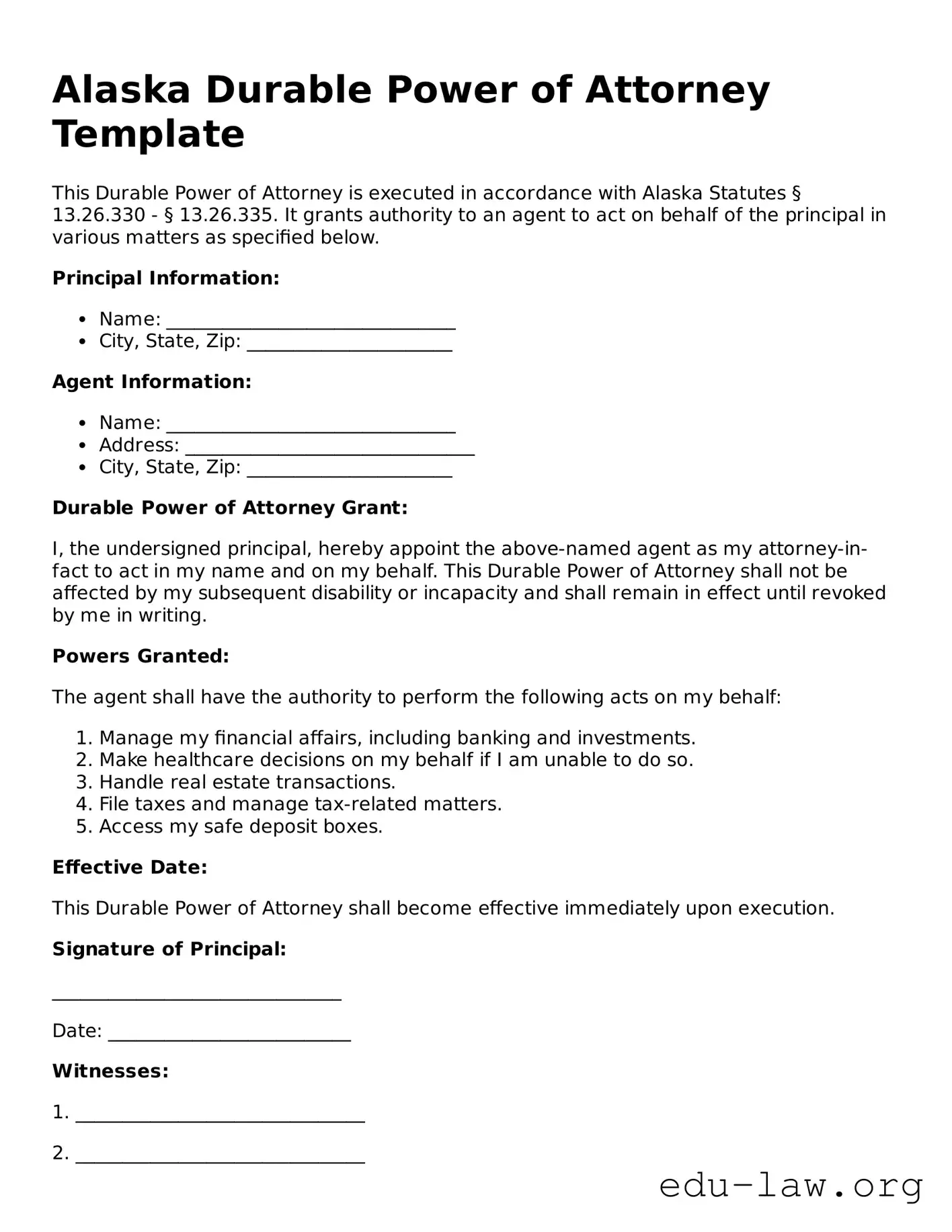
Alaska Durable Power of Attorney Template
This Durable Power of Attorney is executed in accordance with Alaska Statutes § 13.26.330 - § 13.26.335. It grants authority to an agent to act on behalf of the principal in various matters as specified below.
Principal Information:
Agent Information:
Durable Power of Attorney Grant:
I, the undersigned principal, hereby appoint the above-named agent as my attorney-in-fact to act in my name and on my behalf. This Durable Power of Attorney shall not be affected by my subsequent disability or incapacity and shall remain in effect until revoked by me in writing.
Powers Granted:
The agent shall have the authority to perform the following acts on my behalf:
Effective Date:
This Durable Power of Attorney shall become effective immediately upon execution.
Signature of Principal:
_______________________________
Date: __________________________
Witnesses:
1. _______________________________
2. _______________________________
Notarization:
State of Alaska
County of ________________________
Subscribed and sworn to before me on this ____ day of __________, 20__.
_______________________________
Notary Public
My Commission Expires: ______________
| Fact Name | Description |
|---|---|
| Definition | The Alaska Durable Power of Attorney form allows an individual to appoint someone else to manage their financial affairs, even if they become incapacitated. |
| Governing Law | This form is governed by Alaska Statutes, specifically AS 13.26.330 to AS 13.26.365. |
| Durability | It remains effective even if the principal becomes mentally incompetent, which is a key feature of a durable power of attorney. |
| Agent Authority | The appointed agent can perform a variety of financial tasks, such as managing bank accounts, paying bills, and making investment decisions. |
| Revocation | The principal can revoke the power of attorney at any time, as long as they are mentally competent to do so. |
| Witness Requirements | In Alaska, the form must be signed by the principal in the presence of at least two witnesses or a notary public to be valid. |
Filling out the Alaska Durable Power of Attorney form is a straightforward process. This document allows you to designate someone to act on your behalf in financial or legal matters. After completing the form, you will need to sign it in the presence of a notary public to ensure its validity.
What is a Durable Power of Attorney in Alaska?
A Durable Power of Attorney (DPOA) is a legal document that allows a person, known as the principal, to appoint another individual, called the agent or attorney-in-fact, to make decisions on their behalf. This authority remains in effect even if the principal becomes incapacitated. In Alaska, this document is particularly useful for managing financial affairs or health care decisions when the principal is unable to do so themselves.
Who can be appointed as an agent in a Durable Power of Attorney?
In Alaska, the principal can choose any competent adult to act as their agent. This could be a family member, friend, or a trusted professional. It is important to select someone who is trustworthy and capable of making decisions in the principal's best interest. The agent must agree to take on this responsibility and should be informed about the principal's wishes and values.
What powers can be granted to the agent in a Durable Power of Attorney?
The powers granted to the agent can vary based on the principal's needs. Common powers include managing bank accounts, paying bills, making investment decisions, and handling real estate transactions. The principal can also specify health care decisions, such as consenting to medical treatments or making end-of-life choices. It is essential to clearly outline these powers in the document to avoid any confusion later on.
How does one create a Durable Power of Attorney in Alaska?
To create a Durable Power of Attorney in Alaska, the principal must complete a written document that includes specific language indicating that the power of attorney is durable. The document must be signed by the principal in the presence of a notary public or two witnesses. This step ensures that the document is legally binding and recognized by financial institutions and health care providers.
Can a Durable Power of Attorney be revoked?
Yes, a principal can revoke a Durable Power of Attorney at any time, as long as they are mentally competent. To revoke the document, the principal should create a written notice of revocation and inform the agent and any institutions that may have relied on the original document. It is advisable to destroy any copies of the original DPOA to prevent confusion.
What happens if the agent cannot serve or is unable to fulfill their duties?
If the appointed agent is unable to serve, the Durable Power of Attorney may include alternate agents who can step in. If no alternates are named, or if the agent is unable to fulfill their duties, a court may need to appoint a guardian or conservator to handle the principal's affairs. This can be a lengthy and costly process, which is why naming alternates is often a good idea.
Is a Durable Power of Attorney effective immediately?
A Durable Power of Attorney can be set up to take effect immediately upon signing, or it can be made effective only upon the principal's incapacity. This choice should be clearly stated in the document. If it is effective immediately, the agent can start making decisions right away. If it is contingent upon incapacity, the principal will need to provide proof of their inability to make decisions for the agent to act.
Do I need a lawyer to create a Durable Power of Attorney in Alaska?
While it is not legally required to have a lawyer to create a Durable Power of Attorney in Alaska, consulting with one is highly recommended. A lawyer can help ensure that the document complies with state laws and accurately reflects the principal's wishes. Additionally, they can provide guidance on the powers to be granted and the implications of those decisions.
Can a Durable Power of Attorney be used for health care decisions?
Yes, a Durable Power of Attorney can include provisions for health care decisions. However, it is often advisable to create a separate document known as a Health Care Proxy or Advance Health Care Directive for this purpose. This helps ensure that health care wishes are clearly articulated and can be easily accessed by medical providers when needed.
Not specifying the powers granted: Individuals often forget to clearly outline the specific powers they wish to grant. This can lead to confusion and disputes later on.
Failing to date the form: A common oversight is neglecting to include the date on the form. Without a date, the document may be considered invalid.
Choosing an untrustworthy agent: Some people select an agent without considering their reliability and integrity. It's crucial to choose someone who will act in your best interest.
Not having witnesses or notarization: The Alaska Durable Power of Attorney requires either witnesses or notarization. Skipping this step can render the document ineffective.
Leaving out alternate agents: Failing to name alternate agents can create complications if the primary agent is unable or unwilling to act. Always have a backup.
Overlooking specific limitations: Some individuals forget to include any limitations on the agent's powers. Clearly stating these limitations can prevent misuse of authority.
Using outdated forms: Laws change over time, and using an outdated version of the form can lead to issues. Always ensure you have the most current version.
Not reviewing the document: Individuals often fail to review the completed document thoroughly. It’s essential to ensure all information is accurate and complete.
Ignoring state-specific requirements: Each state has unique requirements for Durable Power of Attorney forms. Ignoring these can lead to the document being deemed invalid.
A Durable Power of Attorney (DPOA) is an important legal document that allows an individual to appoint someone else to manage their financial or medical decisions if they become unable to do so. In Alaska, this form is often used alongside several other documents to ensure comprehensive planning and protection. Here are some common forms that may accompany a DPOA:
Each of these documents serves a unique purpose, and together they can create a robust plan for managing an individual's affairs. It is advisable to consider all options and consult with a legal professional to ensure that all documents align with personal goals and legal requirements.
The Alaska Durable Power of Attorney form shares similarities with the General Power of Attorney. Both documents grant an individual the authority to act on behalf of another person in legal or financial matters. The key difference lies in the durability aspect; while a General Power of Attorney may become invalid if the principal becomes incapacitated, a Durable Power of Attorney remains effective even in such circumstances, ensuring continuity of decision-making during critical times.
Another document comparable to the Alaska Durable Power of Attorney is the Medical Power of Attorney. This form specifically authorizes an individual to make healthcare decisions for another person. Like the Durable Power of Attorney, it allows for the delegation of decision-making authority, but it focuses exclusively on medical matters. This ensures that a trusted person can make vital health-related choices when the individual is unable to do so.
The Limited Power of Attorney is also similar, as it permits a person to act on behalf of another but restricts that authority to specific tasks or time frames. This document is useful for individuals who want to maintain control over their affairs while delegating certain responsibilities. The Alaska Durable Power of Attorney, in contrast, provides broader and ongoing authority, allowing the agent to handle various matters without the limitations imposed by a Limited Power of Attorney.
A Trust is another relevant document. While not a power of attorney, a trust allows one person to manage assets for the benefit of another. Both documents involve the management of another's affairs, but a trust is typically more complex and involves the transfer of assets into a separate legal entity. The Durable Power of Attorney, however, is more straightforward and can be used for immediate decision-making without the need for asset transfer.
The Advance Healthcare Directive is similar to the Medical Power of Attorney but encompasses a broader range of healthcare decisions. It allows individuals to outline their medical treatment preferences and appoint a decision-maker. Like the Durable Power of Attorney, it ensures that the individual’s wishes are respected when they cannot communicate them, but it focuses specifically on healthcare rather than financial or legal matters.
The Financial Power of Attorney is closely related, as it specifically grants authority to manage financial affairs. This document can be durable or non-durable, depending on the principal's preferences. The Alaska Durable Power of Attorney is often more comprehensive, allowing the agent to handle various legal and financial decisions, whereas the Financial Power of Attorney may limit the scope of authority to financial matters alone.
The Springing Power of Attorney is another document that shares similarities with the Alaska Durable Power of Attorney. A Springing Power of Attorney becomes effective only upon the occurrence of a specified event, such as the principal’s incapacitation. In contrast, a Durable Power of Attorney is effective immediately, providing immediate authority to the agent, which can be beneficial in urgent situations.
Lastly, the Guardianship documents can be compared to the Durable Power of Attorney. While a Durable Power of Attorney allows an individual to appoint someone to make decisions on their behalf, a Guardianship involves a court appointing an individual to manage the affairs of someone who is unable to do so. Both processes aim to protect the interests of individuals who cannot manage their own affairs, but the legal frameworks and oversight differ significantly.
When filling out the Alaska Durable Power of Attorney form, it's essential to approach the task with care. This document allows someone to make decisions on your behalf, so accuracy and clarity are crucial. Here are ten things to keep in mind:
By following these guidelines, you can help ensure that your Durable Power of Attorney form is filled out correctly and serves its intended purpose.
Understanding the Alaska Durable Power of Attorney form is crucial for anyone considering its use. However, there are several misconceptions surrounding this important legal document. Below is a list of common misunderstandings, along with explanations to clarify them.
This is a common misconception. While the Durable Power of Attorney often focuses on financial decisions, it can also grant authority over healthcare decisions if specified in the document.
In fact, the "durable" aspect of this power of attorney means it remains effective even if the principal becomes incapacitated, as long as it was properly executed.
While you can choose anyone you trust to act as your agent, there are some restrictions. For example, certain professionals may be limited in their ability to serve in this role depending on the situation.
This is not true. Each Durable Power of Attorney can be tailored to fit individual needs and circumstances, allowing for specific powers to be granted or limited as desired.
While notarization can enhance the document’s credibility, Alaska law does not require it for a Durable Power of Attorney to be valid. Witness signatures can suffice in many cases.
This is a misconception. The principal can revoke or amend the Durable Power of Attorney at any time, as long as they are competent to do so.
People of all ages can benefit from a Durable Power of Attorney. Unexpected events can happen at any time, making this document valuable for anyone.
This is misleading. The principal can specify which powers are granted, and some may be limited or excluded entirely, depending on the principal’s wishes.
While both documents allow someone to act on behalf of another, a Durable Power of Attorney remains effective during incapacitation, whereas a regular Power of Attorney does not.
This is incorrect. The authority granted under a Durable Power of Attorney ends upon the principal’s death. After that, a will or trust governs the distribution of assets.
By understanding these misconceptions, individuals can make more informed decisions regarding their use of the Alaska Durable Power of Attorney form.
When filling out and using the Alaska Durable Power of Attorney form, keep these key takeaways in mind: