In the vast and rugged landscapes of Alaska, where the wilderness meets the complexities of healthcare, the Alaska Do Not Resuscitate (DNR) Order form serves as a crucial document for individuals wishing to express their end-of-life preferences. This form empowers patients to make informed decisions about their medical care, particularly in situations where resuscitation efforts may not align with their wishes. It is designed for use by adults who are capable of making their own healthcare decisions, allowing them to specify that they do not want cardiopulmonary resuscitation (CPR) or other life-saving measures in the event of a cardiac arrest or respiratory failure. The DNR form must be signed by a physician, ensuring that medical professionals are aware of and respect the patient's choices. Additionally, it is important to note that this document can be easily accessed and should be kept in a prominent location, ensuring that family members and healthcare providers are aware of the patient's wishes at critical moments. Understanding the implications of the DNR Order is vital for Alaskans, as it not only reflects personal values and beliefs but also fosters meaningful conversations about end-of-life care among families and healthcare teams.
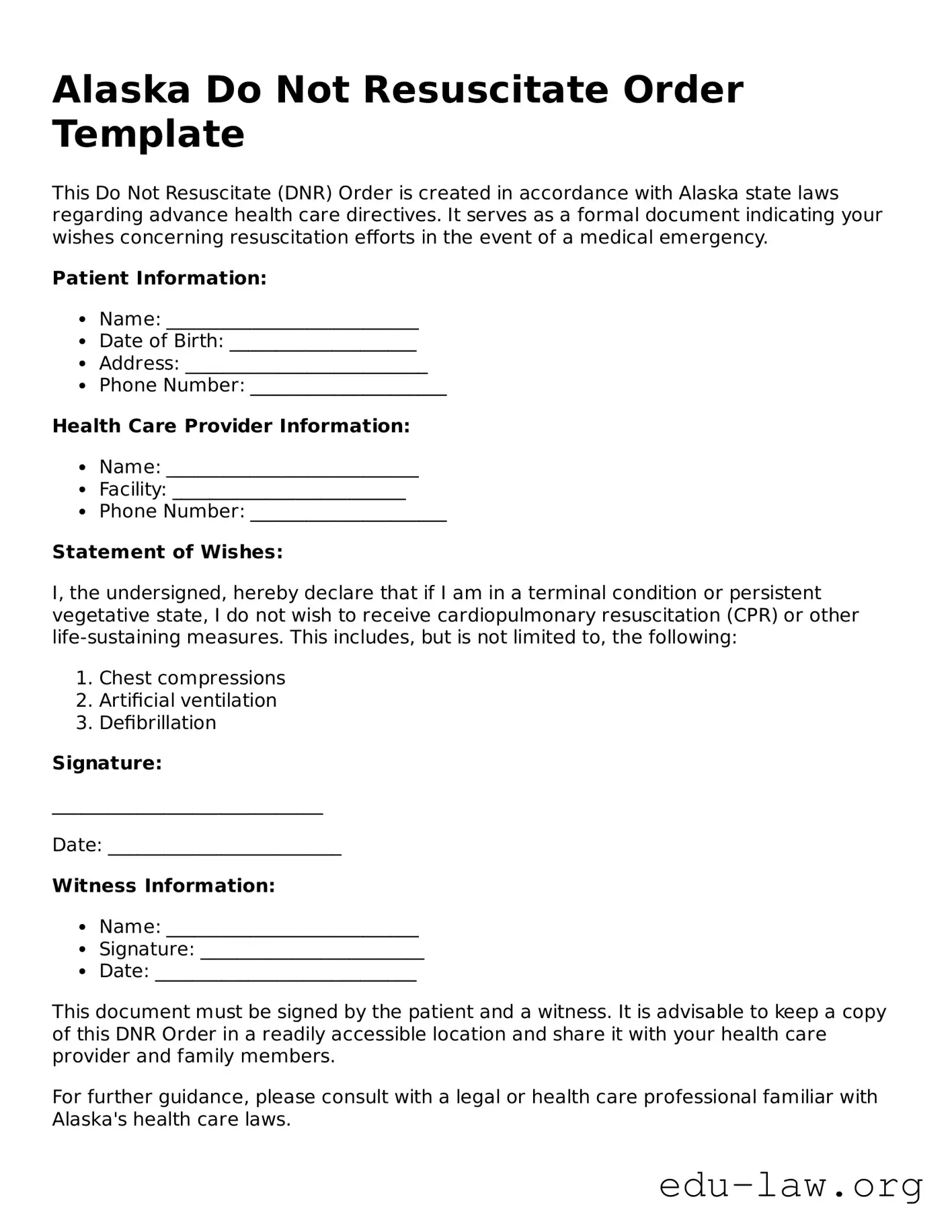
Alaska Do Not Resuscitate Order Template
This Do Not Resuscitate (DNR) Order is created in accordance with Alaska state laws regarding advance health care directives. It serves as a formal document indicating your wishes concerning resuscitation efforts in the event of a medical emergency.
Patient Information:
Health Care Provider Information:
Statement of Wishes:
I, the undersigned, hereby declare that if I am in a terminal condition or persistent vegetative state, I do not wish to receive cardiopulmonary resuscitation (CPR) or other life-sustaining measures. This includes, but is not limited to, the following:
Signature:
_____________________________
Date: _________________________
Witness Information:
This document must be signed by the patient and a witness. It is advisable to keep a copy of this DNR Order in a readily accessible location and share it with your health care provider and family members.
For further guidance, please consult with a legal or health care professional familiar with Alaska's health care laws.
| Fact Name | Description |
|---|---|
| Definition | An Alaska Do Not Resuscitate (DNR) Order is a legal document that instructs medical personnel not to perform cardiopulmonary resuscitation (CPR) if a patient's heart stops or they stop breathing. |
| Governing Law | The DNR Order in Alaska is governed by Alaska Statutes § 13.52.010 - § 13.52.090. |
| Eligibility | Any adult or emancipated minor can complete a DNR Order in Alaska, provided they have the capacity to make healthcare decisions. |
| Signature Requirement | The form must be signed by the patient or their legally authorized representative. |
| Witnesses | Two witnesses must sign the DNR Order, affirming that they witnessed the patient or representative signing the document. |
| Healthcare Provider Signature | A physician must sign the DNR Order to validate it and ensure it complies with state regulations. |
| Revocation | The patient can revoke the DNR Order at any time, verbally or in writing, without penalty. |
| Emergency Services | Emergency medical personnel must have a copy of the DNR Order to honor it during emergencies. |
| Location of Form | The DNR Order should be kept in an easily accessible location, such as on the refrigerator or in a medical file. |
| Limitations | The DNR Order only applies to resuscitation efforts and does not affect other medical treatments or interventions. |
Filling out the Alaska Do Not Resuscitate Order form is an important step in expressing your healthcare wishes. Once you have completed the form, it will need to be signed and dated. Make sure to keep a copy for your records and share it with your healthcare provider and family members.
What is a Do Not Resuscitate (DNR) Order in Alaska?
A Do Not Resuscitate Order is a medical directive that instructs healthcare providers not to perform cardiopulmonary resuscitation (CPR) if a patient’s heart stops beating or if they stop breathing. In Alaska, this order is intended for individuals who wish to avoid aggressive life-saving measures in the event of a medical emergency. It is a personal choice that reflects an individual’s values and preferences regarding end-of-life care.
Who can complete a DNR Order in Alaska?
In Alaska, a DNR Order can be completed by a patient who is at least 18 years old and is capable of making their own medical decisions. If the patient is unable to make decisions, a legally authorized representative, such as a spouse, adult child, or legal guardian, may complete the order on their behalf. It is essential that the person completing the DNR Order understands the patient’s wishes and medical condition.
How is a DNR Order documented in Alaska?
A DNR Order in Alaska must be documented on a specific form provided by the state. This form typically requires the patient's information, the signature of the patient or their authorized representative, and the signature of a physician. It is crucial that the form is filled out accurately to ensure that healthcare providers understand the patient's wishes regarding resuscitation.
Is a DNR Order valid in all healthcare settings in Alaska?
Yes, a properly executed DNR Order is valid across various healthcare settings in Alaska, including hospitals, nursing homes, and emergency medical services. However, it is important for individuals to ensure that their DNR Order is readily accessible to healthcare providers. Carrying a copy of the order or wearing a medical alert bracelet can help ensure that medical personnel are aware of the patient's wishes in an emergency situation.
Can a DNR Order be revoked or changed?
Yes, a DNR Order can be revoked or changed at any time by the patient or their authorized representative. To revoke the order, the individual must communicate their decision clearly, and it is advisable to notify healthcare providers of the change. It is also recommended to destroy any copies of the previous DNR Order to prevent confusion during medical emergencies.
What happens if a DNR Order is not followed?
If a DNR Order is not followed, it can lead to unwanted medical interventions that the patient did not wish to receive. In such cases, healthcare providers may be subject to legal and ethical scrutiny. It is vital for healthcare professionals to verify the existence of a DNR Order before initiating resuscitation efforts to respect the patient's wishes and avoid potential conflicts.
Are there any legal protections for healthcare providers who follow a DNR Order?
Yes, healthcare providers in Alaska who follow a valid DNR Order are generally protected from legal liability. As long as the order is properly executed and documented, medical personnel are acting within their legal rights when they honor the patient's wishes. This protection helps ensure that healthcare providers can make decisions in line with the patient's preferences without fear of legal repercussions.
Where can I obtain a DNR Order form in Alaska?
DNR Order forms can be obtained from various sources, including hospitals, healthcare providers, and the Alaska Department of Health and Social Services. It is advisable to consult with a healthcare professional for assistance in completing the form to ensure that it meets all necessary legal requirements and accurately reflects the patient's wishes.
Not Including Essential Information: One common mistake is failing to provide all required personal information. The form typically requires details such as the patient's name, date of birth, and medical record number. Omitting any of this information can lead to delays or complications in honoring the order.
Incorrect Signatures: The form must be signed by the patient or their legal representative. A frequent error occurs when individuals do not have the appropriate person sign the document. Ensure that the signature aligns with the legal requirements to avoid invalidation.
Not Consulting a Healthcare Provider: Some people fill out the form without discussing it with a healthcare provider. This can lead to misunderstandings about the implications of a Do Not Resuscitate Order. Consulting a medical professional can provide clarity on the patient's wishes and the medical context.
Failing to Update the Form: Life circumstances change, and so do medical wishes. A common oversight is not revisiting or updating the Do Not Resuscitate Order as needed. Regularly reviewing the form ensures it accurately reflects the current wishes of the patient.
Not Distributing Copies: After completing the form, individuals often forget to distribute copies to relevant parties. It is crucial to provide copies to healthcare providers, family members, and any facility where the patient may receive care. This ensures that the order is recognized and followed in emergencies.
When considering end-of-life care options, various forms and documents complement the Alaska Do Not Resuscitate (DNR) Order. These documents help ensure that a person's wishes regarding medical treatment and care are respected. Below is a list of commonly used forms that may accompany the DNR Order.
These documents work together to provide a comprehensive view of an individual's healthcare preferences. By preparing them in advance, individuals can ensure their wishes are honored, providing peace of mind for themselves and their loved ones.
The Alaska Do Not Resuscitate (DNR) Order form shares similarities with the Advance Healthcare Directive. Both documents serve to express an individual's healthcare preferences in situations where they may not be able to communicate their wishes. An Advance Healthcare Directive typically includes instructions on various medical treatments, while a DNR specifically focuses on the refusal of resuscitation efforts. This means that individuals can outline their desires for end-of-life care comprehensively, ensuring that their values and preferences are respected by medical professionals and loved ones alike.
Another document akin to the DNR Order is the Physician Orders for Life-Sustaining Treatment (POLST). While the DNR Order is a specific request regarding resuscitation, the POLST form provides a broader scope of medical decisions. It is designed for patients with serious illnesses and includes orders regarding various types of life-sustaining treatments, such as intubation or feeding tubes. Both documents require a physician's signature and aim to ensure that patients receive care aligned with their personal wishes, particularly in emergency situations.
The Living Will is also comparable to the DNR Order, as both documents address end-of-life decisions. A Living Will outlines an individual's preferences for medical treatment in the event of terminal illness or irreversible conditions. Like the DNR, it provides guidance to healthcare providers about the types of interventions a person wishes to receive or refuse. The key difference lies in the specificity; while a DNR focuses solely on resuscitation, a Living Will encompasses a wider range of medical scenarios.
Lastly, the Healthcare Proxy or Durable Power of Attorney for Healthcare is another important document related to the DNR Order. This legal document allows individuals to designate someone to make healthcare decisions on their behalf if they become incapacitated. While the DNR Order specifies a person's wishes regarding resuscitation, the Healthcare Proxy ensures that a trusted individual can advocate for those wishes and make other medical decisions as necessary. Both documents are vital tools in ensuring that a person's healthcare preferences are honored when they cannot voice them directly.
When filling out the Alaska Do Not Resuscitate Order form, it is crucial to approach the task with care and precision. Here are six important guidelines to consider.
Understanding the Alaska Do Not Resuscitate (DNR) Order form is crucial for both patients and healthcare providers. However, several misconceptions can lead to confusion. Below are five common misconceptions about the DNR form, along with clarifications.
This is not true. A DNR order specifically addresses resuscitation efforts in the event of cardiac arrest. Patients with a DNR can still receive other forms of medical treatment and care.
This misconception overlooks the fact that anyone can request a DNR order, regardless of their health status. It is a personal decision that reflects an individual's wishes regarding resuscitation.
In reality, a DNR order can be revoked or modified at any time. Patients or their designated representatives have the right to change their wishes as circumstances evolve.
This is misleading. A DNR order is valid in various healthcare settings, including at home, nursing facilities, and during emergency medical services. It is important to ensure that the order is properly documented and communicated.
Healthcare providers are legally obligated to honor a valid DNR order. It is essential for patients to communicate their wishes clearly and ensure that the order is properly documented in their medical records.
Addressing these misconceptions can help individuals make informed decisions regarding their healthcare preferences. Understanding the Alaska DNR Order form is an important step in advocating for one’s own health and wishes.
When considering the Alaska Do Not Resuscitate (DNR) Order form, it is essential to understand its significance and how to properly fill it out. Here are key takeaways: