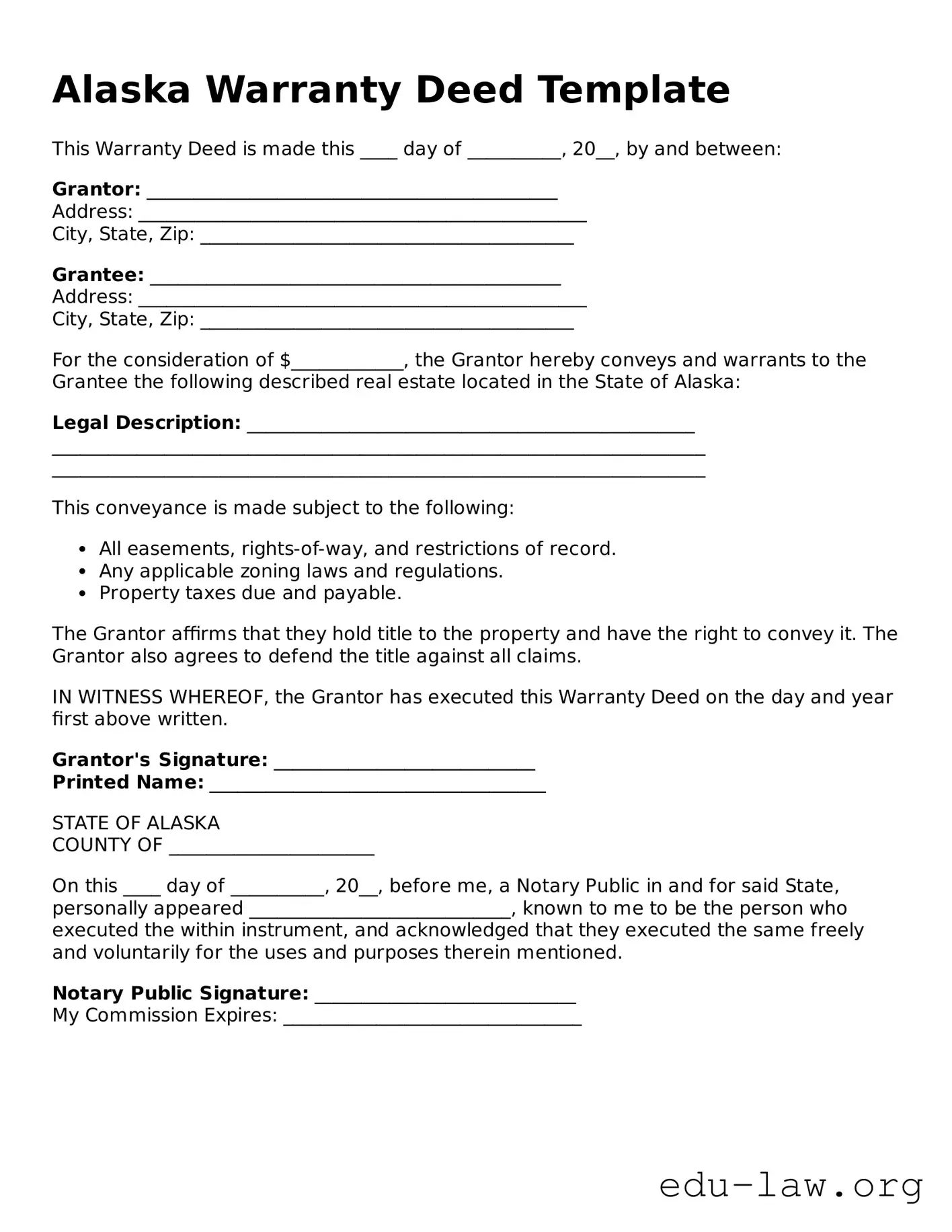
The Alaska Deed form serves as a critical instrument in the transfer of property ownership within the state. This legal document outlines the essential details of the transaction, including the names of the grantor and grantee, a clear description of the property, and the consideration exchanged for the property. It is imperative that the deed is executed in accordance with state laws, ensuring that it is signed, dated, and notarized to validate the transfer. Additionally, the form may specify the type of deed being utilized, such as a warranty deed or quitclaim deed, each offering different levels of protection and assurance regarding the title. Understanding the nuances of the Alaska Deed form is vital for both buyers and sellers, as it not only facilitates the legal transfer of real estate but also serves to safeguard the rights of all parties involved. Properly completing and recording this form with the appropriate local authorities is essential to ensure that the transfer is recognized and enforceable under Alaska law.
Alaska Warranty Deed Template
This Warranty Deed is made this ____ day of __________, 20__, by and between:
Grantor: ____________________________________________
Address: ________________________________________________
City, State, Zip: ________________________________________
Grantee: ____________________________________________
Address: ________________________________________________
City, State, Zip: ________________________________________
For the consideration of $____________, the Grantor hereby conveys and warrants to the Grantee the following described real estate located in the State of Alaska:
Legal Description: ________________________________________________
______________________________________________________________________
______________________________________________________________________
This conveyance is made subject to the following:
The Grantor affirms that they hold title to the property and have the right to convey it. The Grantor also agrees to defend the title against all claims.
IN WITNESS WHEREOF, the Grantor has executed this Warranty Deed on the day and year first above written.
Grantor's Signature: ____________________________
Printed Name: ____________________________________
STATE OF ALASKA
COUNTY OF ______________________
On this ____ day of __________, 20__, before me, a Notary Public in and for said State, personally appeared ____________________________, known to me to be the person who executed the within instrument, and acknowledged that they executed the same freely and voluntarily for the uses and purposes therein mentioned.
Notary Public Signature: ____________________________
My Commission Expires: ________________________________
| Fact Name | Details |
|---|---|
| Type of Deed | The Alaska Deed form is primarily used for transferring real estate ownership. |
| Governing Law | The transfer of property in Alaska is governed by Alaska Statutes, Title 34, Chapter 15. |
| Signature Requirement | The deed must be signed by the grantor (the person transferring the property). |
| Notarization | A notary public must witness the signing of the deed for it to be valid. |
| Recording | To protect the interests of the new owner, the deed should be recorded with the local recorder’s office. |
| Consideration | The deed should state the consideration (payment) for the property, though it can be nominal. |
| Property Description | A clear and accurate legal description of the property being transferred is required. |
Filling out the Alaska Deed form is an important step in transferring property ownership. Once completed, the form will need to be submitted to the appropriate local government office for recording. This ensures that the transfer is officially recognized and documented.
What is an Alaska Deed form?
An Alaska Deed form is a legal document used to transfer ownership of real property in the state of Alaska. This form outlines the details of the transaction, including the names of the parties involved, a description of the property, and any conditions related to the transfer. It serves as a public record of the change in ownership and is essential for establishing legal rights to the property.
What types of deeds are available in Alaska?
In Alaska, several types of deeds can be used, including warranty deeds, quitclaim deeds, and special warranty deeds. A warranty deed provides a guarantee that the seller holds clear title to the property and has the right to sell it. A quitclaim deed transfers whatever interest the seller may have in the property without any guarantees. Special warranty deeds offer a middle ground, ensuring that the seller only warrants against claims made during their ownership.
Do I need a lawyer to complete an Alaska Deed form?
While it is not legally required to have a lawyer assist with the completion of an Alaska Deed form, seeking legal advice can be beneficial. A lawyer can help ensure that the deed is filled out correctly, that all necessary legal requirements are met, and that your rights are protected throughout the process. This is especially important in complex transactions or when dealing with significant assets.
How do I fill out an Alaska Deed form?
Filling out an Alaska Deed form involves several steps. First, clearly identify the grantor (seller) and grantee (buyer) by including their full legal names and addresses. Next, provide a detailed description of the property being transferred, including its legal description and physical address. Finally, sign the deed in front of a notary public. Ensure that all required information is accurate and complete to avoid complications later.
Is there a fee to record an Alaska Deed?
Yes, there is typically a fee associated with recording an Alaska Deed. This fee varies by location and is paid to the local recording office where the deed is filed. Recording the deed is essential, as it provides public notice of the property transfer and protects the grantee's ownership rights against future claims.
What happens if the Alaska Deed form is not recorded?
If an Alaska Deed form is not recorded, the transfer of property ownership may not be legally recognized. This can lead to complications, such as disputes over ownership or challenges from third parties. Recording the deed is crucial for establishing a clear chain of title and ensuring that the new owner's rights are protected.
Can I change or revoke an Alaska Deed after it has been signed?
Once an Alaska Deed has been signed and recorded, it generally cannot be changed or revoked unilaterally. However, the grantor and grantee may agree to execute a new deed to modify the terms or transfer ownership again. In some cases, legal action may be required to challenge the validity of a deed if there are grounds to do so, such as fraud or coercion.
What should I do if I lose my Alaska Deed?
If you lose your Alaska Deed, you can obtain a certified copy from the local recording office where the deed was originally filed. This certified copy will serve as an official record of the property transfer. It is advisable to keep a copy of the deed in a secure location to prevent future issues related to ownership verification.
Failing to include all required information. The deed form must have complete details, including names, addresses, and legal descriptions of the property.
Not signing the document. All parties involved in the transaction must sign the deed. Missing signatures can invalidate the document.
Using incorrect legal descriptions. The property must be accurately described using legal terms. Mistakes in this area can lead to confusion or disputes.
Neglecting to have the deed notarized. Most states, including Alaska, require that the deed be notarized to be considered valid.
Overlooking the date of execution. The date when the deed is signed should be clearly indicated. Omitting this information can create issues later.
Not providing a witness signature, if required. Some deeds may need a witness to sign in addition to the notary, depending on local laws.
Inaccurate property tax identification numbers. Ensure that the correct tax identification number is included to avoid complications with property records.
Failing to check for existing liens or encumbrances. Before completing the deed, it is essential to confirm that there are no outstanding claims against the property.
Not keeping a copy of the completed deed. After submission, retaining a copy for personal records is important for future reference.
When dealing with property transactions in Alaska, several forms and documents often accompany the Deed form. Each of these documents serves a specific purpose in ensuring a smooth transfer of property ownership. Below is a list of common forms that may be used alongside the Alaska Deed form.
Having these documents prepared and organized can streamline the property transfer process. Each plays a vital role in protecting the interests of both buyers and sellers, ensuring that all aspects of the transaction are clear and legally sound.
The warranty deed is a document that provides a guarantee from the seller to the buyer. It assures that the seller holds clear title to the property and has the right to sell it. In Alaska, as in other states, this type of deed protects the buyer from future claims against the property. The warranty deed also includes a covenant that the seller will defend the title against any claims, offering an additional layer of security for the buyer.
The quitclaim deed serves a different purpose. It transfers whatever interest the seller has in the property without making any guarantees about the title. This means that if the seller has no legal claim to the property, the buyer receives nothing. In Alaska, quitclaim deeds are often used among family members or in divorce settlements, where the parties may trust each other to handle the transfer without the need for warranties.
A special warranty deed is similar to a warranty deed but with a key distinction. It only guarantees the title against defects that occurred during the time the seller owned the property. This type of deed is commonly used in commercial transactions in Alaska. It provides some assurance to the buyer while limiting the seller's liability for issues that may have existed prior to their ownership.
The bargain and sale deed is another type of property transfer document. This deed implies that the seller has the right to sell the property but does not provide any warranties against defects in the title. In Alaska, it is often used in foreclosure sales or other situations where the seller may not be able to provide a full warranty. Buyers should proceed with caution, as this type of deed carries more risk.
An executor's deed is utilized in situations where a property owner has passed away, and their estate is being settled. The executor of the estate uses this deed to transfer property to the heirs or beneficiaries. In Alaska, this type of deed ensures that the transfer is legally recognized and that the heirs receive their rightful share of the estate.
A trustee's deed is similar to an executor's deed but is used when property is held in a trust. The trustee has the authority to transfer property according to the terms of the trust. In Alaska, this deed is essential for managing and distributing trust assets, ensuring that the transfer aligns with the trust's stipulations.
The mineral deed is specific to the transfer of mineral rights associated with a property. In Alaska, where natural resources are abundant, this type of deed allows the seller to convey rights to minerals like oil, gas, or minerals found beneath the land. Buyers of mineral deeds should be aware that they may not receive ownership of the land itself, only the rights to what lies below the surface.
Lastly, the leasehold deed pertains to the leasing of property rather than outright ownership. This document grants a tenant the right to use and occupy a property for a specified period. In Alaska, leasehold deeds are common in situations where land is leased for commercial or residential purposes, establishing clear terms for both the lessor and lessee.
When filling out the Alaska Deed form, attention to detail is crucial. Here are some important dos and don'ts to keep in mind:
When it comes to the Alaska Deed form, many misconceptions can lead to confusion for property owners and buyers. Here are seven common misunderstandings:
Understanding these misconceptions can help individuals navigate the complexities of property ownership in Alaska more effectively. Always consider consulting a legal professional for specific advice tailored to your situation.
When filling out and using the Alaska Deed form, it's important to understand the key elements to ensure a smooth process. Here are some essential takeaways:
Following these guidelines can help ensure that the process of filling out and using the Alaska Deed form is efficient and effective.