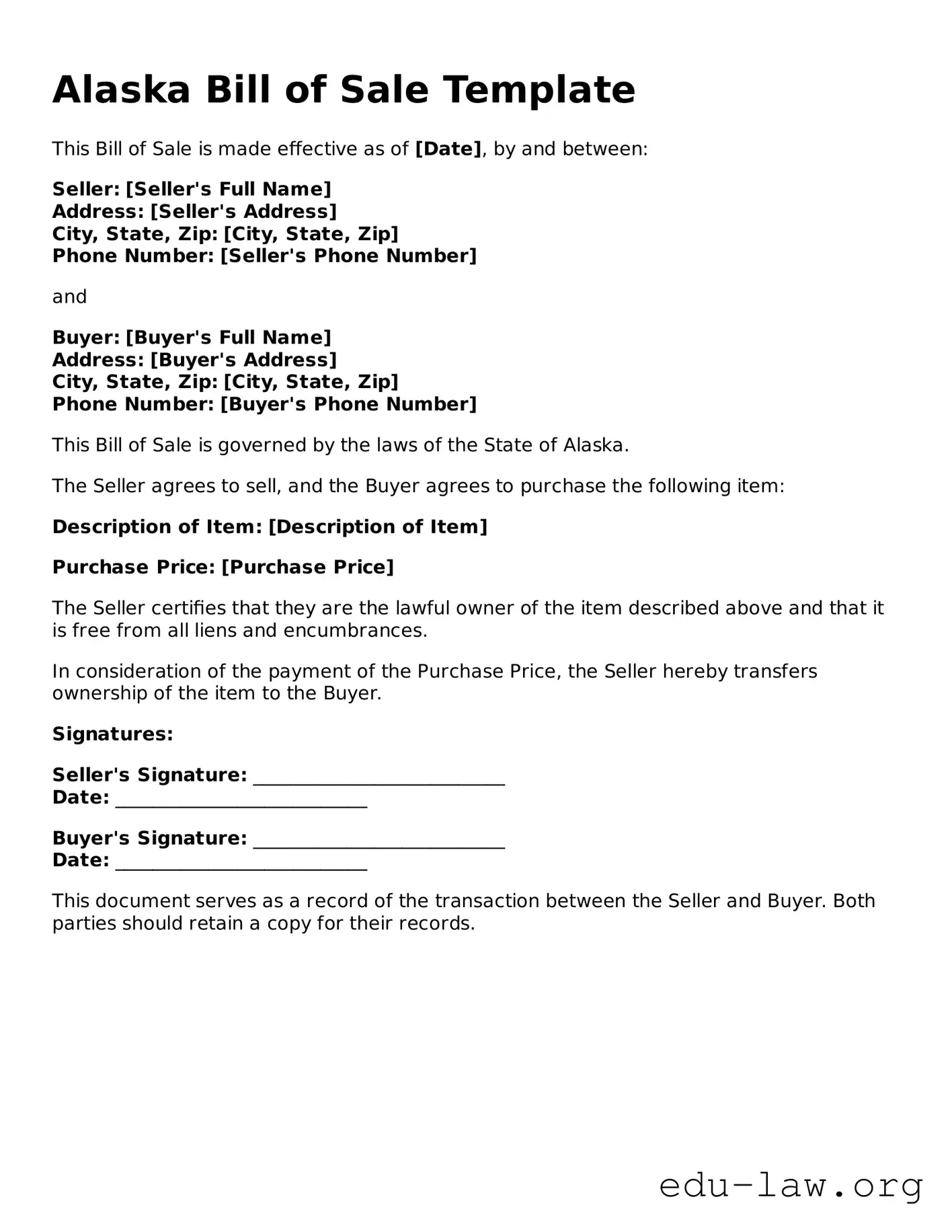
When buying or selling a vehicle, boat, or other personal property in Alaska, having the right documentation is crucial. The Alaska Bill of Sale form serves as an important record of the transaction, providing essential details that protect both the buyer and the seller. This form typically includes information such as the names and addresses of both parties, a description of the item being sold, and the sale price. Additionally, it may require signatures from both parties to confirm the agreement. Having a properly completed Bill of Sale can help prevent disputes and ensure a smooth transfer of ownership. Whether you're a seasoned seller or a first-time buyer, understanding the importance of this document can make your transaction easier and more secure.
Alaska Bill of Sale Template
This Bill of Sale is made effective as of [Date], by and between:
Seller: [Seller's Full Name]
Address: [Seller's Address]
City, State, Zip: [City, State, Zip]
Phone Number: [Seller's Phone Number]
and
Buyer: [Buyer's Full Name]
Address: [Buyer's Address]
City, State, Zip: [City, State, Zip]
Phone Number: [Buyer's Phone Number]
This Bill of Sale is governed by the laws of the State of Alaska.
The Seller agrees to sell, and the Buyer agrees to purchase the following item:
Description of Item: [Description of Item]
Purchase Price: [Purchase Price]
The Seller certifies that they are the lawful owner of the item described above and that it is free from all liens and encumbrances.
In consideration of the payment of the Purchase Price, the Seller hereby transfers ownership of the item to the Buyer.
Signatures:
Seller's Signature: ___________________________
Date: ___________________________
Buyer's Signature: ___________________________
Date: ___________________________
This document serves as a record of the transaction between the Seller and Buyer. Both parties should retain a copy for their records.
| Fact Name | Description |
|---|---|
| Definition | The Alaska Bill of Sale is a legal document used to transfer ownership of personal property from one party to another. |
| Governing Law | The transfer of ownership in Alaska is governed by Alaska Statutes, specifically Title 45, Chapter 29. |
| Types of Property | This form can be used for various types of personal property, including vehicles, boats, and equipment. |
| Notarization | While notarization is not required for all Bill of Sale forms in Alaska, it is recommended for added legal protection. |
| Importance of Accuracy | Accurate details about the buyer, seller, and property are crucial to avoid disputes later on. |
| Record Keeping | Both parties should keep a copy of the Bill of Sale for their records, as it serves as proof of the transaction. |
| Additional Considerations | In some cases, additional documentation may be required, such as a title transfer for vehicles. |
Once you have the Alaska Bill of Sale form in hand, you can proceed to fill it out with the necessary information. This document will require details about the buyer, seller, and the item being sold. Ensuring that all information is accurate will help facilitate a smooth transaction.
After completing the form, ensure that both parties retain a copy for their records. This will provide proof of the transaction and can be helpful for future reference.
What is an Alaska Bill of Sale?
An Alaska Bill of Sale is a legal document that records the transfer of ownership of personal property from one party to another. This form is often used for vehicles, boats, and other tangible items. It provides proof of the transaction and can be essential for registering the item with the state or for tax purposes.
Do I need a Bill of Sale in Alaska?
What information should be included in an Alaska Bill of Sale?
An effective Bill of Sale should include the following information: the names and addresses of both the buyer and seller, a detailed description of the item being sold (including make, model, year, and VIN for vehicles), the sale price, the date of the transaction, and any warranties or conditions of the sale. Signatures from both parties are also necessary to validate the document.
Is a Bill of Sale required for vehicle sales in Alaska?
Can I create my own Bill of Sale in Alaska?
Do I need a notary for an Alaska Bill of Sale?
How do I complete a Bill of Sale in Alaska?
Where can I obtain an Alaska Bill of Sale form?
What should I do after completing the Bill of Sale?
Failing to include complete information about the buyer and seller. Both parties should provide full names, addresses, and contact information.
Not accurately describing the item being sold. A detailed description, including make, model, year, and condition, is essential.
Leaving out the sale price. The form must clearly state the agreed-upon price for the transaction.
Neglecting to include the date of the transaction. This date is important for record-keeping and legal purposes.
Not obtaining signatures from both parties. The document is not valid without the signatures of both the buyer and seller.
Using incorrect or outdated forms. Always ensure you are using the most current version of the Alaska Bill of Sale form.
Overlooking the need for witnesses or notarization. Depending on the item and local regulations, additional verification may be required.
The Alaska Bill of Sale form is a crucial document for anyone looking to buy or sell personal property in Alaska. However, it is often accompanied by other forms and documents that help to clarify the transaction and protect the interests of both parties involved. Below are five common forms that may be used alongside the Bill of Sale.
Using these additional forms and documents along with the Alaska Bill of Sale can provide clarity and security in your transaction. Each document plays a specific role in ensuring that both the buyer and seller are protected and that the transfer of ownership is smooth and legally binding.
The Alaska Bill of Sale form shares similarities with the general Bill of Sale used in many states across the United States. This document serves the same fundamental purpose: to transfer ownership of personal property from one individual to another. Like the Alaska version, a general Bill of Sale typically includes details such as the names of the buyer and seller, a description of the item being sold, and the sale price. Both documents aim to provide legal proof of the transaction, protecting the interests of both parties involved.
Another document that resembles the Alaska Bill of Sale is the Vehicle Bill of Sale. This specific form is used when transferring ownership of a motor vehicle. It includes similar elements, such as the vehicle identification number (VIN), make, model, and year of the vehicle, alongside the buyer and seller's information. Just like the Alaska Bill of Sale, the Vehicle Bill of Sale serves to document the transfer and can be used for registration purposes with state authorities.
The Personal Property Bill of Sale is yet another document akin to the Alaska Bill of Sale. This form is used for the sale of tangible personal property, which can include items like furniture, electronics, or machinery. It shares key components with the Alaska version, such as the identification of the seller and buyer, a detailed description of the property, and the agreed-upon price. Both documents provide a legal record of the transaction, ensuring clarity and accountability for both parties.
In addition, the Boat Bill of Sale is similar to the Alaska Bill of Sale, particularly because Alaska has a rich tradition of boating and fishing. This document specifically addresses the sale of boats and includes details such as the boat's registration number, hull identification number, and any applicable equipment. Like the Alaska Bill of Sale, it serves to formalize the transfer of ownership and can be essential for registration and insurance purposes.
The Firearm Bill of Sale also mirrors the Alaska Bill of Sale in its function of transferring ownership of firearms. This document must comply with specific regulations and often includes details about the firearm, such as its make, model, and serial number. Both documents serve to protect the rights of the seller and buyer, while also ensuring compliance with applicable laws regarding the sale of firearms.
The Equipment Bill of Sale is another document that parallels the Alaska Bill of Sale, particularly in transactions involving heavy machinery or specialized equipment. This form includes descriptions of the equipment, such as serial numbers and condition, and outlines the terms of the sale. Both documents aim to provide a clear record of the transfer of ownership, which is crucial in industries reliant on equipment for operations.
The Livestock Bill of Sale is similar as well, especially in agricultural contexts. This document is used to transfer ownership of livestock, such as cattle or horses. It includes details about the animals being sold, such as breed, age, and any identifying marks. Much like the Alaska Bill of Sale, it serves to document the transaction and can be important for record-keeping in farming and ranching operations.
Finally, the Real Estate Bill of Sale, while primarily associated with real property, shares the same foundational purpose as the Alaska Bill of Sale. It documents the transfer of ownership, albeit for real estate instead of personal property. This document includes details about the property, such as its address and legal description, and outlines the terms of the sale. Both forms provide necessary legal documentation to ensure a clear transfer of ownership and protect the rights of both parties involved.
When filling out the Alaska Bill of Sale form, it's important to approach the task with care. Here are some essential dos and don'ts to keep in mind:
By following these guidelines, you can help ensure a smooth transaction and protect the interests of both the buyer and the seller.
The Alaska Bill of Sale form is often misunderstood. Here are five common misconceptions about it:
Many people believe the Bill of Sale is only necessary for vehicle transactions. In reality, it can be used for various items, including boats, trailers, and even personal property like furniture.
Some think that notarization is mandatory for the Bill of Sale to be valid. While notarization can add an extra layer of authenticity, it is not required in Alaska for the form to be legally binding.
Another misconception is that a Bill of Sale is only necessary for high-value items. Regardless of the price, having a Bill of Sale can help protect both the buyer and seller by documenting the transaction.
Some people confuse a Bill of Sale with a simple receipt. While both serve as proof of a transaction, a Bill of Sale includes more detailed information about the item, the parties involved, and the terms of the sale.
Many believe that a Bill of Sale holds no legal weight. However, when properly completed, it is a legally binding document that can be used in court to resolve disputes regarding the sale.
When filling out and using the Alaska Bill of Sale form, it’s essential to understand its purpose and the information it requires. Here are some key takeaways to keep in mind:
Understanding these points will help ensure a smooth transaction and protect both parties involved in the sale.