When starting a business in Alaska, one of the essential steps is to file the Articles of Incorporation. This form serves as a foundational document that officially establishes your corporation in the state. Key elements of the form include the corporation's name, which must be unique and comply with state naming requirements. Additionally, the form requires information about the registered agent, who will act as the corporation's official point of contact for legal documents. You will also need to specify the purpose of your corporation, whether it be for profit or non-profit activities. The number of shares the corporation is authorized to issue, as well as the names and addresses of the initial directors, must be clearly outlined. Completing the Articles of Incorporation accurately is crucial, as it not only affects your legal standing but also impacts your ability to operate effectively in Alaska. Understanding these components will help ensure that you navigate this important process smoothly and set your business on the path to success.
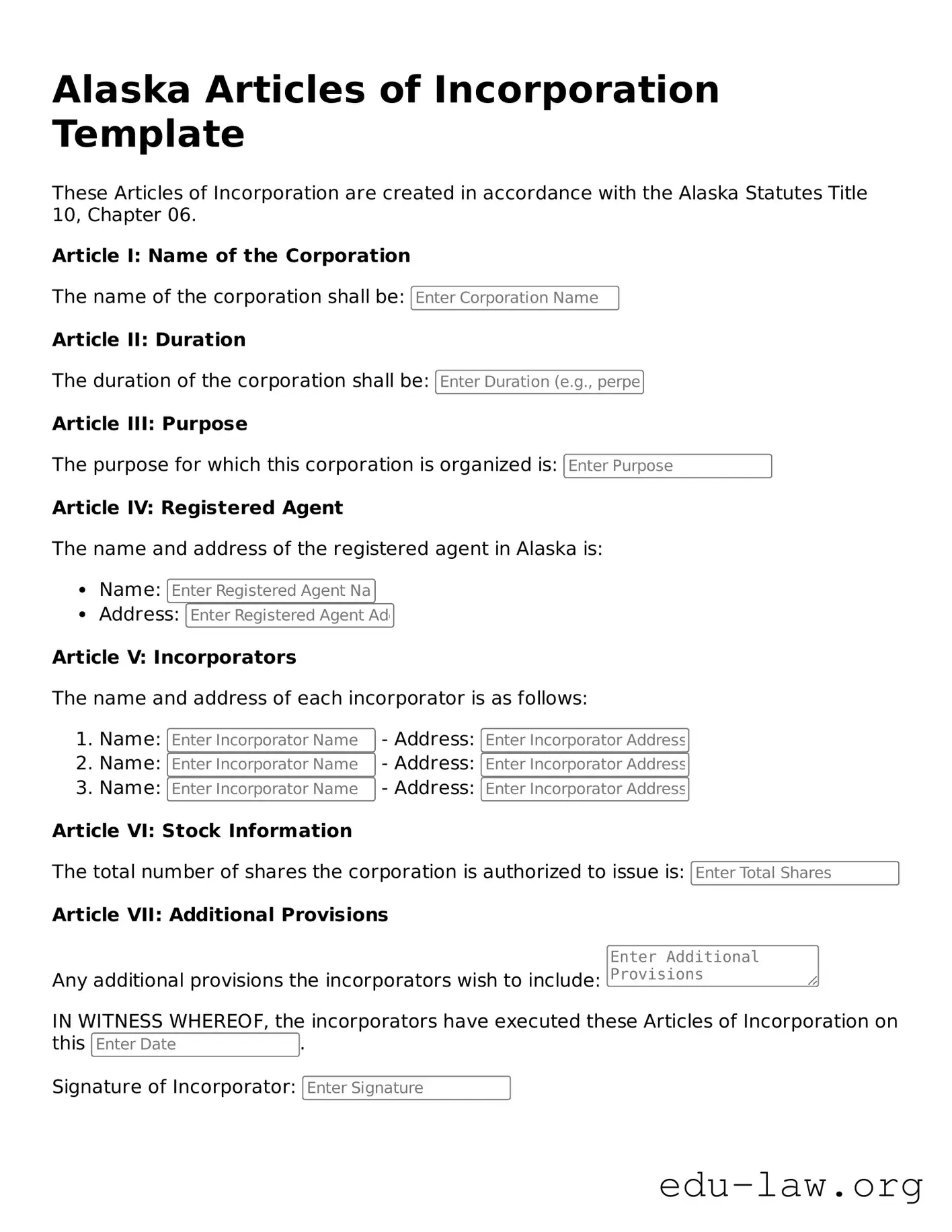
Alaska Articles of Incorporation Template
These Articles of Incorporation are created in accordance with the Alaska Statutes Title 10, Chapter 06.
Article I: Name of the Corporation
The name of the corporation shall be:
Article II: Duration
The duration of the corporation shall be:
Article III: Purpose
The purpose for which this corporation is organized is:
Article IV: Registered Agent
The name and address of the registered agent in Alaska is:
Article V: Incorporators
The name and address of each incorporator is as follows:
Article VI: Stock Information
The total number of shares the corporation is authorized to issue is:
Article VII: Additional Provisions
Any additional provisions the incorporators wish to include:
IN WITNESS WHEREOF, the incorporators have executed these Articles of Incorporation on this .
Signature of Incorporator:
| Fact Name | Details |
|---|---|
| Governing Law | Alaska Statutes Title 10, Chapter 20 |
| Purpose | The form is used to establish a corporation in Alaska. |
| Filing Fee | The standard filing fee is $250. |
| Required Information | Includes name, address, and purpose of the corporation. |
| Registered Agent | A registered agent must be designated to receive legal documents. |
| Incorporator | At least one incorporator is required to sign the form. |
| Annual Reports | Corporations must file annual reports to maintain good standing. |
| Processing Time | Typically takes 5-10 business days for processing. |
After completing the Alaska Articles of Incorporation form, it is essential to submit it to the appropriate state office along with any required fees. This will initiate the process of establishing your corporation in Alaska.
What are the Articles of Incorporation in Alaska?
The Articles of Incorporation are legal documents that establish a corporation in Alaska. They outline the basic details of the corporation, including its name, purpose, and the number of shares it is authorized to issue. Filing these articles is a crucial first step in forming a corporation in the state.
How do I file the Articles of Incorporation in Alaska?
To file the Articles of Incorporation in Alaska, you must complete the required form and submit it to the Division of Corporations, Business, and Professional Licensing. This can typically be done online, by mail, or in person. Ensure that all information is accurate and complete to avoid delays in processing.
What information is required on the Articles of Incorporation form?
The form generally requires the corporation's name, the purpose of the corporation, the address of its principal office, the names and addresses of the incorporators, and the number of shares the corporation is authorized to issue. It’s important to provide precise details to ensure compliance with state regulations.
Is there a fee to file the Articles of Incorporation?
Yes, there is a filing fee associated with the Articles of Incorporation in Alaska. The fee amount may vary based on the type of corporation you are forming. Be sure to check the latest fee schedule on the Division of Corporations' website to ensure you submit the correct amount.
How long does it take for the Articles of Incorporation to be processed?
The processing time can vary depending on the volume of submissions and the method of filing. Generally, online submissions may be processed more quickly than those submitted by mail. It’s advisable to allow a few weeks for processing, especially during peak filing seasons.
Can I amend the Articles of Incorporation after they are filed?
Yes, amendments to the Articles of Incorporation can be made after the initial filing. If changes are needed, such as altering the corporation's name or purpose, you will need to file an amendment form with the Division of Corporations. There may be an additional fee for this process.
Do I need a lawyer to file the Articles of Incorporation?
While it is not a legal requirement to have a lawyer file the Articles of Incorporation, it can be beneficial to consult one, especially if you have questions about the process or need assistance with complex issues. Many people successfully file without legal assistance, but having expert guidance can provide peace of mind.
What happens after my Articles of Incorporation are approved?
Once your Articles of Incorporation are approved, your corporation is officially recognized by the state. You will receive a certificate of incorporation, which serves as proof of your corporation's existence. Afterward, you should focus on meeting ongoing compliance requirements, such as obtaining necessary licenses and filing annual reports.
Can I use a name that is similar to another corporation's name?
In Alaska, your corporation's name must be unique and distinguishable from existing corporations. Before filing, it is wise to conduct a name search through the Division of Corporations' database to ensure that your desired name is available. This helps prevent potential legal issues down the road.
What is the purpose of having a registered agent for my corporation?
A registered agent is a person or business designated to receive legal documents on behalf of your corporation. Having a registered agent ensures that you can be reached for important notices and legal correspondence. This is a requirement in Alaska and helps maintain your corporation's good standing.
Incorrect Business Name: Failing to ensure that the chosen business name is unique can lead to rejection. It’s essential to check the availability of the name with the Alaska Division of Corporations.
Missing Registered Agent Information: Every corporation in Alaska must have a registered agent. Omitting this information can delay the incorporation process.
Improper Purpose Statement: The purpose of the corporation must be clearly stated. Vague or overly broad descriptions can cause confusion and may not meet state requirements.
Inaccurate Number of Shares: When specifying the number of shares, it’s important to be precise. Errors in this section can lead to complications in ownership and distribution.
Failure to Sign the Document: A common oversight is not signing the Articles of Incorporation. Without a signature, the form is considered incomplete and cannot be processed.
Incorrect Filing Fee: Each filing requires a specific fee. Submitting the wrong amount can result in delays or rejection of the application.
The Alaska Articles of Incorporation form is a key document for establishing a corporation in Alaska. However, several other forms and documents are often required or recommended to ensure compliance with state regulations and to facilitate the smooth operation of the corporation. Below is a list of commonly used documents.
These documents play a crucial role in the establishment and ongoing compliance of a corporation in Alaska. Proper management and filing of these forms can help ensure legal protection and operational efficiency for the business.
The Articles of Incorporation is often compared to the Certificate of Incorporation, which serves a similar purpose in many states. Both documents are essential for establishing a corporation and provide foundational information about the business, such as its name, purpose, and registered agent. While the terminology may vary, the underlying function remains the same: to legally recognize the existence of the corporation and outline its structure. The Certificate of Incorporation may also include details about the corporation's shares, which can be crucial for investors and stakeholders.
Another document that shares similarities with the Articles of Incorporation is the Bylaws. While the Articles outline the basic framework of the corporation, the Bylaws delve into the internal rules and procedures that govern the corporation's operations. Bylaws typically cover aspects such as the roles of officers and directors, meeting protocols, and voting procedures. Together, these documents ensure that the corporation operates smoothly and adheres to both legal requirements and its own established guidelines.
The Operating Agreement is akin to the Articles of Incorporation but is specifically designed for limited liability companies (LLCs). Like the Articles, the Operating Agreement outlines the structure of the business, including ownership percentages and management responsibilities. This document is crucial for LLCs as it defines how the company will be run and how profits and losses will be distributed among members. While the Articles focus on the formation of the entity, the Operating Agreement emphasizes the operational aspects.
The Partnership Agreement also bears resemblance to the Articles of Incorporation, particularly for businesses structured as partnerships. This document outlines the terms of the partnership, including the roles and responsibilities of each partner, profit-sharing arrangements, and procedures for resolving disputes. Just as the Articles establish the legal framework for a corporation, the Partnership Agreement provides the necessary guidelines for partners to work together effectively.
Lastly, the Statement of Information is another document that can be compared to the Articles of Incorporation. Required in many states, this document provides updated information about the corporation after its formation. It typically includes details such as the names and addresses of directors and officers, as well as the corporation's principal business address. While the Articles of Incorporation serve as the initial filing to create the corporation, the Statement of Information ensures that the state has current and accurate data about the business as it evolves.
When filling out the Alaska Articles of Incorporation form, it's important to ensure accuracy and completeness. Below is a list of things you should and shouldn't do to help streamline the process.
Following these guidelines will help you complete the Articles of Incorporation form accurately and efficiently.
Misconceptions about the Alaska Articles of Incorporation form can lead to confusion for those looking to establish a business. Here are six common misconceptions, along with clarifications.
When filling out and using the Alaska Articles of Incorporation form, keep these key points in mind:
Completing the form accurately is crucial. Mistakes can lead to delays or complications in the incorporation process. Take your time to review all information before submission.