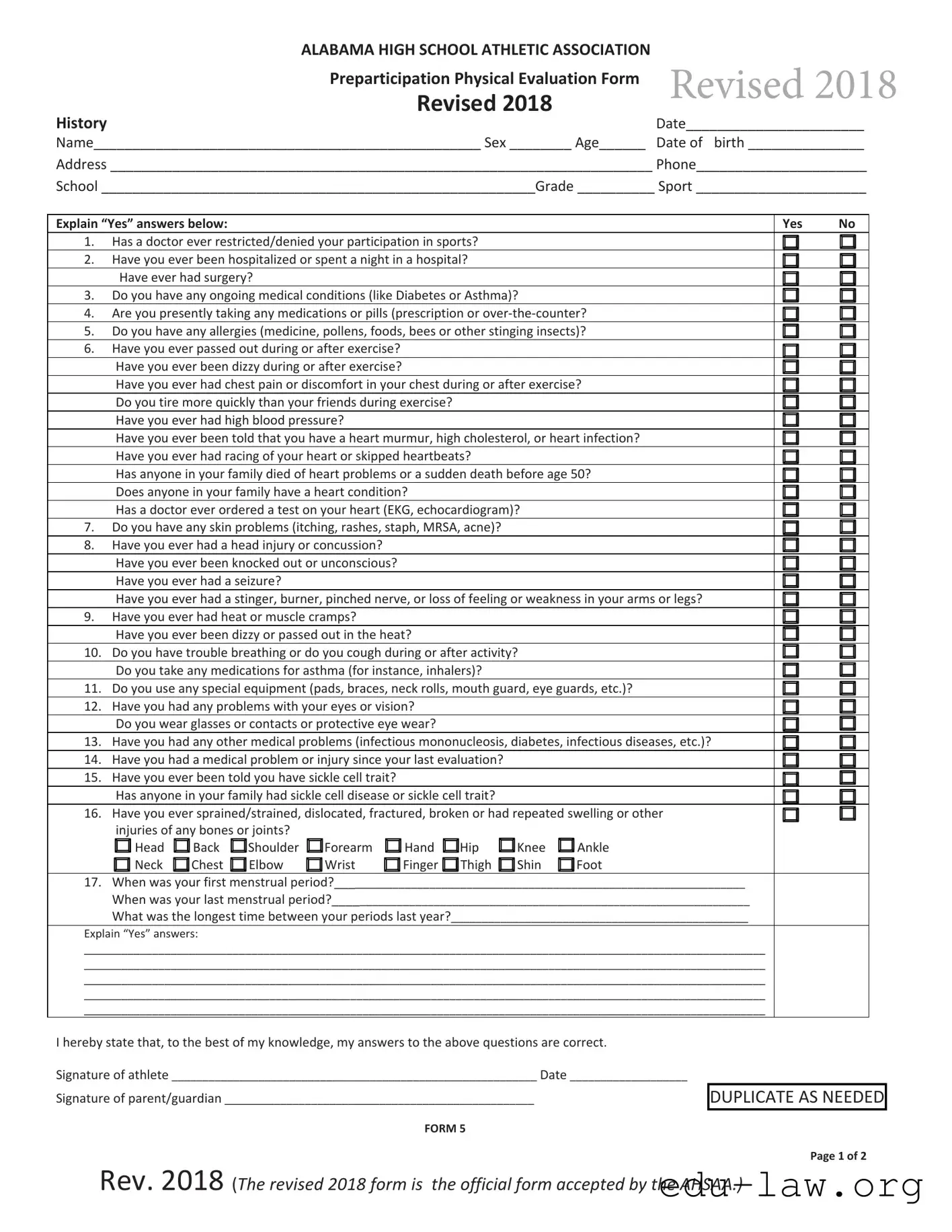
Participating in high school athletics is an exciting journey for many students in Alabama, but it comes with certain responsibilities, particularly regarding health and safety. Before stepping onto the field or court, athletes must complete the Alabama High School Physical form, a crucial document that ensures they are fit to compete. This form collects essential information about the athlete's medical history, including any past injuries, surgeries, or ongoing health issues. It also requires a thorough physical examination conducted by a licensed physician, who will assess the athlete's overall health and readiness for sports participation. Key components of the form include sections for personal details, a checklist of potential health concerns, and a physician's evaluation. Notably, the form emphasizes the importance of transparency; athletes and their guardians must provide accurate answers to health questions to ensure the safety of all participants. This preparticipation physical evaluation not only protects the individual athlete but also upholds the integrity of the sport, allowing everyone to enjoy a safe and competitive environment.

ALABAMA HIGH SCHOOL ATHLETIC ASSOCIATION |
Revised 2018 |
Revised 2018 |
|
Preparticipation Physical Evaluation Form |
|
History |
Date_______________________ |
Name__________________________________________________ Sex ________ Age______ Date of birth _______________
Address ______________________________________________________________________ Phone______________________
School ________________________________________________________Grade __________ Sport ______________________
Explain “Yes” answers below: |
|
|
|
|
|
Yes |
No |
||||
1. |
Has a doctor ever restricted/denied your participation in sports? |
|
|
|
|
|
|||||
2. |
Have you ever been hospitalized or spent a night in a hospital? |
|
|
|
|
|
|||||
|
Have ever had surgery? |
|
|
|
|
|
|
|
|
||
3. |
Do you have any ongoing medical conditions (like Diabetes or Asthma)? |
|
|
|
|
||||||
4. |
Are you presently taking any medications or pills (prescription or over‐the‐counter? |
|
|||||||||
5. |
Do you have any allergies (medicine, pollens, foods, bees or other stinging insects)? |
|
|||||||||
6. |
Have you ever passed out during or after exercise? |
|
|
|
|
|
|
|
|||
|
|
|
|
|
|
|
|||||
|
Have you ever been dizzy during or after exercise? |
|
|
|
|
|
|
|
|||
|
Have you ever had chest pain or discomfort in your chest during or after exercise? |
|
|||||||||
|
Do you tire more quickly than your friends during exercise? |
|
|
|
|
|
|
||||
|
Have you ever had high blood pressure? |
|
|
|
|
|
|
|
|||
|
Have you ever been told that you have a heart murmur, high cholesterol, or heart infection? |
|
|||||||||
|
Have you ever had racing of your heart or skipped heartbeats? |
|
|
|
|
|
|||||
|
Has anyone in your family died of heart problems or a sudden death before age 50? |
|
|||||||||
|
Does anyone in your family have a heart condition? |
|
|
|
|
|
|
||||
|
Has a doctor ever ordered a test on your heart (EKG, echocardiogram)? |
|
|
|
|
||||||
7. |
Do you have any skin problems (itching, rashes, staph, MRSA, acne)? |
|
|
|
|
|
|||||
8. |
Have you ever had a head injury or concussion? |
|
|
|
|
|
|
|
|||
|
Have you ever been knocked out or unconscious? |
|
|
|
|
|
|
|
|||
|
Have you ever had a seizure? |
|
|
|
|
|
|
|
|
||
|
Have you ever had a stinger, burner, pinched nerve, or loss of feeling or weakness in your arms or legs? |
|
|||||||||
9. |
Have you ever had heat or muscle cramps? |
|
|
|
|
|
|
|
|||
|
Have you ever been dizzy or passed out in the heat? |
|
|
|
|
|
|
||||
10. Do you have trouble breathing or do you cough during or after activity? |
|
|
|
|
|||||||
|
Do you take any medications for asthma (for instance, inhalers)? |
|
|
|
|
|
|||||
11. Do you use any special equipment (pads, braces, neck rolls, mouth guard, eye guards, etc.)? |
|
||||||||||
12. Have you had any problems with your eyes or vision? |
|
|
|
|
|
|
|||||
|
Do you wear glasses or contacts or protective eye wear? |
|
|
|
|
|
|
||||
13. Have you had any other medical problems (infectious mononucleosis, diabetes, infectious diseases, etc.)? |
|
||||||||||
14. Have you had a medical problem or injury since your last evaluation? |
|
|
|
|
|
||||||
15. Have you ever been told you have sickle cell trait? |
|
|
|
|
|
|
|
||||
|
Has anyone in your family had sickle cell disease or sickle cell trait? |
|
|
|
|
|
|||||
16. Have you ever sprained/strained, dislocated, fractured, broken or had repeated swelling or other |
|
||||||||||
|
injuries of any bones or joints? |
|
|
|
|
|
|
|
|
||
|
Head |
Back |
Shoulder |
Forearm |
Hand |
Hip |
Knee |
Ankle |
|
||
|
Neck |
Chest |
Elbow |
Wrist |
Finger |
Thigh |
Shin |
Foot |
|
||
17.When was your first menstrual period?__________________________________________________________________
When was your last menstrual period?___________________________________________________________________
What was the longest time between your periods last year?________________________________________________
Explain “Yes” answers:
______________________________________________________________________________________________________________
______________________________________________________________________________________________________________
______________________________________________________________________________________________________________
______________________________________________________________________________________________________________
______________________________________________________________________________________________________________
I hereby state that, to the best of my knowledge, my answers to the above questions are correct.
Signature of athlete ___________________________________________________________ Date ___________________
Signature of parent/guardian __________________________________________________
FORM 5
DUPLICATE AS NEEDED
Rev. 2018 (The revised 2018 form is the official form accepted by the AHSAA.)
Page 1 of 2

Preparticipation Physical Evaluation Rule 1, Sec. 14 — In order for a student to be eligible for interscholastic athletics, there must be
on file in the Superintendent’s or Principal’s office a current physician’s statement certifying that
__________________________________________ the student has passed a physical exam, and that in the opinion of the examining physician (M.D.
|
|
|
Student's name |
or D.O.) the student is fully able to participate in interscholastic athletics (Grade s 7‐12). The |
||||
|
|
|
AHSAA Physicians Certificate (Form 5 Rev. 2018) must be used. A physical exam will satisfy the |
|||||
|
|
|
|
|
||||
Physical Examination |
requirement for one calendar year through the end of the month from the date of the exam. For |
|||||||
example, a physical given on May 5, 2019, will satisfy the requirement through May 31, 2020. |
||||||||
|
|
|
|
|
|
|
||
|
|
|
Height ____________ Weight _____________ BP _____ / _____ Pulse ____________ |
|
||||
|
|
|
Vision R 20 / ____ L 20 / ____ Corrected: Y N |
Revised 2018 |
|
|||
|
|
|
|
|
||||
|
|
|
|
|
|
|
|
|
|
|
LIMITED |
|
Normal |
|
|
Abnormal Findings |
|
|
|
|
|
|
|
|
|
|
|
|
Cardiovascular |
|
|
|
|
|
|
|
|
|
|
|
|
|
|
|
|
|
|
|
|
|
|
|
|
|
|
|
Pulses |
|
|
|
|
|
|
|
|
|
|
|
|
|
|
|
|
|
Heart |
|
|
|
|
|
|
|
|
|
|
|
|
|
|
|
|
|
Lungs |
|
|
|
|
|
|
|
|
|
|
|
|
|
|
|
|
|
Skin |
|
|
|
|
|
|
|
|
|
|
|
|
|
|
|
|
|
E.N.T. |
|
|
|
|
|
|
|
|
|
|
|
|
|
|
|
COMPLETE |
|
Abdominal |
|
|
|
|
|
|
|
|
|
|
|
|
|
|
|
|
Genitalia (males) |
|
|
|
|
||
|
|
|
|
|
|
|
||
|
|
|
|
|
|
|
|
|
|
|
|
Musculoskeletal |
|
|
|
|
|
|
|
|
|
|
|
|
|
|
|
|
|
Neck |
|
|
|
|
|
|
|
|
|
|
|
|
|
|
|
|
|
Shoulder |
|
|
|
|
|
|
|
|
|
|
|
|
|
|
|
|
|
Elbow |
|
|
|
|
|
|
|
|
|
|
|
|
|
|
|
|
|
Wrist |
|
|
|
|
|
|
|
|
|
|
|
|
|
|
|
|
|
Hand |
|
|
|
|
|
|
|
|
|
|
|
|
|
|
|
|
|
Back |
|
|
|
|
|
|
|
|
|
|
|
|
|
|
|
|
|
Knee |
|
|
|
|
|
|
|
|
|
|
|
|
|
|
|
|
|
Ankle |
|
|
|
|
|
|
|
|
|
|
|
|
|
|
|
|
|
Foot |
|
|
|
|
|
|
|
|
|
|
|
|
|
|
|
|
|
Other |
|
|
|
|
|
|
|
|
|
|
|
|
|
|
Clearance:
A.Cleared
B.Cleared after completing evaluation/rehabilitation for: _______________________________________
C. Not cleared for: |
Collision |
|
|
|
Contact |
|
|
|
Noncontact ____ Strenuous |
____ Moderately strenuous |
____ Nonstrenuous |
Due to: ____________________________________________________________________________________________
Recommendation: _________________________________________________________________________________________
________________________________________________________________________________________________________
________________________________________________________________________________________________________
Name of physician ________________________________________________________________ Date ____________________
Address ________________________________________________________________________ Phone___________________
.
Signature of physician _____________________________________________________________, M.D. or D.O.
(Form must be signed and dated by the attending physician.)
Rev. 2018 (The revised 2018 form is the official form accepted by the AHSAA.)
| Fact Name | Details |
|---|---|
| Governing Law | The Alabama High School Athletic Association (AHSAA) Rule 1, Sec. 14 requires a current physician's statement for student-athletes. |
| Eligibility Requirement | Students in grades 7-12 must have a physical exam on file to be eligible for interscholastic athletics. |
| Validity of Exam | A physical exam is valid for one calendar year from the date it was conducted. |
| Form Usage | The AHSAA Physicians Certificate (Form 5) is the required document for certifying a student's ability to participate in sports. |
Filling out the Alabama High School Physical form is an important step in ensuring that student-athletes are cleared for participation in sports. This form collects essential health information and requires signatures from both the athlete and a parent or guardian. Follow the steps below to complete the form accurately.
What is the Alabama High School Physical form?
The Alabama High School Physical form is a document required for students in grades 7-12 who wish to participate in interscholastic athletics. It includes a preparticipation physical evaluation and a history of the student’s medical background. The form must be completed by a licensed physician (M.D. or D.O.) and submitted to the school’s Superintendent or Principal.
Who needs to complete the physical form?
All students in grades 7-12 who want to participate in school sports must complete the physical form. This requirement ensures that students are medically fit to engage in athletic activities and helps to identify any potential health issues that may need to be addressed before participation.
How often do students need to submit the physical form?
Students must submit a new physical form each year. The physical examination is valid for one calendar year from the date of the exam. Therefore, a new evaluation is required annually to ensure ongoing eligibility for sports participation.
What information is required on the physical form?
The physical form requires personal information such as the student's name, age, address, school, and grade. Additionally, it includes a medical history section where students must disclose any past injuries, medical conditions, or ongoing health issues. The physician will also complete a physical examination section, indicating whether the student is cleared for participation.
What happens if a student is not cleared for participation?
If a student is not cleared for participation, the physician will provide specific recommendations and may require further evaluation or rehabilitation. The form will indicate the reasons for not being cleared and any restrictions on the type of activities the student can engage in.
Can a student participate in sports without a completed physical form?
No, a student cannot participate in sports without a completed and submitted physical form. This requirement is in place to ensure the safety and well-being of all student-athletes. Schools must have a current physician's statement on file to confirm that the student is fit to participate in athletics.
Where should the completed physical form be submitted?
The completed physical form should be submitted to the school’s Superintendent or Principal. It is important to ensure that the form is filed correctly and kept up-to-date to maintain eligibility for athletic participation.
Inaccurate Personal Information: Filling out the name, age, or address incorrectly can lead to confusion. Always double-check these details to ensure they match your identification documents.
Missing Medical History: Failing to disclose past injuries or medical conditions can jeopardize your eligibility. Be thorough when answering questions about previous surgeries, allergies, or chronic conditions.
Ignoring Signature Requirements: Both the athlete and a parent or guardian must sign the form. Neglecting this step can result in the form being rejected.
Not Updating Information: If there have been any changes in health status since the last physical, it’s crucial to update the form. This includes new medications or recent injuries.
Submitting Without a Doctor's Approval: Ensure that the physician has completed their section and provided their signature. A form without this certification is not valid for participation.
When preparing for participation in high school athletics in Alabama, several forms and documents accompany the Alabama High School Physical form. Each of these documents plays a crucial role in ensuring the safety and eligibility of student-athletes. Below is a list of commonly required forms.
Having all necessary forms completed and submitted is essential for student-athletes. This ensures they are fully prepared to engage in their chosen sports safely and in compliance with school policies. Always check with your school for any additional requirements or specific procedures that may apply.
The Preparticipation Physical Evaluation (PPE) form is similar to the NCAA Student-Athlete Pre-Participation Evaluation form. Both documents aim to ensure that student-athletes are physically fit to participate in sports. The NCAA form collects medical history and requires a physical examination by a licensed physician. Like the Alabama form, it includes questions about past injuries and medical conditions that could affect athletic performance.
The AHA (American Heart Association) Health History Questionnaire is another document that shares similarities with the Alabama High School Physical form. This questionnaire focuses on cardiovascular health and asks about family history, previous heart conditions, and symptoms during exercise. Both forms emphasize the importance of understanding the athlete's medical background to prevent health risks during physical activities.
The UIL (University Interscholastic League) Pre-Participation Physical Evaluation form serves Texas student-athletes and is comparable to the Alabama form. It also requires a thorough medical history and a physical examination. Both documents aim to identify any health issues that may hinder participation in sports, ensuring the safety of student-athletes.
The NFHS (National Federation of State High School Associations) Sports Physical form is another related document. It collects similar information regarding medical history and physical examination results. Both forms require a physician’s signature to confirm that the athlete is cleared for participation, reinforcing the importance of professional medical oversight in high school athletics.
The AAP (American Academy of Pediatrics) Sports Participation Physical Evaluation form is akin to the Alabama High School Physical form. It includes sections for medical history, physical examination findings, and clearance recommendations. Both documents prioritize the health and safety of young athletes, ensuring they are fit to engage in sports activities.
The OSHA (Occupational Safety and Health Administration) Medical History Questionnaire shares some elements with the Alabama form, particularly in assessing health risks. While OSHA focuses on workplace safety, both documents require detailed medical histories to identify potential health issues that could arise during physical activities, whether in sports or occupational settings.
The Canadian Sport Institute's Physical Activity Readiness Questionnaire (PAR-Q) is another similar document. It assesses an individual's readiness for physical activity by asking about existing health conditions and previous injuries. Like the Alabama form, it aims to protect participants from potential health risks associated with exercise.
The State Department of Health’s School Sports Physical Form also mirrors the Alabama High School Physical form. It collects medical history and requires a physician's assessment. Both forms are designed to ensure that students are physically capable of participating in school sports, emphasizing the necessity of medical clearance.
Finally, the Youth Sports Physical form used by various local sports leagues aligns closely with the Alabama form. It gathers similar information about the athlete's medical history and requires a physical examination. Both forms serve the same purpose of safeguarding the health of young athletes before they engage in sports activities.
When filling out the Alabama High School Physical form, it is important to follow certain guidelines to ensure accuracy and compliance. Here are six things you should and shouldn't do:
Misconception 1: The physical form is only necessary for contact sports.
In reality, all students participating in interscholastic athletics, regardless of the type of sport, must complete the physical form. This ensures that every athlete is medically cleared to participate safely.
Misconception 2: A physical exam is valid indefinitely.
The physical exam is only valid for one calendar year from the date of the exam. Athletes must renew their physicals annually to remain eligible.
Misconception 3: Parents do not need to sign the form.
Parental or guardian signatures are required on the physical form. This ensures that parents are informed about their child's health status and participation in sports.
Misconception 4: Any doctor can fill out the physical form.
The physical must be completed by a licensed physician (M.D. or D.O.). This requirement ensures that the evaluation is conducted by a qualified medical professional.
Misconception 5: The form only asks about current health issues.
The form also inquires about past medical history, including previous injuries and surgeries. This comprehensive approach helps identify any potential risks for the athlete.
Misconception 6: Athletes can participate without a completed form.
Students cannot participate in any athletic activities until the physical form is completed and submitted. This policy is in place to protect the health and safety of all athletes.
Misconception 7: The physical form is optional for high school athletes.
The physical form is mandatory for all high school athletes. Without it, students will not be allowed to compete in sports.
Misconception 8: The physical exam is the same for all athletes.
The physical exam can vary based on the athlete's age, sport, and medical history. Each evaluation is tailored to ensure the athlete's safety and well-being.
Misconception 9: Completing the form is a one-time process.
Completing the form is an ongoing responsibility. Athletes must update their information and submit new forms as required, especially if there are changes in their health status.
When filling out and using the Alabama High School Physical form, there are several important points to keep in mind. This form is essential for ensuring that student-athletes are medically cleared to participate in sports.
By following these guidelines, student-athletes can ensure that they are properly prepared to participate in sports while prioritizing their health and safety.