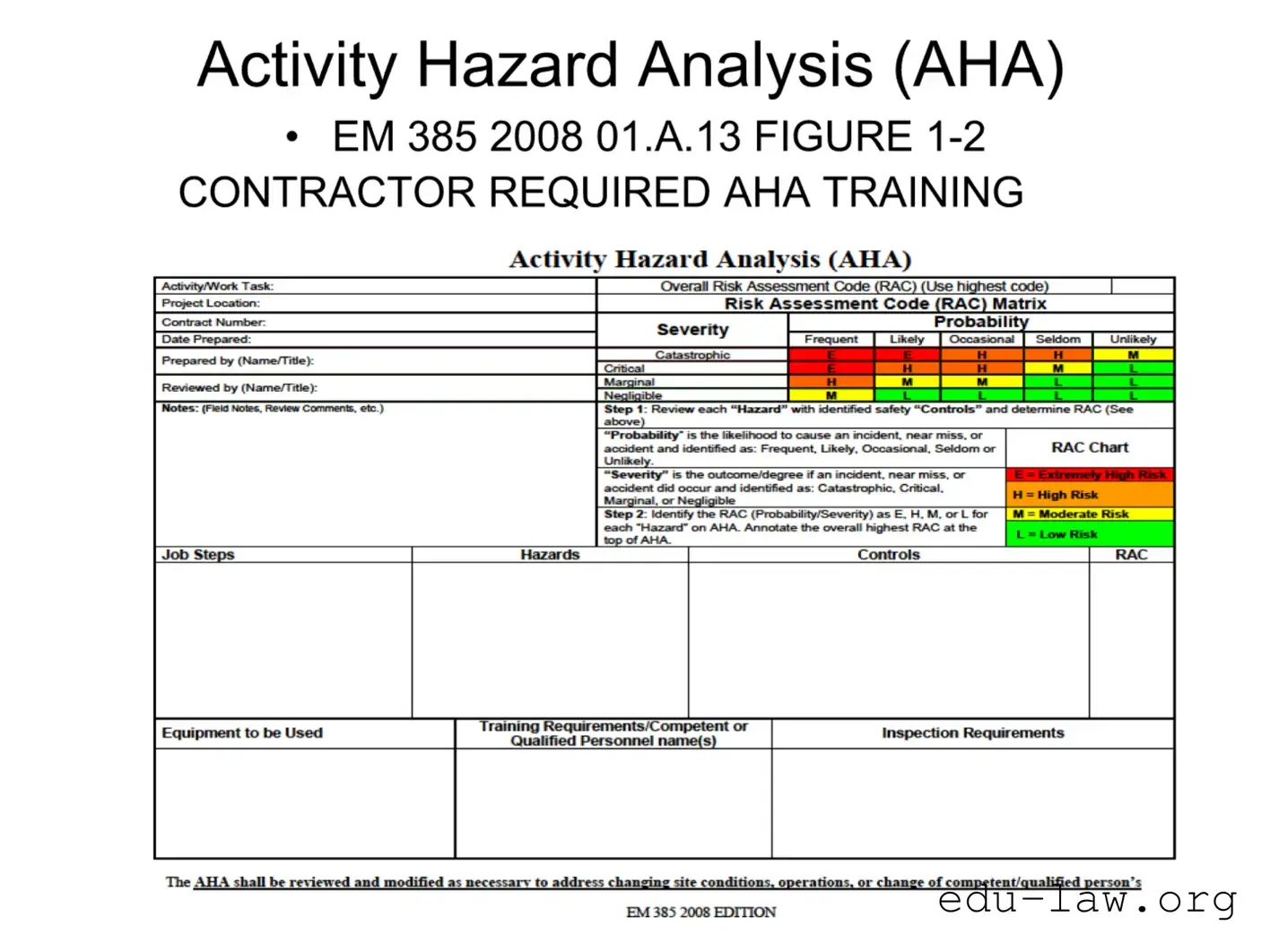
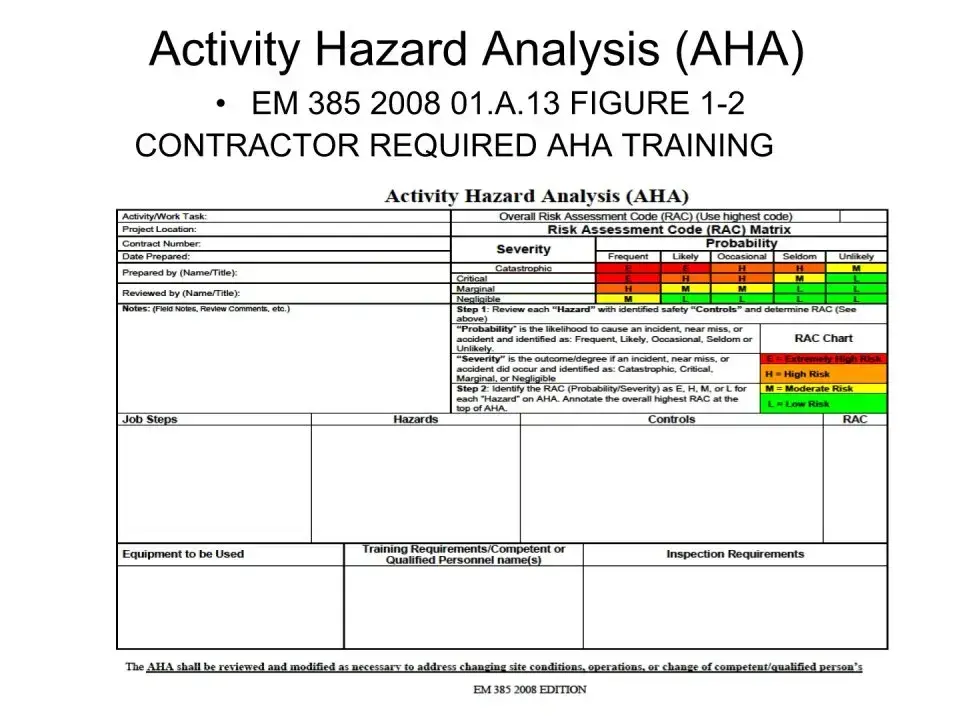
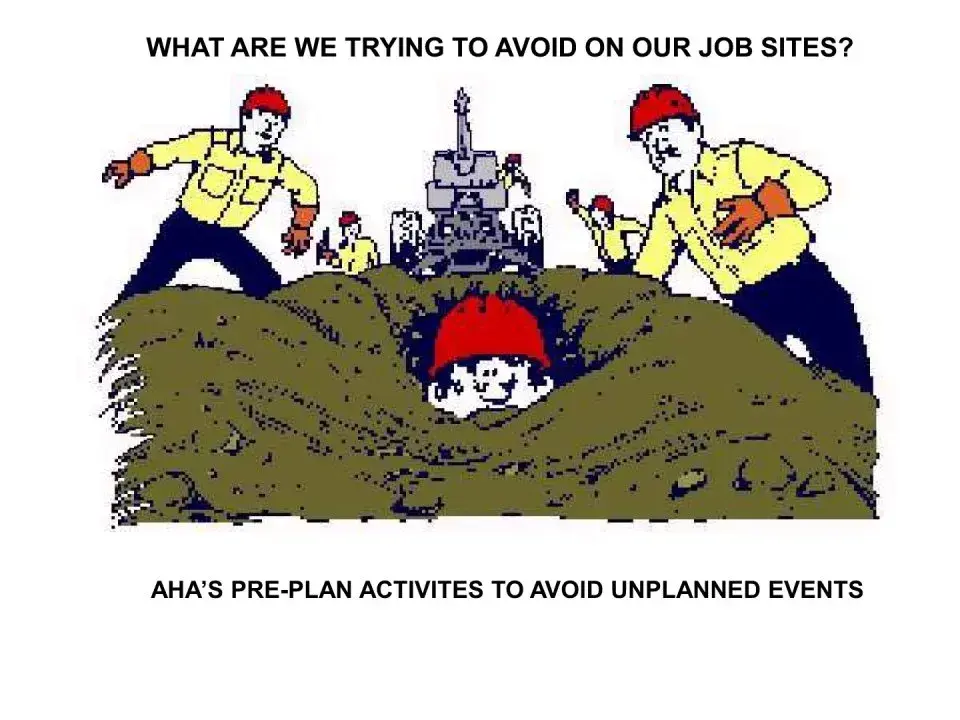
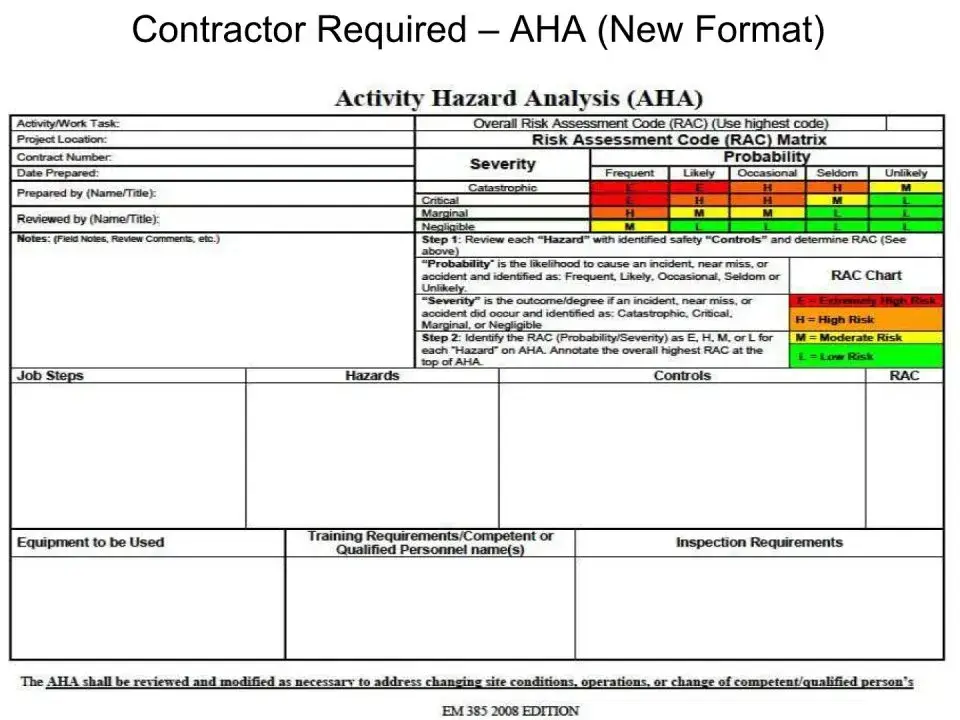
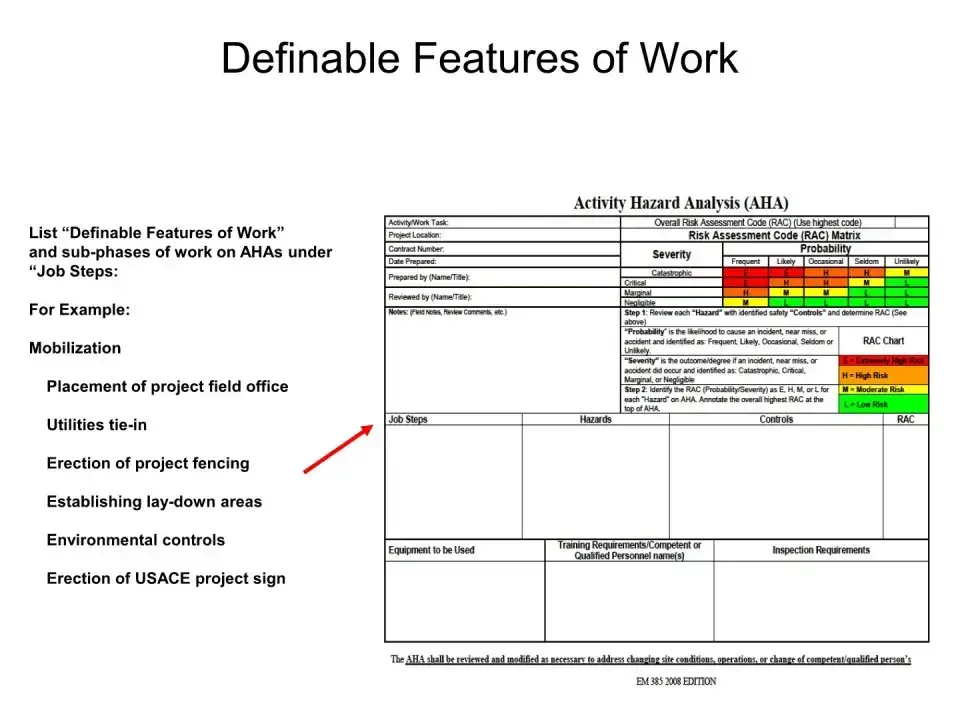
The AHA EM 385 form plays a critical role in ensuring workplace safety on construction sites and other high-risk environments. This form is designed to conduct an Activity Hazard Analysis (AHA), which helps identify potential hazards associated with specific work tasks. By assessing risks through a structured process, the AHA establishes necessary controls to mitigate those risks to an acceptable level. The form includes key elements such as the Risk Assessment Code (RAC), which evaluates both the probability and severity of incidents, guiding teams in their safety planning. It also outlines required training for personnel, inspection protocols, and necessary equipment for each task. Importantly, the AHA is not a static document; it must be regularly reviewed and updated to reflect any changes in site conditions or personnel. Before any work begins, the AHA must be accepted by the Government Designated Authority and communicated to all involved parties, ensuring everyone is on the same page regarding safety measures. This proactive approach aims to prevent unplanned events and maintain a safe working environment.
| Fact Name | Details |
|---|---|
| Purpose | The AHA EM 385 form is used to identify hazards and establish controls for safe work practices. |
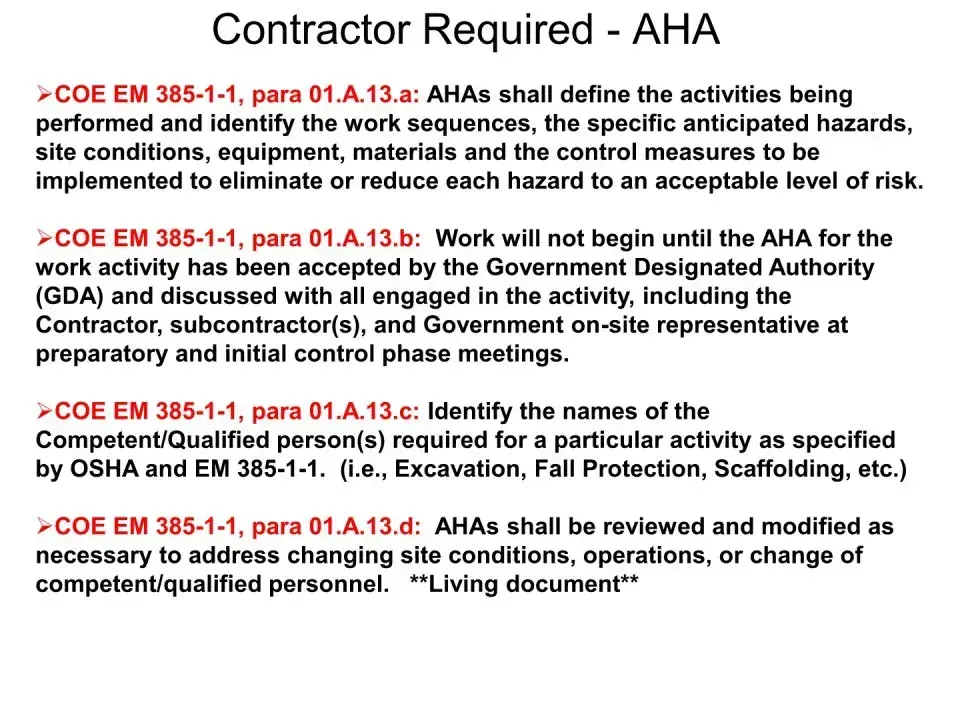
| Governing Law | It is governed by the U.S. Army Corps of Engineers (COE) EM 385-1-1 safety regulations. |
| Risk Assessment Code (RAC) | The form uses a Risk Assessment Code to evaluate hazards based on their severity and probability. |
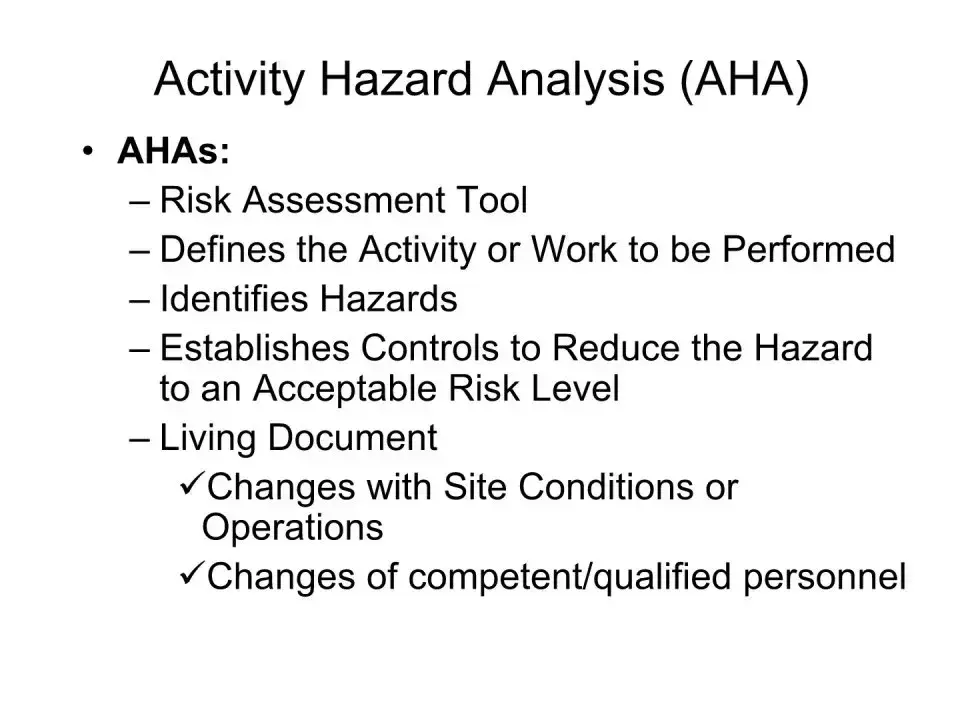
| Living Document | The AHA is a living document that must be updated to reflect changes in site conditions or personnel. |
| Training Requirements | It specifies the training requirements for competent or qualified personnel involved in the activity. |
| Review Process | The AHA must be reviewed and accepted by the Government Designated Authority before work begins. |
| Job Steps | Each AHA outlines specific job steps, associated hazards, and controls to mitigate risks. |
| Control Measures | Control measures are established to reduce hazards to an acceptable risk level. |
| Documentation | It serves as a record of the hazards identified and the safety measures implemented. |
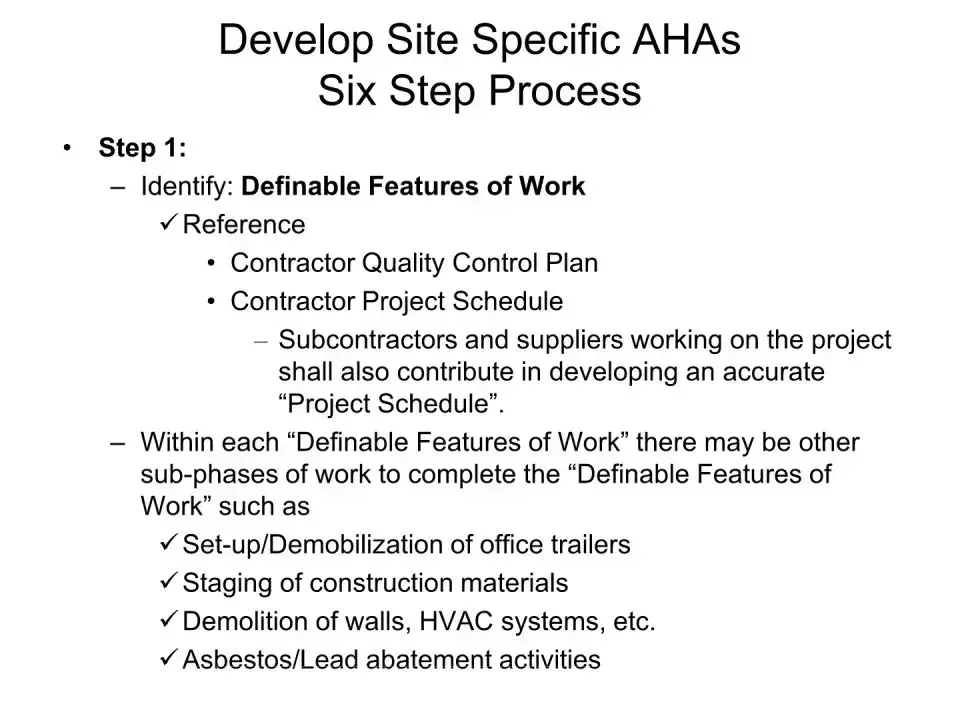
Filling out the AHA EM 385 form is a systematic process that helps ensure safety and compliance on job sites. Follow these steps carefully to complete the form accurately.
What is the purpose of the AHA EM 385 form?
The AHA EM 385 form is designed to identify hazards associated with specific work tasks and outline the controls necessary to mitigate those risks. It serves as a risk assessment tool that helps ensure safety on job sites by detailing the activities to be performed, anticipated hazards, site conditions, and required safety measures. This form is crucial for preventing unplanned events and ensuring that all personnel understand their responsibilities regarding safety.
Who is required to complete the AHA EM 385 form?
How often should the AHA EM 385 form be reviewed?
The AHA EM 385 form is considered a living document. It should be reviewed and updated regularly to reflect any changes in site conditions, operations, or personnel. If new hazards are identified or if there is a change in the work being performed, the AHA must be modified accordingly. Regular reviews help maintain safety standards and ensure that all workers are protected throughout the duration of the project.
What information is included in the AHA EM 385 form?
The AHA EM 385 form includes several key components: a description of the activity or work task, an overall Risk Assessment Code (RAC), identified hazards, control measures, equipment to be used, training requirements, and inspection needs. It also specifies the names of competent or qualified personnel required for the tasks. This comprehensive information helps ensure that all safety measures are in place before work commences.
What happens if the AHA EM 385 form is not completed properly?
If the AHA EM 385 form is not completed correctly, work may be halted until the necessary corrections are made. The GDA will not allow work to begin without an accepted AHA, which can lead to project delays and potential safety risks. It is essential for contractors and subcontractors to ensure the form is accurately filled out and reviewed to avoid these consequences and maintain compliance with safety regulations.
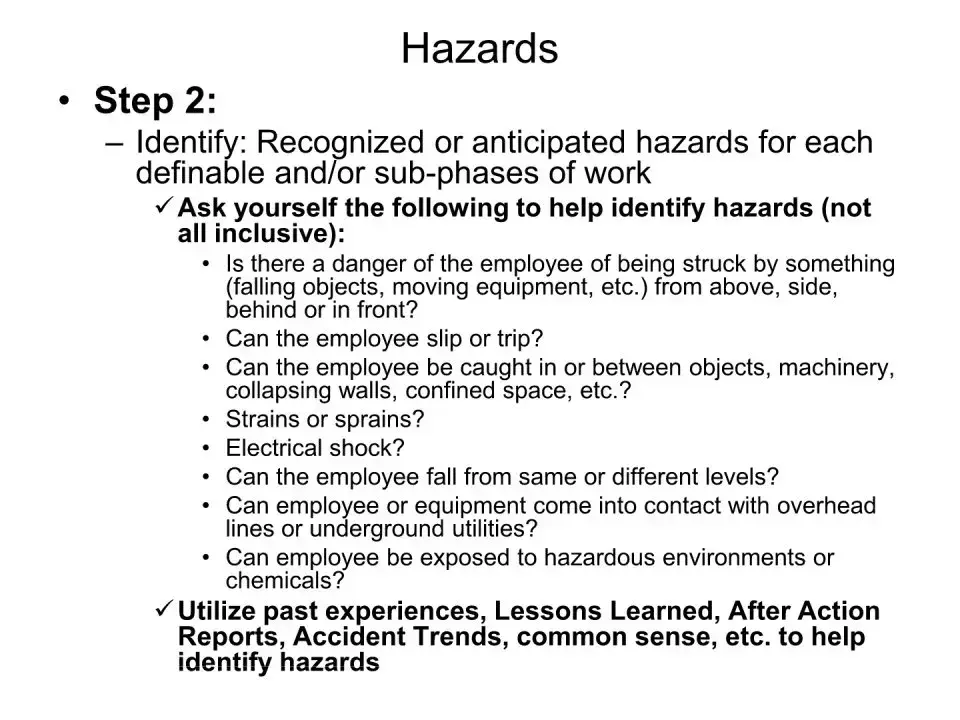
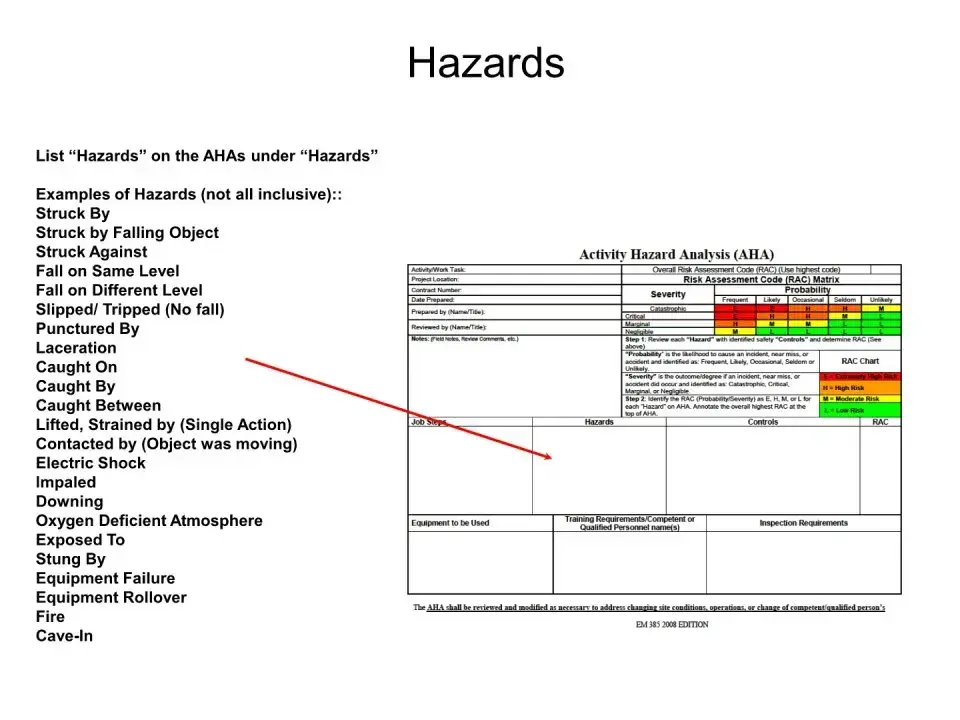
Inadequate Hazard Identification: Failing to thoroughly review each hazard associated with the activity can lead to missing critical risks. Each hazard should be clearly identified and linked to appropriate controls.
Incorrect Risk Assessment Code (RAC): Using an incorrect RAC can compromise safety. It is essential to accurately assess both the probability and severity of each hazard, ensuring the highest RAC is recorded at the top of the AHA.
Neglecting Training Requirements: Omitting the names of competent or qualified personnel can result in unqualified individuals performing tasks. Ensure that all training requirements are clearly stated and that the responsible personnel are identified.
Failure to Update the AHA: Not revising the AHA in response to changing site conditions or operations can lead to outdated safety measures. The AHA is a living document and should be regularly reviewed and modified as necessary.
The AHA EM 385 form is an essential document used to assess and manage risks associated with specific work tasks. Alongside this form, several other documents are commonly utilized to ensure comprehensive safety and compliance on job sites. Below is a list of these documents, each serving a unique purpose in the overall safety framework.
Utilizing these documents in conjunction with the AHA EM 385 form promotes a safer work environment. Each document plays a vital role in identifying hazards, implementing controls, and ensuring that all personnel are prepared for potential risks. By prioritizing safety and compliance, organizations can protect their workers and maintain a productive workplace.
The Activity Hazard Analysis (AHA) form is similar to the Job Safety Analysis (JSA) document. Both documents aim to identify hazards associated with specific tasks and outline the necessary controls to mitigate those risks. The JSA typically focuses on the steps involved in a job, detailing the potential hazards and the required safety measures. Like the AHA, the JSA is intended to be a living document, meaning it should be updated as conditions change or new hazards are identified. This ensures that safety remains a priority throughout the duration of a project.
Another document that shares similarities with the AHA is the Risk Assessment Matrix. This tool helps evaluate the likelihood and severity of potential hazards, similar to the Risk Assessment Code (RAC) used in the AHA. Both documents categorize risks to help teams understand which hazards require immediate attention. The Risk Assessment Matrix provides a visual representation of risk levels, making it easier for teams to prioritize safety measures. Like the AHA, it serves as a guide to ensure safety protocols are in place before work begins.
The Safety Data Sheet (SDS) is also comparable to the AHA form. While the AHA focuses on specific tasks and activities, the SDS provides detailed information about hazardous materials used on-site. Both documents aim to promote safety by informing workers of potential hazards and necessary precautions. The SDS includes information on handling, storage, and emergency measures, which complements the controls identified in the AHA. Together, they create a comprehensive safety framework for managing risks effectively.
Similarly, the Pre-Task Plan (PTP) serves a purpose akin to that of the AHA. The PTP outlines the specific tasks to be performed, identifies hazards, and details the safety measures to be implemented. Like the AHA, it requires team members to discuss and agree on the plan before work begins. This collaborative approach fosters a culture of safety, ensuring everyone is aware of the risks and the controls in place. Both documents are essential for planning and executing work safely.
The Incident Report form also shares some similarities with the AHA. While the AHA is proactive, focusing on preventing accidents, the Incident Report is reactive, documenting what went wrong after an incident occurs. Both forms emphasize the importance of identifying hazards and implementing controls. Analyzing incidents helps organizations improve their AHA processes, ensuring that future risks are mitigated more effectively. Thus, both documents contribute to a continuous improvement cycle in workplace safety.
The Toolbox Talk is another document that resembles the AHA. Toolbox Talks are informal safety meetings that focus on specific hazards related to upcoming tasks. Like the AHA, these talks are designed to raise awareness about potential risks and the necessary precautions. They encourage open communication among team members and provide an opportunity to discuss the AHA findings in a more interactive setting. Both tools aim to reinforce safety culture and ensure everyone is on the same page regarding safety expectations.
The Method Statement is also similar to the AHA in that it outlines how specific tasks will be carried out safely. It provides detailed instructions on the methods and equipment to be used, along with the associated risks and controls. While the AHA focuses on hazard identification, the Method Statement emphasizes the execution of work in a safe manner. Both documents are vital for ensuring that safety measures are not only planned but also effectively implemented during the work process.
Finally, the Safety Management Plan (SMP) can be compared to the AHA. The SMP is a broader document that outlines the overall safety strategy for a project, including risk assessments, safety training, and emergency procedures. The AHA fits within this larger framework, focusing on specific activities and the associated risks. Both documents work together to create a comprehensive approach to safety, ensuring that all aspects of risk management are covered and that workers are protected throughout the project.
When filling out the AHA EM 385 form, it is essential to follow certain guidelines to ensure accuracy and compliance. Here are seven things you should and shouldn't do:
Misconceptions about the AHA EM 385 form can lead to confusion and mismanagement of safety protocols. Here are ten common misunderstandings along with clarifications:
Understanding these misconceptions can help ensure that safety protocols are followed correctly, fostering a safer work environment for all involved.
When filling out and using the AHA EM 385 form, it is crucial to keep several key points in mind:
By adhering to these guidelines, you can help ensure a safer work environment and compliance with necessary regulations.