The Agreement Nonparent Relative Caregiver form is a crucial legal document designed to facilitate the temporary care of a child by a relative or a voluntary caregiver when the parent is unable to provide direct supervision. This form aligns with the Texas Family Code and outlines the responsibilities and authority granted to the caregiver. Parents must provide essential information about themselves and the child, including names, addresses, and contact details. They also specify the relationship between the child and the caregiver, which can include grandparents, aunts, uncles, or adult siblings. The form empowers the caregiver to make significant decisions on behalf of the child, such as authorizing medical treatments, enrolling the child in educational programs, and managing participation in extracurricular activities. Importantly, it also emphasizes the need for both parties to communicate any changes in contact information promptly. Furthermore, the form includes critical warnings and disclosures that highlight the legal implications of the agreement, ensuring that both the parent and caregiver understand their rights and responsibilities. It is essential for parents to recognize that this agreement does not transfer legal custody but rather grants temporary authority for specific decisions regarding the child’s welfare.
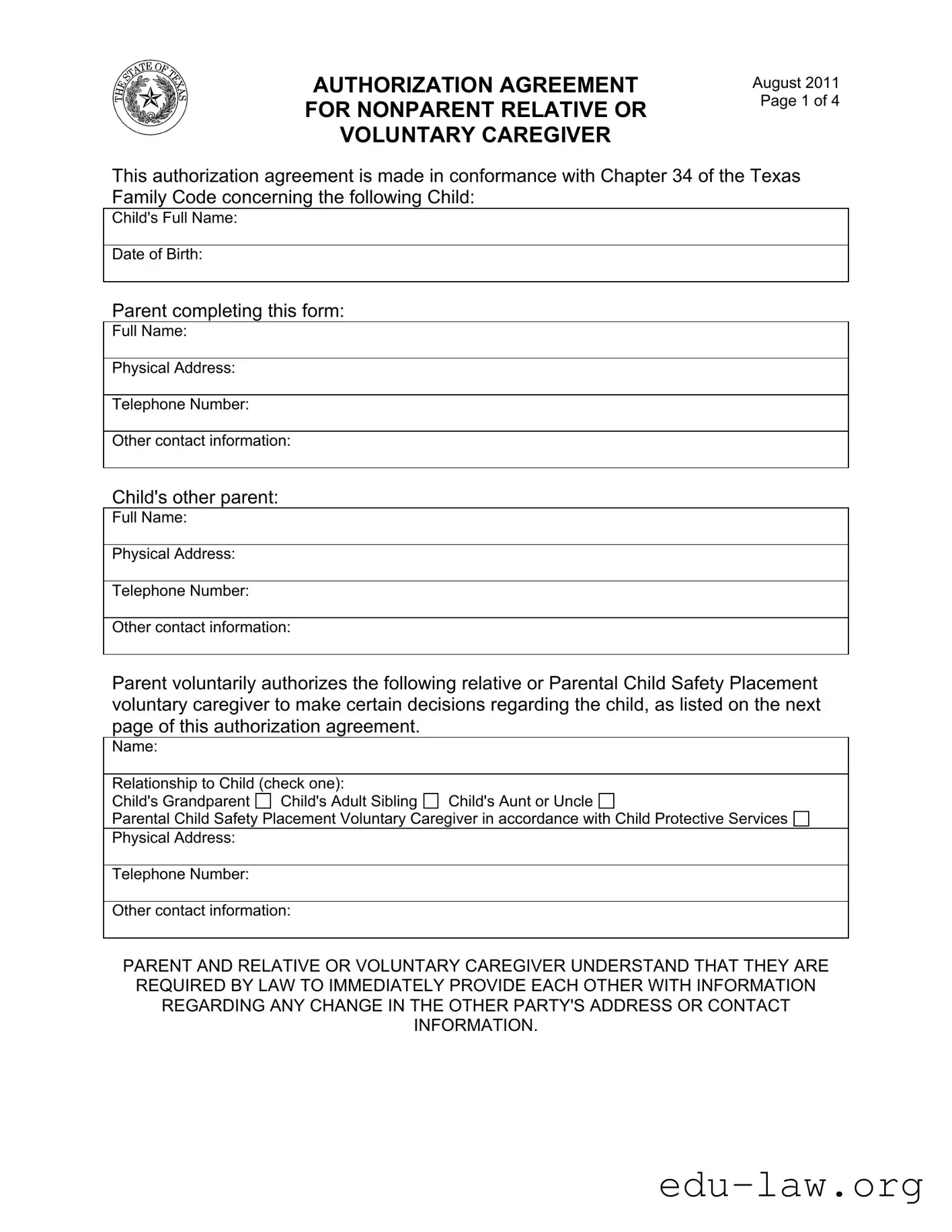
AUTHORIZATION AGREEMENT FOR NONPARENT RELATIVE OR VOLUNTARY CAREGIVER
August 2011 Page 1 of 4
This authorization agreement is made in conformance with Chapter 34 of the Texas Family Code concerning the following Child:
Child's Full Name:
Date of Birth:
Parent completing this form:
Full Name:
Physical Address:
Telephone Number:
Other contact information:
Child's other parent:
Full Name:
Physical Address:
Telephone Number:
Other contact information:
Parent voluntarily authorizes the following relative or Parental Child Safety Placement voluntary caregiver to make certain decisions regarding the child, as listed on the next page of this authorization agreement.
Name:
Relationship to Child (check one):
Child's Grandparent Child's Adult Sibling Child's Aunt or Uncle
Parental Child Safety Placement Voluntary Caregiver in accordance with Child Protective Services
Physical Address:
Telephone Number:
Other contact information:
PARENT AND RELATIVE OR VOLUNTARY CAREGIVER UNDERSTAND THAT THEY ARE REQUIRED BY LAW TO IMMEDIATELY PROVIDE EACH OTHER WITH INFORMATION REGARDING ANY CHANGE IN THE OTHER PARTY'S ADDRESS OR CONTACT INFORMATION.

AUTHORIZATION AGREEMENT FOR NONPARENT RELATIVE OR VOLUNTARY CAREGIVER
August 2011 Page 2 of 4
Parent authorizes the above named relative or voluntary caregiver to perform the following acts in regard to the child and the relative or voluntary caregiver assumes the responsibility of performing these functions:
(1)To authorize medical, dental, psychological, surgical treatment, and immunization of the child, including executing any consents or authorizations for the release of information as required by law relating to the treatment or immunization;
(2)To obtain and maintain health insurance coverage for the child and automobile insurance coverage for the child, if appropriate;
(3)To enroll the child in a
(4)To authorize the child to participate in
(5)To authorize the child to obtain a learner's permit, driver's license, or
(6)To authorize employment of the child; and
(7)To apply for and receive public benefits on behalf of the child.
(8)This authorization agreement does not confer on the relative or voluntary caregiver of the child the right to authorize the performance of an abortion on the child or the administration of emergency contraception to the child
To the best of the parent's and the relative's or voluntary caregiver's knowledge (check if applicable):
This child is not the subject of a current
To the best of the parent's and the relative's or voluntary caregiver's knowledge (choose one from below):
THERE IS NO COURT INVOLVEMENT WITH THIS CHILD
All of the following statements must apply:
•There is no court order or pending suit affecting the
•There is no pending litigation in any court concerning custody, possession, or placement of the child or access to or visitation with the child.
•The court does not have continuing jurisdiction concerning the child.
THIS CHILD HAS BEEN THE SUBJECT OF A COURT ACTION
The court with continuing jurisdiction concerning the child has given written approval for the execution of the authorization agreement accompanied by the following information:
•The county in which the court is located;
•The number of the court; and
•The cause number in which the order was issued or the litigation is pending. Please staple a copy of the court's order to this agreement.

AUTHORIZATION AGREEMENT FOR NONPARENT RELATIVE OR VOLUNTARY CAREGIVER
August 2011 Page 3 of 4
WARNINGS AND DISCLOSURES
This authorization agreement is an important legal document. The parent and the relative or voluntary caregiver must read all of the warnings and disclosures before signing this authorization agreement.
The parent and relative are not required to consult an attorney but are advised to do so.
A parent's rights as a parent may be adversely affected by placing or leaving the parent's child with another person.
This authorization agreement does not confer on the relative or voluntary caregiver the rights of a managing or possessory conservator or legal guardian.
A parent who is a party to this authorization agreement may terminate the authorization agreement and resume custody, possession, care, and control of the child on demand and at any time the parent may request the return of the child.
Failure by the relative or voluntary caregiver to return the child to the parent immediately on request may have criminal and civil consequences.
Under other applicable law, the relative or voluntary caregiver may be liable for certain expenses relating to the child in the relative's or voluntary caregiver's care, but the parent still retains the parental obligation to support the child.
In certain circumstances, this authorization agreement may not be entered into without written permission of the court. Examples of when court permission must be granted include when a court has entered a previous order granting custody or establishing a child support obligation.
This authorization agreement may be terminated by certain court orders affecting the child.
This authorization agreement does not supersede, invalidate, or terminate any prior authorization agreement regarding the child.
This authorization agreement is void if a prior authorization agreement regarding the child is in effect and has not expired or been terminated.
MAILING REQUIREMENTS:
When both parents do not sign the parent authorization agreement, a copy of the agreement MUST be mailed to the
1.The parties mail a copy of this agreement to a
2.If the parties do not receive a response from the
EXCEPTION TO MAILING REQUIREMENTS:
If a parent who did not sign the authorization agreement does not have
1.A protective order has been issued against the

AUTHORIZATION AGREEMENT FOR NONPARENT RELATIVE OR VOLUNTARY CAREGIVER
August 2011 Page 4 of 4
who signed the agreement or any child of the parent who signed the agreement; or
2.The
kidnapping, assault and sexual assault); or
O any other criminal offense in Texas or any other state if the offense involves a violent act or prohibited sexual conduct.
This authorization agreement (select one of the following two):
Expires on this date: |
OR |
Is valid until revoked in writing by either party
In addition, check here if you want the agreement to continue in effect after your death or during any period of incapacity.
Execution of a subsequent authorization agreement does not by itself supersede, invalidate, or terminate a prior authorization agreement.
By signing below, parent and the relative or voluntary caregiver acknowledge that they have each read this authorization agreement carefully, are entering into the authorization agreement voluntarily, and have read and understand all of the Warnings and Disclosures included in this authorization agreement.
_____________________________________
PARENT
Printed name:
SUBSCRIBED AND ACKNOWLEDGED BEFORE ME on this ____ day of _________________, 20____.
_____________________________________
Notary Public in and for the State of TEXAS
_____________________________________
PARENT**
Printed name:
SUBSCRIBED AND ACKNOWLEDGED BEFORE ME on this ____ day of _________________, 20____.
_____________________________________
Notary Public in and for the State of TEXAS
_____________________________________
RELATIVE OR VOLUNTARY CAREGIVER
Printed name:
SUBSCRIBED AND ACKNOWLEDGED BEFORE ME on this ____ day of _________________, 20____.
_____________________________________
Notary Public in and for the State of TEXAS
| Fact Name | Details |
|---|---|
| Governing Law | This agreement is governed by Chapter 34 of the Texas Family Code. |
| Authorized Decisions | The caregiver can make important decisions, including medical treatment and school enrollment. |
| Mailing Requirements | A copy of the agreement must be mailed to a non-signing parent within 10 days if both parents do not sign. |
| Termination Conditions | The agreement can be terminated by either parent at any time upon request. |
| Exceptions to Mailing | No mailing is required if a protective order exists against the non-signing parent. |
To complete the Agreement Nonparent Relative Caregiver form, follow these steps carefully. This form allows a parent to authorize a relative or caregiver to make important decisions for a child. After filling out the form, it must be signed and may require notarization. Ensure all information is accurate before submission.
What is the purpose of the Agreement Nonparent Relative Caregiver form?
The Agreement Nonparent Relative Caregiver form serves as a legal document that allows a parent to authorize a relative or voluntary caregiver to make specific decisions on behalf of their child. This can include medical decisions, educational enrollments, and participation in extracurricular activities. By signing this agreement, the parent ensures that the caregiver has the authority to act in the child's best interests, while also maintaining the parent's rights to custody and control. It is important for both parties to understand the responsibilities and limitations that come with this agreement.
Who can be designated as a caregiver under this agreement?
The agreement allows for a variety of relatives to be designated as caregivers. This includes the child's grandparents, adult siblings, aunts, uncles, or a voluntary caregiver approved by Child Protective Services. The relationship to the child must be clearly indicated on the form. This flexibility allows families to make arrangements that best suit their unique situations, ensuring that the child is cared for by someone they know and trust.
What are the rights and responsibilities of the caregiver?
The caregiver granted authority through this agreement has several responsibilities. They can make medical decisions, enroll the child in school, and authorize participation in activities. However, it is crucial to note that the caregiver does not gain full parental rights. The parent retains the right to terminate the agreement at any time and reclaim custody of the child. This means that the caregiver must act in the child's best interests and be prepared to return the child to the parent upon request.
What are the mailing requirements if both parents do not sign the agreement?
If both parents do not sign the Agreement Nonparent Relative Caregiver form, the parent who does sign must mail a copy of the agreement to the non-signing parent. This must be done within ten days of signing, using certified or registered mail. If there is no response from the non-signing parent within twenty days, a second copy must be mailed via first-class mail within forty-five days. However, if there is a protective order against the non-signing parent or a history of violent offenses, mailing may not be required. Understanding these requirements is essential to ensure the agreement is valid and legally binding.
Incomplete Information: Many individuals fail to fill out all required fields, such as the child's full name, date of birth, or the contact details of the parent and caregiver. This oversight can delay the processing of the agreement.
Incorrect Relationship Designation: It's common for people to misidentify their relationship to the child. Selecting the wrong option, such as marking "Aunt or Uncle" instead of "Grandparent," can lead to complications in the agreement's validity.
Neglecting to Notify Changes: The form requires both parties to inform each other of any changes in contact information. Failing to do so can create confusion and legal issues down the line.
Ignoring Mailing Requirements: When both parents do not sign the agreement, it is essential to mail a copy to the non-signing parent. Many overlook this step, risking the agreement's validity.
The Agreement Nonparent Relative Caregiver form is an important document that allows a relative or voluntary caregiver to make decisions regarding a child. Along with this form, there are several other documents that may be necessary to ensure the proper care and legal standing of the child. Below are descriptions of four such documents.
Each of these documents plays a crucial role in protecting the child's well-being and ensuring that caregivers have the necessary authority to act in the child's best interest. It is important to handle these forms with care and to seek guidance when needed.
The Authorization Agreement for Nonparent Relative Caregiver form shares similarities with the Power of Attorney document. Both allow individuals to grant authority to another person to make decisions on their behalf. In the case of the Power of Attorney, this authority can cover a wide range of matters, including financial and legal decisions. Conversely, the Nonparent Relative Caregiver form specifically focuses on decisions related to the care and well-being of a child. Each document requires the parties involved to understand their rights and responsibilities fully.
Another document that resembles the Nonparent Relative Caregiver form is the Child Custody Agreement. Both documents address the care and custody of a child, outlining who has the right to make decisions regarding the child's welfare. A Child Custody Agreement typically involves court approval and is often part of divorce or separation proceedings. In contrast, the Nonparent Relative Caregiver form is more informal and can be executed without court involvement, as long as specific conditions are met.
The Temporary Guardianship Agreement is also similar to the Nonparent Relative Caregiver form. This document allows a parent to appoint someone else as a temporary guardian for their child. Both agreements grant the designated person the authority to make decisions about the child's health, education, and general welfare. However, a Temporary Guardianship Agreement usually has a set expiration date or condition under which it becomes void, whereas the Nonparent Relative Caregiver form can remain in effect until revoked by the parent.
The Authorization for Medical Treatment form is another related document. This form allows a parent to authorize another person to make medical decisions for their child. Both documents emphasize the importance of parental consent for medical care. However, the Nonparent Relative Caregiver form encompasses a broader range of responsibilities, including educational and social activities, while the Authorization for Medical Treatment focuses solely on health-related decisions.
Similar to the Nonparent Relative Caregiver form is the Caregiver Affidavit. This document allows a relative to provide proof of their relationship to the child and their role in the child's life. Both documents can help clarify the caregiver's authority and responsibilities. However, the Caregiver Affidavit is often used in situations where legal proof of guardianship is required, while the Nonparent Relative Caregiver form is more focused on day-to-day decision-making.
Lastly, the Consent for Release of Information form bears resemblance to the Nonparent Relative Caregiver form. This document allows a parent to give permission for another person to access specific information about the child, such as medical records or school information. Both forms emphasize the importance of parental consent in sharing information. However, the Nonparent Relative Caregiver form provides a broader scope of authority, allowing the caregiver to make various decisions on behalf of the child, rather than just accessing information.
When filling out the Agreement Nonparent Relative Caregiver form, it is essential to approach the task with care and attention to detail. This document serves a significant purpose in ensuring the well-being of the child involved. Here are seven important things to consider doing and avoiding during this process:
Misconceptions about the Agreement Nonparent Relative Caregiver form can lead to confusion. Here are five common misunderstandings:
Here are key takeaways regarding the Agreement Nonparent Relative Caregiver form: