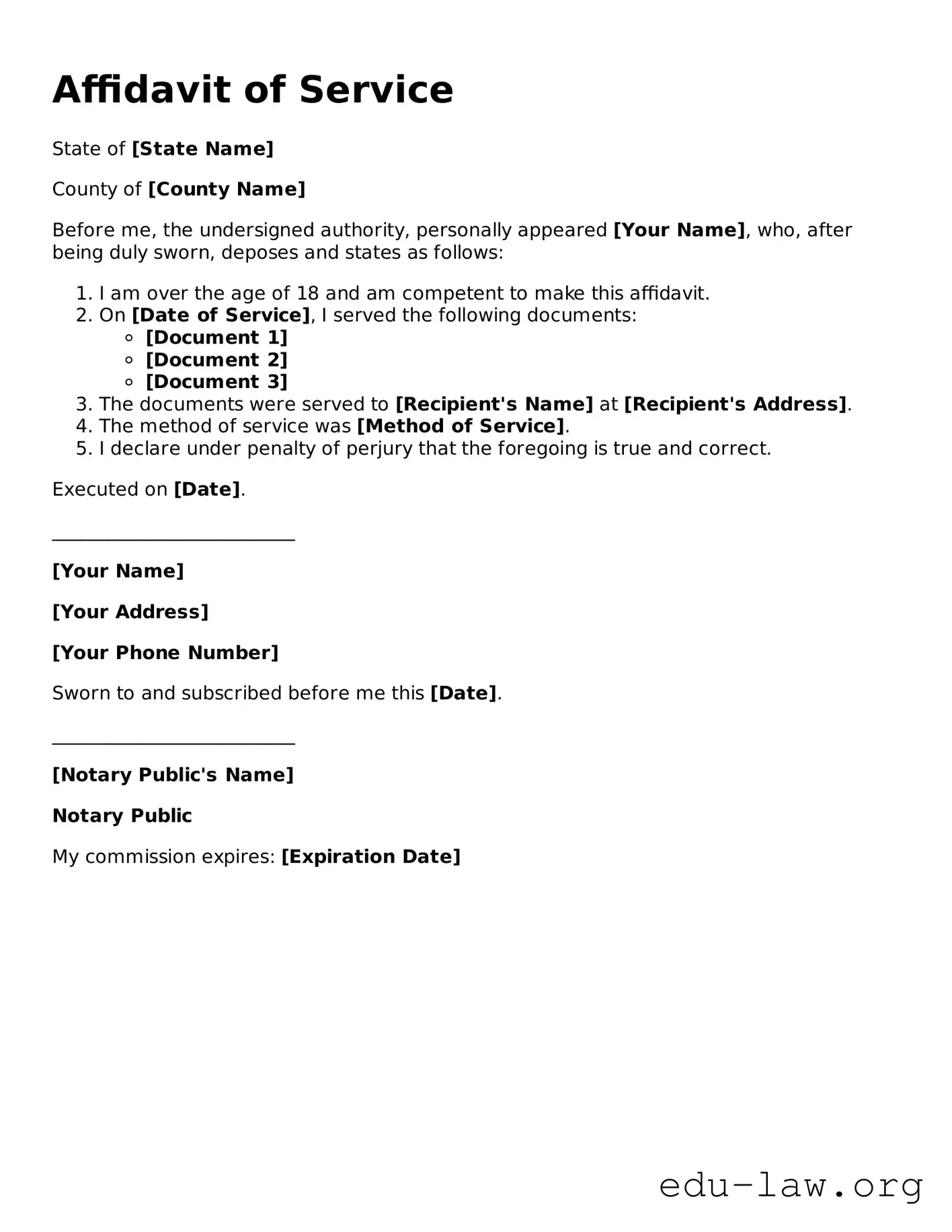
The Affidavit of Service form plays a crucial role in the legal process, ensuring that all parties involved in a case are properly notified of actions taken against them. This form serves as a formal declaration that documents the delivery of legal documents, such as summonses, complaints, or subpoenas, to the intended recipients. By completing this form, the server confirms that they have successfully delivered the necessary paperwork, providing essential evidence that the recipient has been made aware of the legal proceedings. Typically, the Affidavit of Service includes key details such as the date and time of service, the method used for delivery, and the identity of the individual who received the documents. It is important to note that this affidavit must be signed in the presence of a notary public or another authorized official, lending credibility to the claims made within it. Understanding the significance of this form can help ensure that the legal process moves forward smoothly, as it establishes a clear record of communication and compliance with legal requirements.
Affidavit of Service
State of [State Name]
County of [County Name]
Before me, the undersigned authority, personally appeared [Your Name], who, after being duly sworn, deposes and states as follows:
Executed on [Date].
__________________________
[Your Name]
[Your Address]
[Your Phone Number]
Sworn to and subscribed before me this [Date].
__________________________
[Notary Public's Name]
Notary Public
My commission expires: [Expiration Date]
| Fact Name | Description |
|---|---|
| Definition | An Affidavit of Service is a legal document that confirms a party has delivered legal documents to another party. |
| Purpose | This form serves as proof that the recipient received the documents, which is crucial for legal proceedings. |
| Components | The affidavit typically includes the name of the server, the date of service, and details about how the documents were served. |
| Governing Law | Each state has specific laws governing the use of the Affidavit of Service. For example, California follows the California Code of Civil Procedure Section 417.10. |
| Signature Requirement | The server must sign the affidavit, affirming that the information provided is accurate. |
| Filing | In many jurisdictions, the Affidavit of Service must be filed with the court to complete the service process. |
| Types of Service | Service can be accomplished through personal delivery, mail, or other methods allowed by law. |
| Consequences of Non-Compliance | If the affidavit is not properly completed or filed, it may lead to delays or dismissal of the case. |
| Variations | Different states may have variations in the form and requirements, so it is essential to use the correct version for your jurisdiction. |
| Accessibility | Many states provide downloadable versions of the Affidavit of Service form on their official court websites. |
Once you have the Affidavit of Service form ready, you will need to fill it out carefully. After completing the form, you will submit it to the court or the relevant authority as required. Ensure that all details are accurate to avoid any delays in processing.
What is an Affidavit of Service?
An Affidavit of Service is a legal document that confirms a person has been served with legal papers, such as a summons or complaint. It serves as proof that the required documents were delivered to the intended recipient. This document is often necessary in court proceedings to ensure that all parties have been properly notified of legal actions against them.
Who can serve legal documents?
Legal documents can typically be served by a variety of individuals, including professional process servers, law enforcement officers, or anyone over the age of 18 who is not involved in the case. It's important that the person serving the documents is impartial and can provide an accurate account of the service.
What information is included in an Affidavit of Service?
An Affidavit of Service usually contains the following information: the name of the person served, the date and time of service, the method of service (such as personal delivery or mail), and the name of the person who served the documents. It may also include the address where the service took place and any additional details that help establish the validity of the service.
Do I need to file the Affidavit of Service with the court?
Yes, in most cases, you will need to file the Affidavit of Service with the court to demonstrate that the other party has been properly notified. Filing this document is crucial for the legal process to move forward. Check with your local court for specific filing requirements and deadlines.
What happens if the Affidavit of Service is not completed correctly?
If the Affidavit of Service is not completed correctly, it could lead to complications in your case. The court may not accept the document, which can delay proceedings or even result in a dismissal of your case. It’s essential to ensure that all information is accurate and that the affidavit is signed and notarized, if required.
Can I contest an Affidavit of Service?
Yes, you can contest an Affidavit of Service if you believe that you were not properly served. You may challenge the validity of the service in court, providing evidence to support your claim. It’s advisable to consult with a legal professional if you find yourself in this situation to ensure that your rights are protected.
Not including all required information: Individuals often forget to fill out essential details such as the date of service, the name of the person served, and the address where the service took place. Omitting any of this information can lead to delays or complications in legal proceedings.
Incorrectly identifying the server: The person who serves the documents must be clearly identified. Sometimes, people mistakenly list their own name instead of the name of the individual who performed the service, which can create confusion.
Failing to sign the affidavit: After completing the form, it’s crucial to sign it. Some individuals neglect this step, thinking that completing the form is sufficient. Without a signature, the affidavit is not valid.
Not providing a detailed description of the service: A vague description can lead to questions about the validity of the service. It is important to provide specific details about how the documents were delivered, whether in person or by mail.
Ignoring local rules and requirements: Each jurisdiction may have its own rules regarding affidavits of service. Failing to check these local requirements can result in the form being rejected. It’s always wise to review the specific guidelines that apply to your area.
The Affidavit of Service is a crucial document in the legal process, serving as proof that a particular legal document has been delivered to a party involved in a case. However, it often accompanies various other forms and documents that support or complement its purpose. Below is a list of commonly used documents that may be associated with the Affidavit of Service.
Understanding these documents and their functions can greatly enhance the clarity and efficiency of legal proceedings. Each plays a significant role in ensuring that all parties are informed and that the legal process is conducted fairly and transparently.
The Affidavit of Service is similar to a Proof of Service. Both documents serve to confirm that legal documents have been delivered to the appropriate parties. While an Affidavit of Service is typically sworn before a notary public, a Proof of Service may not require notarization in all jurisdictions. The essential purpose of both documents is to provide evidence that the recipient has been properly notified of legal actions, ensuring that due process is upheld.
Another document similar to the Affidavit of Service is the Certificate of Service. This document is often used in court filings to show that a party has served documents to other involved parties. Unlike the Affidavit of Service, which is a sworn statement, the Certificate of Service is generally a simple declaration. Both documents play a crucial role in maintaining transparency in legal proceedings by confirming that all parties have received necessary information.
The Summons is another document that bears resemblance to the Affidavit of Service. A Summons is issued by the court to notify a defendant that a legal action has been initiated against them. The Affidavit of Service, in this context, serves to prove that the Summons was delivered to the defendant. Both documents are vital in ensuring that the defendant is aware of the legal action and has the opportunity to respond.
In addition, the Notice of Hearing is akin to the Affidavit of Service. This document informs parties involved in a legal matter about the date and time of a scheduled hearing. The Affidavit of Service can be used to confirm that the Notice of Hearing was properly served. Both documents help ensure that all parties are kept informed and can participate in the legal process.
The Subpoena also shares similarities with the Affidavit of Service. A Subpoena commands a person to appear in court or produce documents. The Affidavit of Service can be used to verify that the Subpoena was delivered to the intended recipient. Both documents are essential in legal proceedings, as they ensure that witnesses and evidence are present when needed.
The Request for Admission is another document that relates to the Affidavit of Service. This document is used to ask the other party to admit certain facts in a case. When a Request for Admission is served, an Affidavit of Service may accompany it to confirm delivery. Both documents help streamline the legal process by clarifying issues before trial.
The Motion to Compel is also similar to the Affidavit of Service. This motion is filed when one party seeks to force another to comply with a request, such as producing documents or answering interrogatories. The Affidavit of Service can demonstrate that the Motion to Compel was served to the opposing party. Both documents are essential in ensuring compliance with legal procedures.
Lastly, the Interrogatories are comparable to the Affidavit of Service. Interrogatories are written questions sent by one party to another in a lawsuit, requiring a written response. When these questions are served, an Affidavit of Service may be used to confirm that the Interrogatories were delivered. Both documents facilitate communication between parties and ensure that necessary information is exchanged in a timely manner.
When completing the Affidavit of Service form, it is essential to approach the task with care. Below is a list of things you should and shouldn't do to ensure the form is filled out correctly.
Things You Should Do:
Things You Shouldn't Do:
By following these guidelines, you can help ensure that your Affidavit of Service is completed properly and effectively.
There are several misconceptions about the Affidavit of Service form. Understanding the truth behind these can help ensure proper legal procedures are followed. Here are six common misconceptions:
While it may seem easy to hand over documents, only specific individuals, such as a registered process server or a person over the age of 18 who is not involved in the case, can serve legal documents.
Some believe that filing an Affidavit of Service is not necessary. However, it is crucial to provide proof that documents were served properly in legal proceedings.
Many think that documents can be served at any hour. In reality, there are specific times considered appropriate for service, usually during business hours.
Some people believe that as long as the documents are delivered, the method of service does not matter. Different types of cases have specific requirements for how service must be conducted.
Serving documents does not mean that the case is automatically accepted by the court. The recipient still has the right to respond or contest the documents served.
Many confuse the Affidavit of Service with a summons. The Affidavit of Service is a declaration that service was completed, while a summons is a legal document that notifies a person of a legal action against them.
When filling out and using the Affidavit of Service form, it is essential to understand the key elements involved. Here are six important takeaways: