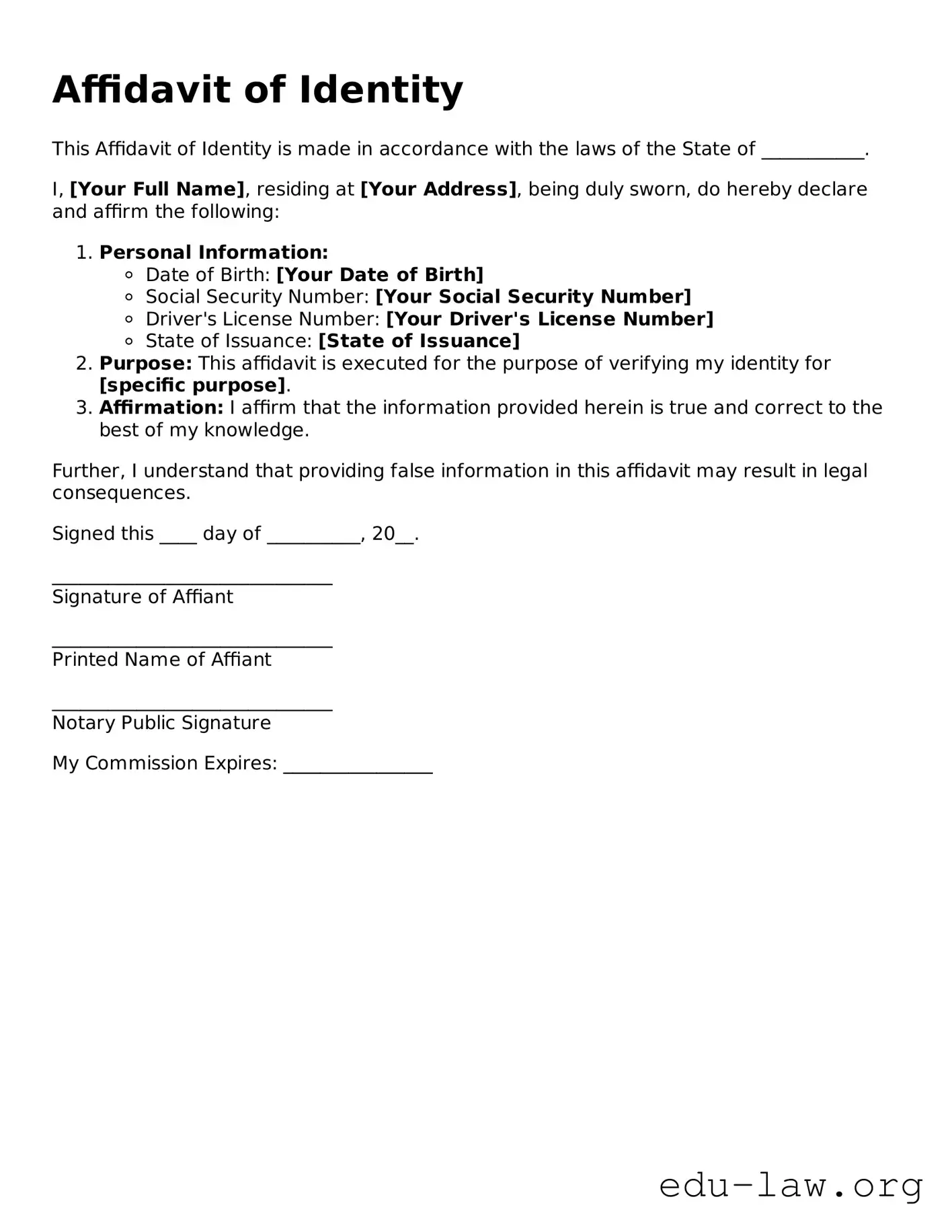
The Affidavit of Identity form serves as a vital tool for individuals seeking to establish their identity in various legal contexts. This document is often utilized in situations where proof of identity is necessary, such as during court proceedings, the application for government benefits, or the resolution of disputes involving personal identification. By signing this form, an individual asserts their identity under oath, providing a sworn statement that can help clarify any uncertainties regarding their name, address, or other personal details. It typically requires the affiant to provide personal information, such as their full name, date of birth, and other identifying details, while also including a statement affirming that the information provided is accurate to the best of their knowledge. Furthermore, the form may need to be notarized to enhance its credibility, thereby ensuring that the identity verification process is both secure and reliable. Understanding the purpose and proper use of the Affidavit of Identity is essential for anyone navigating legal situations that require clear and verified identification.
Affidavit of Identity
This Affidavit of Identity is made in accordance with the laws of the State of ___________.
I, [Your Full Name], residing at [Your Address], being duly sworn, do hereby declare and affirm the following:
Further, I understand that providing false information in this affidavit may result in legal consequences.
Signed this ____ day of __________, 20__.
______________________________
Signature of Affiant
______________________________
Printed Name of Affiant
______________________________
Notary Public Signature
My Commission Expires: ________________
| Fact Name | Description |
|---|---|
| Purpose | The Affidavit of Identity form is used to verify a person's identity in various legal situations. |
| State-Specific Forms | Different states may have their own versions of the Affidavit of Identity, each with specific requirements. |
| Governing Laws | In many states, the governing laws include specific statutes related to identity verification and affidavits. |
| Notarization | Typically, the form must be notarized to be considered valid, ensuring the authenticity of the identity verification. |
After obtaining the Affidavit of Identity form, you will need to complete it accurately to ensure that your identity is verified properly. This process is essential for various legal and administrative purposes. Following the steps outlined below will help you fill out the form correctly.
What is an Affidavit of Identity?
An Affidavit of Identity is a legal document that serves to verify a person's identity. It is often used in situations where an individual needs to confirm their identity for legal purposes, such as applying for a loan, opening a bank account, or participating in legal proceedings. This document typically includes personal information such as your full name, address, date of birth, and may require a signature in the presence of a notary public.
Why might I need an Affidavit of Identity?
You may need an Affidavit of Identity if you are facing challenges in proving your identity. This can occur if you have lost important identification documents or if there are discrepancies in your identification records. The affidavit acts as a sworn statement that can help clarify your identity in various legal contexts.
How do I complete an Affidavit of Identity?
To complete an Affidavit of Identity, you will first need to gather relevant personal information. This includes your full legal name, any previous names, date of birth, and current address. Next, fill out the affidavit form accurately and clearly. After completing the form, it is crucial to sign it in front of a notary public, who will verify your identity and witness your signature.
Is there a specific format for the Affidavit of Identity?
Do I need a lawyer to create an Affidavit of Identity?
While it is not mandatory to hire a lawyer to create an Affidavit of Identity, consulting with one can be beneficial, especially if your situation is complex. A lawyer can provide guidance on the necessary information to include and help ensure that the affidavit meets all legal standards.
How long is an Affidavit of Identity valid?
The validity of an Affidavit of Identity can vary based on the purpose for which it is used. Generally, it remains valid as long as the information contained within it is accurate and has not changed. However, some institutions may have their own expiration policies, so it’s wise to confirm with them.
Can I use an Affidavit of Identity for multiple purposes?
Yes, an Affidavit of Identity can often be used for multiple purposes, provided that the information remains accurate. However, some organizations may require a new affidavit for each separate transaction or legal matter, so it’s important to verify their specific requirements.
What happens if I provide false information in an Affidavit of Identity?
Providing false information in an Affidavit of Identity can have serious legal consequences, including charges of perjury or fraud. It is essential to ensure that all information included in the affidavit is truthful and accurate to avoid potential legal repercussions.
Incomplete Information: One common mistake is leaving sections blank. Every part of the form must be filled out accurately to ensure it is processed without delay.
Incorrect Personal Details: People often miswrite their name, address, or date of birth. Double-checking these details can prevent potential issues later on.
Not Signing the Form: Failing to provide a signature is a frequent oversight. Remember, your signature is essential for validating the affidavit.
Using Outdated Forms: Submitting an old version of the affidavit can lead to rejection. Always ensure you have the most current form from the appropriate authority.
Missing Notary Acknowledgment: Some individuals forget to have their affidavit notarized. This step is crucial for the document's legitimacy.
Providing Insufficient Identification: Many people do not include the necessary identification documents. Ensure you attach all required IDs to support your affidavit.
Ignoring Instructions: Each affidavit may come with specific instructions. Not following these can result in delays or rejection of the form.
When preparing an Affidavit of Identity, several other forms and documents may be necessary to support your claims or provide additional context. Understanding these documents can help streamline your process and ensure you have everything you need. Below is a list of commonly used forms that often accompany the Affidavit of Identity.
Having these documents ready can make the process smoother and more efficient. It's always a good idea to double-check your requirements based on your specific situation, as different jurisdictions may have varying needs. Being prepared not only saves time but also ensures that your Affidavit of Identity serves its intended purpose effectively.
The Affidavit of Identity is similar to a Declaration of Identity. Both documents serve to verify a person's identity, often in situations where official identification is not available. A Declaration of Identity may be used in legal proceedings or for administrative purposes, providing a sworn statement that confirms the identity of the individual. The language in both documents emphasizes the importance of truthfulness, and they may be signed in front of a notary public to enhance their credibility.
Another document akin to the Affidavit of Identity is the Identity Verification Form. This form is often used by financial institutions and other organizations to confirm an individual's identity before opening accounts or processing transactions. Like the Affidavit of Identity, it requires personal information and may necessitate supporting documentation. The primary goal is to prevent fraud and ensure that the person is who they claim to be.
The Affidavit of Identity shares similarities with the Statement of Identity. This document is typically used in cases where an individual needs to assert their identity for legal reasons, such as during court proceedings. A Statement of Identity may also be required when applying for certain government benefits. Both documents require a declaration under oath and may include details about the individual's background to establish identity.
A Common Affidavit is another document that resembles the Affidavit of Identity. This type of affidavit can be used for various purposes, including identity verification. While it may cover a broader range of statements, it still requires the affiant to swear to the truth of the information provided. The focus remains on establishing the individual’s identity, similar to the Affidavit of Identity.
The Affidavit of Identity is also comparable to a Witness Statement. This document is often used in legal contexts where a witness provides their account of an event or verifies the identity of another person. Both documents may be signed under oath and can be used in court. The Witness Statement focuses on the observations of the witness, while the Affidavit of Identity centers on the individual’s personal details.
The Identity Affidavit serves a similar purpose as the Affidavit of Identity. This document is often used in immigration cases or other legal matters where proof of identity is crucial. It requires the individual to provide personal information and affirm their identity under oath. Both documents aim to establish a person's identity and can be critical in legal proceedings.
Lastly, a Notarized Identity Affidavit is closely related to the Affidavit of Identity. This document is typically signed in front of a notary public, which adds an extra layer of verification. It includes the same essential information as the Affidavit of Identity but emphasizes the role of the notary in confirming the identity of the signer. This notarization can enhance the document's acceptance in various legal and administrative contexts.
When filling out the Affidavit of Identity form, it is important to follow specific guidelines to ensure accuracy and compliance. Here are nine things to keep in mind:
The Affidavit of Identity form is often misunderstood. Here are six common misconceptions about this important document:
Understanding these misconceptions can help individuals navigate the complexities of identity verification more effectively.
When filling out and using the Affidavit of Identity form, keep these key takeaways in mind: