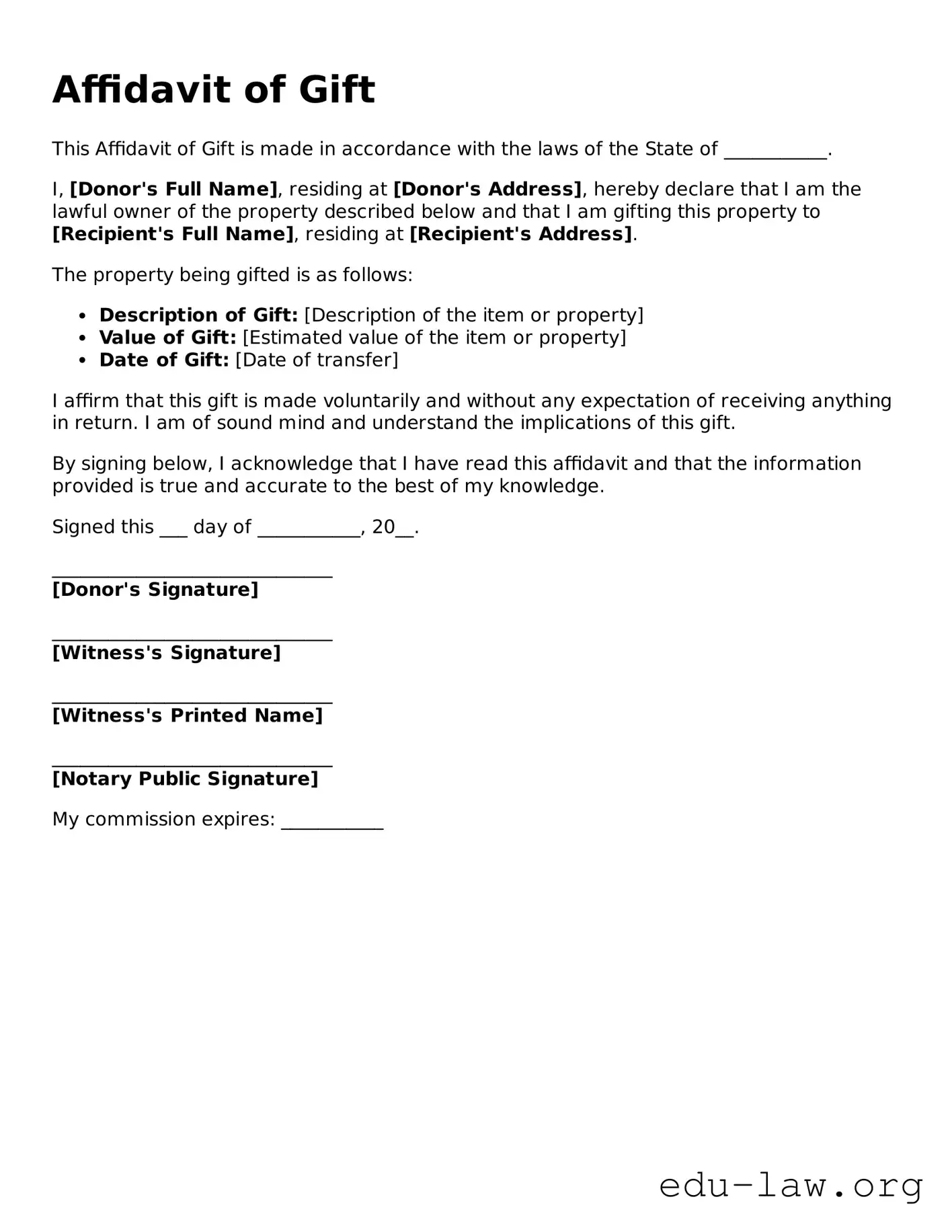
The Affidavit of Gift form plays a crucial role in the process of transferring ownership of personal property without the exchange of money. This form is often used in situations where an individual wishes to gift items such as vehicles, real estate, or valuable collectibles to another person. By completing this document, the donor formally declares their intention to give the property to the recipient, known as the donee. The form typically requires essential details, including the names and addresses of both parties, a description of the property being gifted, and the date of the transfer. Additionally, the donor may need to provide a statement affirming that the gift is made voluntarily and without any coercion. Properly executing the Affidavit of Gift can help prevent future disputes regarding ownership and ensure that the transaction is legally recognized. Understanding the requirements and implications of this form is vital for anyone considering a gift of significant value.
Affidavit of Gift
This Affidavit of Gift is made in accordance with the laws of the State of ___________.
I, [Donor's Full Name], residing at [Donor's Address], hereby declare that I am the lawful owner of the property described below and that I am gifting this property to [Recipient's Full Name], residing at [Recipient's Address].
The property being gifted is as follows:
I affirm that this gift is made voluntarily and without any expectation of receiving anything in return. I am of sound mind and understand the implications of this gift.
By signing below, I acknowledge that I have read this affidavit and that the information provided is true and accurate to the best of my knowledge.
Signed this ___ day of ___________, 20__.
______________________________
[Donor's Signature]
______________________________
[Witness's Signature]
______________________________
[Witness's Printed Name]
______________________________
[Notary Public Signature]
My commission expires: ___________
| Fact Name | Description |
|---|---|
| Definition | An Affidavit of Gift is a legal document that confirms the transfer of property or assets as a gift from one person to another. |
| Purpose | This form is used to provide proof of the gift for tax purposes and to clarify ownership. |
| Notarization | Typically, the Affidavit of Gift must be signed in the presence of a notary public to be considered valid. |
| State-Specific Requirements | Each state may have its own version of the Affidavit of Gift, governed by local laws regarding property transfer. |
| Tax Implications | Gifts above a certain value may be subject to federal gift tax regulations, which should be reviewed by the donor. |
| Revocation | Once the Affidavit is executed, the gift cannot typically be revoked unless specific conditions are met. |
Once you have the Affidavit of Gift form ready, you will need to fill it out accurately to ensure that the gift is properly documented. Follow the steps below to complete the form correctly.
After completing these steps, review the form to ensure all information is accurate. Keep a copy for your records before submitting it as required.
What is an Affidavit of Gift?
An Affidavit of Gift is a legal document that serves as a declaration of the transfer of property or assets as a gift. This form is often used when someone wishes to give property, such as real estate, vehicles, or other valuable items, without expecting anything in return. By completing this affidavit, the giver affirms that the gift is made voluntarily and without coercion, ensuring clarity and legality in the transaction.
Who needs to complete an Affidavit of Gift?
What information is required on the Affidavit of Gift?
Is the Affidavit of Gift legally binding?
Do I need to file the Affidavit of Gift with any government agency?
Can an Affidavit of Gift help with tax implications?
Not providing complete information. Ensure all sections of the form are filled out thoroughly. Missing details can lead to delays or rejection.
Failing to sign the form. A signature is essential. Without it, the affidavit is not valid.
Using incorrect dates. Double-check all dates entered. Errors can raise questions about the validity of the gift.
Not including the correct recipient information. Make sure the recipient's name and address are accurate. This helps avoid confusion.
Overlooking the description of the gift. Clearly describe what is being gifted. This prevents misunderstandings later on.
Neglecting to provide supporting documentation. Attach any necessary documents that support the gift's value or legitimacy.
Ignoring state-specific requirements. Some states may have additional rules for the affidavit. Research your state’s requirements to ensure compliance.
The Affidavit of Gift form is often accompanied by several other documents that help establish the context and legality of a gift. These additional forms and documents provide clarity and support in various situations, ensuring that both the giver and receiver understand their rights and responsibilities. Below is a list of commonly used forms and documents that may accompany the Affidavit of Gift.
Each of these documents plays a crucial role in the process of gifting, ensuring that all parties are protected and that the gift is documented appropriately. By understanding the purpose of each form, individuals can navigate the complexities of gifting with greater confidence and clarity.
The Affidavit of Gift form is similar to a Power of Attorney document. Both forms allow one person to act on behalf of another, but they serve different purposes. A Power of Attorney gives someone the authority to make decisions regarding finances or healthcare for another person. In contrast, the Affidavit of Gift specifically addresses the transfer of property or assets as a gift, ensuring that the giver has made the decision voluntarily and without any pressure.
An additional document that shares similarities is the Bill of Sale. A Bill of Sale is used to transfer ownership of personal property from one person to another, much like the Affidavit of Gift. However, the key difference lies in the consideration. A Bill of Sale typically involves a monetary transaction, while the Affidavit of Gift confirms that no payment is exchanged for the property being gifted. Both documents provide proof of the transfer and can be used for record-keeping purposes.
Lastly, the Letter of Intent can also be compared to the Affidavit of Gift. A Letter of Intent outlines a person's intention to gift property or assets, similar to how the Affidavit of Gift formalizes that intention. While a Letter of Intent may not have the same legal weight as an Affidavit, it serves as a preliminary step in documenting the giver's wishes. Both documents emphasize the giver's intent and can help clarify any misunderstandings regarding the gift.
When filling out the Affidavit of Gift form, it’s essential to be mindful of certain best practices to ensure accuracy and compliance. Here are four things you should do, as well as four things to avoid.
Things You Should Do:
Things You Shouldn't Do:
By following these guidelines, you can navigate the Affidavit of Gift form process with confidence and ease.
Understanding the Affidavit of Gift form is essential for anyone involved in the transfer of property or assets. However, several misconceptions can lead to confusion. Here are nine common misunderstandings about this important document:
Many people think the Affidavit of Gift is limited to real estate. In reality, it can apply to various assets, including vehicles, cash, and personal property.
While notarization can add a layer of credibility, it is not always a requirement for an Affidavit of Gift. However, having it notarized can help in certain situations.
This form is typically used for gifts that exceed a certain value. Smaller gifts may not require this documentation at all.
The Affidavit of Gift is not a contract in the traditional sense. It serves as a declaration of intent rather than a binding agreement.
Some believe that the Affidavit of Gift needs to be submitted to a government office. Generally, it is kept with personal records and only presented if needed.
Both the giver and the recipient should sign the Affidavit of Gift to acknowledge the transfer and ensure clarity.
This form can be used for gifts between friends, charities, and even businesses. It is not restricted to familial relationships.
While the Affidavit of Gift can help clarify the nature of a gift, it does not automatically exempt the giver or recipient from tax obligations. Consulting a tax professional is wise.
Although the form serves as a record of the gift, it can be amended if necessary, provided both parties agree to the changes.
Being aware of these misconceptions can help individuals navigate the process of gifting assets more effectively. Always consider seeking professional advice when dealing with legal documents.
When it comes to gifting property or assets, the Affidavit of Gift form plays a crucial role. Here are some key takeaways to keep in mind when filling out and using this important document:
By keeping these key points in mind, you can navigate the process of using the Affidavit of Gift form with confidence and clarity.