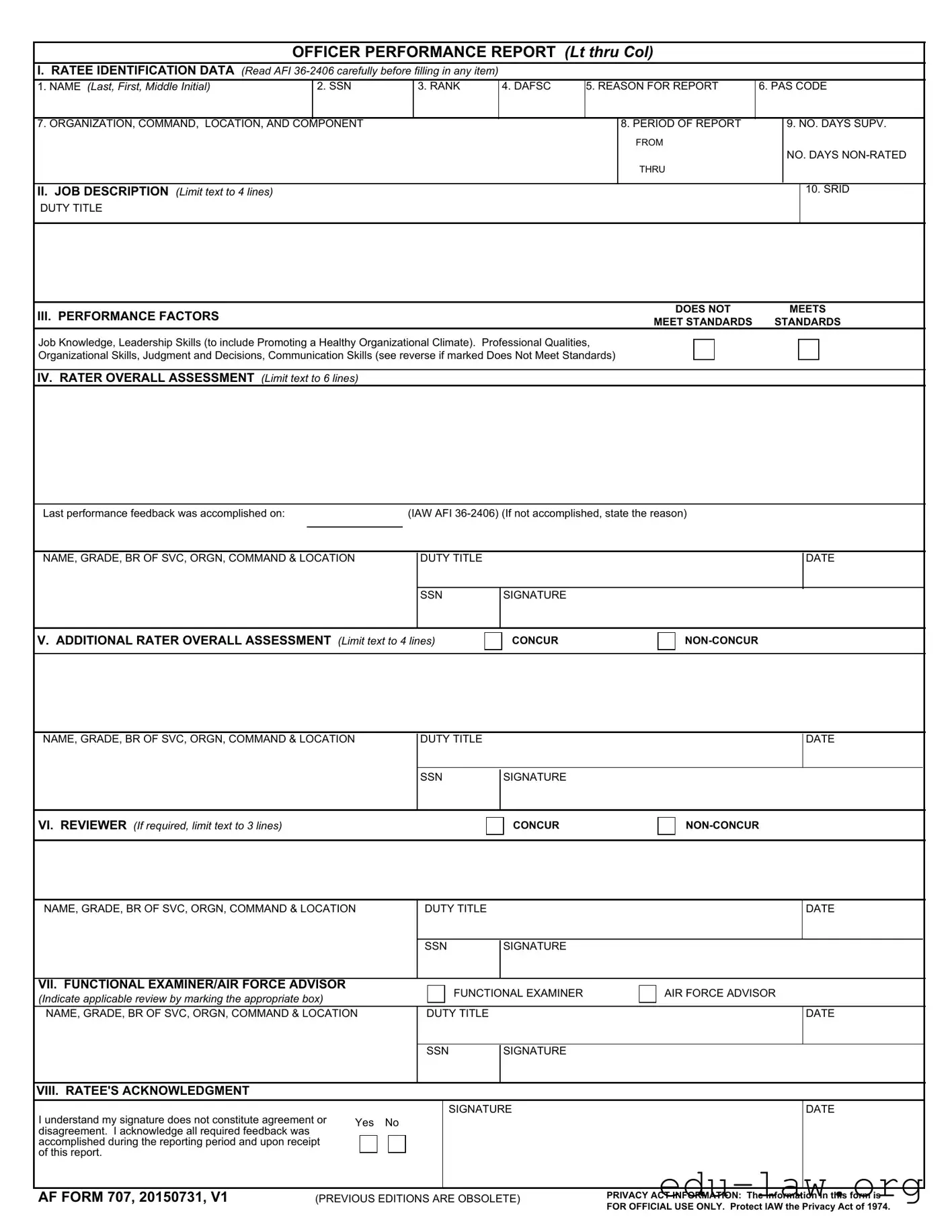
The AF 707 form, known as the Officer Performance Report, serves a crucial role in assessing the performance of officers from Lieutenant through Colonel ranks in the United States Air Force. This form collects essential identification data, including the officer's name, rank, and duty title, as well as the period covered by the report. It evaluates various performance factors, such as job knowledge, leadership skills, and communication abilities, allowing for a comprehensive review of an officer's contributions and effectiveness. Each report includes sections for the rater's overall assessment, additional rater's comments, and, if necessary, a reviewer's input, ensuring multiple perspectives are considered. The form also addresses acknowledgment from the ratee, who confirms receipt of the report without necessarily agreeing with its contents. This process is vital for maintaining accountability and transparency within the Air Force, impacting future assignments, promotions, and overall career progression. Understanding the AF 707 form is essential for both evaluators and those being evaluated, as it plays a significant role in shaping military careers.
OFFICER PERFORMANCE REPORT (LT THRU COL)
I. RATEE IDENTIFICATION DATA (Read AFI
1. NAME (Last, First, Middle Initial)
2. SSN
3. RANK
4. DAFSC
5. REASON FOR REPORT
6. PAS CODE
7. ORGANIZATION, COMMAND, LOCATION, AND COMPONENT
8.PERIOD OF REPORT
FROM
THRU
9.NO. DAYS SUPV.
NO. DAYS
II.JOB DESCRIPTION (Limit text to 4 lines)
DUTY TITLE
10. SRID
III. PERFORMANCE FACTORS |
DOES NOT |
MEETS |
|
MEET STANDARDS |
STANDARDS |
||
|
Job Knowledge, Leadership Skills (to include Promoting a Healthy Organizational Climate). Professional Qualities,
Organizational Skills, Judgment and Decisions, Communication Skills (see reverse if marked Does Not Meet Standards)
IV. RATER OVERALL ASSESSMENT (Limit text to 6 lines)
Last performance feedback was accomplished on: |
|
(IAW AFI |
|
|
|
NAME, GRADE, BR OF SVC, ORGN, COMMAND & LOCATION
DUTY TITLE
DATE
SSN
SIGNATURE
V. ADDITIONAL RATER OVERALL ASSESSMENT (Limit text to 4 lines)
CONCUR
NAME, GRADE, BR OF SVC, ORGN, COMMAND & LOCATION
DUTY TITLE
DATE
SSN
SIGNATURE
VI. REVIEWER (If required, limit text to 3 lines)
CONCUR
NAME, GRADE, BR OF SVC, ORGN, COMMAND & LOCATION
DUTY TITLE
DATE
SSN
SIGNATURE
VII. FUNCTIONAL EXAMINER/AIR FORCE ADVISOR |
FUNCTIONAL EXAMINER |
AIR FORCE ADVISOR |
|||
(Indicate applicable review by marking the appropriate box) |
|||||
|
|
|
|
||
NAME, GRADE, BR OF SVC, ORGN, COMMAND & LOCATION |
DUTY TITLE |
|
DATE |
||
|
|
|
|
|
|
SSN
SIGNATURE
VIII. RATEE'S ACKNOWLEDGMENT
I understand my signature does not constitute agreement or |
Yes No |
|||
disagreement. I acknowledge all required feedback was |
|
|
|
|
accomplished during the reporting period and upon receipt |
|
|
|
|
of this report. |
|
|
|
|
|
|
|
|
|
SIGNATURE
DATE
AF FORM 707, 20150731, V1 |
(PREVIOUS EDITIONS ARE OBSOLETE) |
PRIVACY ACT INFORMATION: The information in this form is |
|
|
FOR OFFICIAL USE ONLY. Protect IAW the Privacy Act of 1974. |

RATEE NAME:
IX. PERFORMANCE FACTORS (If Section III is marked Does Not Meet Standards, fill in applicable block[s]) |
DOES NOT |
|
MEET STANDARDS |
||
|
1. Job Knowledge. Has knowledge required to perform duties effectively. Strives to improve knowledge. Applies knowledge to handle
2.Leadership Skills. Sets and enforces standards. Promotes a Healthy Organizational Climate. Works well with others. Fosters teamwork. Displays initiative.
3.Professional Qualities. Exhibits loyalty, discipline, dedication, integrity, honesty, and officership. Adheres to Air Force Standards (i.e. Fitness standards, dress and appearance, customs and courtesies, and professional conduct.) Accepts personal responsibility. Is fair and objective.
4.Organizational Skills. Plans, coordinates, schedules and uses resources effectively. Meets suspenses. Schedules work for self and others equitably and effectively. Anticipates and solves problems.
5.Judgment and Decisions. Makes timely and accurate decisions. Emphasizes logic in decision making. Retains composure in stressful situations. Recognizes opportunities. Adheres to safety and occupational health requirements. Acts to take advantage of opportunities.
6. Communication Skills. Listens, speaks, and writes effectively.
X.REMARKS (use this section to spell out acronyms from the front)
XI. REFERRAL REPORT (Complete only if report contains referral comments or the overall standards block is marked as does not meet standards)
I am referring this OPR to you according to AFI
Acknowledge receipt by signing and dating below. Your signature merely acknowledges that a referral report has been rendered; it does not imply acceptance of or agreement with the ratings or comments on the report. Once signed, you are entitled to a copy of this memo. You may submit rebuttal comments. Send your written comments to:
not later than 3 duty days (30 for
career, you may apply for a review of the report under AFI |
Chapter 10, Correction of Officer and Enlisted Evaluation Reports, once the report becomes a matter of record as |
|||
defined in AFI |
|
|
|
|
|
|
|
|
|
NAME, GRADE, BR OF SVC OF REFERRING EVALUATOR |
|
DUTY TITLE |
DATE |
|
|
|
|
|
|
|
|
|
|
|
SIGNATURE OF RATEE
DATE
INSTRUCTIONS
ALL: Recommendations must be based on performance and the potential based on that performance. Promotion recommendations are prohibited. Do not comment on completion of or enrollment in Developmental Education, advanced education, previous or anticipated promotion recommendations on AF Form 709, OPR endorsement levels, family activities, marital status, race, sex, ethnic origin, age, religion or sexual orientation. Evaluators enter only the last four numbers of SSN.
RATER: Focus your evaluation in Section IV on what the officer did, how well he or she did it, and how the officer contributed to mission accomplishment. Write in concise "bullet" format. Your comments in Section IV may include recommendations for assignment. Provide a copy of the report to the ratee prior to the report becoming a matter of record and provide
ADDITIONAL RATER: Carefully review the rater's evaluation to ensure it is accurate, unbiased and uninflated. If you disagree, you may ask the rater to review his or her evaluation. You may not direct a change in the evaluation. If you still disagree with the rater, mark
REVIEWER: Carefully review the rater's and additional rater's ratings and comments. If their evaluations are accurate, unbiased and uninflated, mark "CONCUR" and sign the form. If you disagree with previous evaluators, you may ask them to review their evaluations. You may not direct them to change their appraisals. If you still disagree with the
additional rater, mark
RATEE: Your signature is merely an acknowledgement of receipt of this report. It does not constitute concurrence. If you disagree with the content, you may file an evaluation appeal through the Evaluation Reports Appeals Board IAW AFI
PRIVACY ACT STATEMENT
AUTHORITY: Title 10 United States Code (U.S.C.) 8013, Secretary of the Air Force: AFI
PURPOSE: Used to document effectiveness/duty performance history; promotion, school and assignment selection;
ROUTINE USES: May specifically be disclosed outside the DoD as a routine use pursuant to 5 U.S.C. 552a(b)(3). DoD Blanket Routine Uses apply.
DISCLOSURE: Voluntary. Not providing SSN may cause form to not be processed or to positively identify the person being evaluated.
SORN: F036 AF PC A, Effectiveness/Performance Reporting Records
AF FORM 707, 20150731, V1 |
(PREVIOUS EDITIONS ARE OBSOLETE) |
PRIVACY ACT INFORMATION: The information in this form is |
|
FOR OFFICIAL USE ONLY. Protect IAW the Privacy Act of 1974. |
|||
|
|
| Fact Name | Description |
|---|---|
| Form Purpose | The AF 707 form is used to document the performance of officers from the rank of Lieutenant to Colonel. It provides a structured format for evaluating job knowledge, leadership skills, and overall performance. |
| Governing Law | This form is governed by AFI 36-2406, which outlines the procedures for officer and enlisted evaluation reports within the U.S. Air Force. |
| Privacy Considerations | The information collected in the AF 707 form is considered sensitive and is protected under the Privacy Act of 1974. It is designated for official use only. |
| Signature Acknowledgment | By signing the form, the ratee acknowledges receipt of the report. This signature does not imply agreement with the contents, allowing for future appeals if necessary. |
The AF 707 form is essential for documenting an officer's performance within the U.S. Air Force. Completing this form accurately is crucial for reflecting an officer's contributions and overall effectiveness during the reporting period. Follow these steps to fill out the form correctly.
What is the AF 707 form used for?
The AF 707 form, also known as the Officer Performance Report, is used to evaluate the performance of officers in the U.S. Air Force from the rank of Lieutenant to Colonel. This report helps document an officer's effectiveness and duty performance history, which is crucial for promotion, assignment selection, and other personnel actions.
What information do I need to provide on the AF 707 form?
When filling out the AF 707 form, you will need to provide personal identification data such as your name, Social Security Number (SSN), rank, and duty title. Additionally, you must specify the reason for the report, the period of the report, and the number of days supervised. Sections on performance factors and assessments also require detailed information about job knowledge, leadership skills, and other relevant qualities.
How are performance factors assessed on the AF 707 form?
Performance factors on the AF 707 form are assessed based on several criteria. Evaluators will indicate whether an officer meets or does not meet standards in areas such as job knowledge, leadership skills, and communication skills. Each factor has specific descriptions to guide evaluators in making their assessments. The overall assessment is crucial for determining an officer's future opportunities within the Air Force.
What should I do if I disagree with my performance report?
If you disagree with the content of your performance report, you have the right to file an appeal. You can do this through the Evaluation Reports Appeals Board or the Air Force Board for Correction of Military Records. It's important to act promptly and follow the established procedures for submitting your appeal. Your signature on the form only acknowledges receipt, not agreement with the report.
Is the information on the AF 707 form confidential?
Yes, the information on the AF 707 form is considered confidential and is for official use only. It is protected under the Privacy Act of 1974. Therefore, it’s essential to handle this document with care and ensure that it is not disclosed improperly. Providing your SSN is voluntary, but not including it may delay processing of the form.
Incomplete Identification Data: Failing to fill in all required fields such as name, SSN, and rank can delay processing and create confusion.
Incorrect Reporting Period: Not specifying the correct "From" and "Thru" dates can lead to misunderstandings regarding the evaluation timeframe.
Neglecting Job Description: Omitting or inadequately describing the duty title and job responsibilities limits the context for performance assessment.
Misjudging Performance Factors: Incorrectly marking performance factors as "Does Not Meet Standards" without proper justification can negatively impact the ratee’s career.
Missing Signatures: Failing to obtain necessary signatures from the rater, additional rater, and reviewer can invalidate the report.
Ignoring Feedback Procedures: Not providing or documenting performance feedback as required can lead to issues with transparency and accountability.
Overlooking Privacy Compliance: Not handling the form in accordance with the Privacy Act can result in unauthorized disclosure of sensitive information.
Failure to Acknowledge Receipt: Not signing the acknowledgment section can create misunderstandings about the ratee’s awareness of the report's contents.
The AF 707 form, known as the Officer Performance Report, is an essential document used to assess the performance of officers in the U.S. Air Force. Alongside this form, several other documents are frequently utilized to provide a comprehensive evaluation of an officer's career and performance. Below is a list of related forms that may be used in conjunction with the AF 707.
These forms, when used alongside the AF 707, create a holistic view of an officer's performance, potential, and career trajectory. Understanding how each document interacts with the others can help ensure accurate evaluations and informed decisions regarding promotions and assignments.
The AF 707 form, known as the Officer Performance Report, shares similarities with the DA Form 67-9, which is used in the U.S. Army for officer evaluations. Both documents serve to assess an officer's performance over a specific period. They include sections for personal identification, job responsibilities, and performance factors. Just like the AF 707, the DA Form 67-9 requires input from various evaluators, ensuring a comprehensive review of the officer's contributions and potential for future assignments. The emphasis on leadership qualities and professional attributes is a common thread that connects these two forms.
Another comparable document is the OPM Form 1203-FX, which is used for federal job applications. While the primary purpose of the OPM form is to gather information for hiring decisions, it also assesses qualifications and experiences relevant to the position. Similar to the AF 707, the OPM form includes sections that require detailed descriptions of job duties and performance metrics. Both forms aim to provide a clear picture of an individual's capabilities, although the OPM form focuses more on past experiences rather than performance evaluations.
The NCOER, or Non-Commissioned Officer Evaluation Report, is another document that resembles the AF 707. Used in the Army, the NCOER evaluates the performance of non-commissioned officers. Both forms assess job knowledge, leadership skills, and overall effectiveness. They also include input from multiple raters to ensure a well-rounded evaluation. Like the AF 707, the NCOER emphasizes the importance of feedback and development, highlighting the role of mentorship in professional growth.
The Performance Appraisal Form (PAF) used by the U.S. Postal Service shares similarities with the AF 707 in its focus on evaluating employee performance. The PAF assesses job performance against established standards and includes sections for supervisor comments and employee feedback. Both documents aim to document performance and guide future development. They also emphasize the importance of clear communication between the evaluator and the employee, promoting a constructive feedback culture.
The Employee Performance Review (EPR) used by the Department of Veterans Affairs also parallels the AF 707. The EPR evaluates employee performance and is designed to foster professional development. Like the AF 707, it includes sections for self-assessment, supervisor evaluation, and future performance goals. Both forms aim to create a framework for accountability and growth, ensuring that employees understand their contributions to the organization.
The Civilian Performance Appraisal System (CPAS) is another document that aligns with the AF 707. Used by federal civilian employees, the CPAS evaluates job performance and potential for advancement. It includes sections for performance ratings and feedback from supervisors, similar to the AF 707's structure. Both documents focus on aligning individual performance with organizational goals, promoting a culture of excellence and accountability.
The SF-50, Notification of Personnel Action, is also related to the AF 707 in that it documents significant employment actions, including performance-related changes. While the SF-50 is not an evaluation form, it often reflects the outcomes of performance assessments like those captured in the AF 707. Both documents are essential for maintaining accurate personnel records and can influence future career opportunities within the military or federal service.
Lastly, the Performance Evaluation Report (PER) used by the U.S. Coast Guard is similar to the AF 707. The PER evaluates the performance of Coast Guard personnel and includes sections for self-assessment and supervisor evaluations. Both forms assess job performance and leadership abilities, providing a comprehensive overview of an individual's contributions. They share a common goal of fostering professional growth and ensuring that personnel meet established standards.
When filling out the AF 707 form, attention to detail is crucial. Follow these guidelines to ensure accuracy and compliance.
Misconceptions about the AF 707 form can lead to confusion and mistakes. Here are six common misconceptions:
Understanding these misconceptions can help ensure the AF 707 form is filled out correctly and used effectively.
When filling out the AF 707 form, consider the following key takeaways: