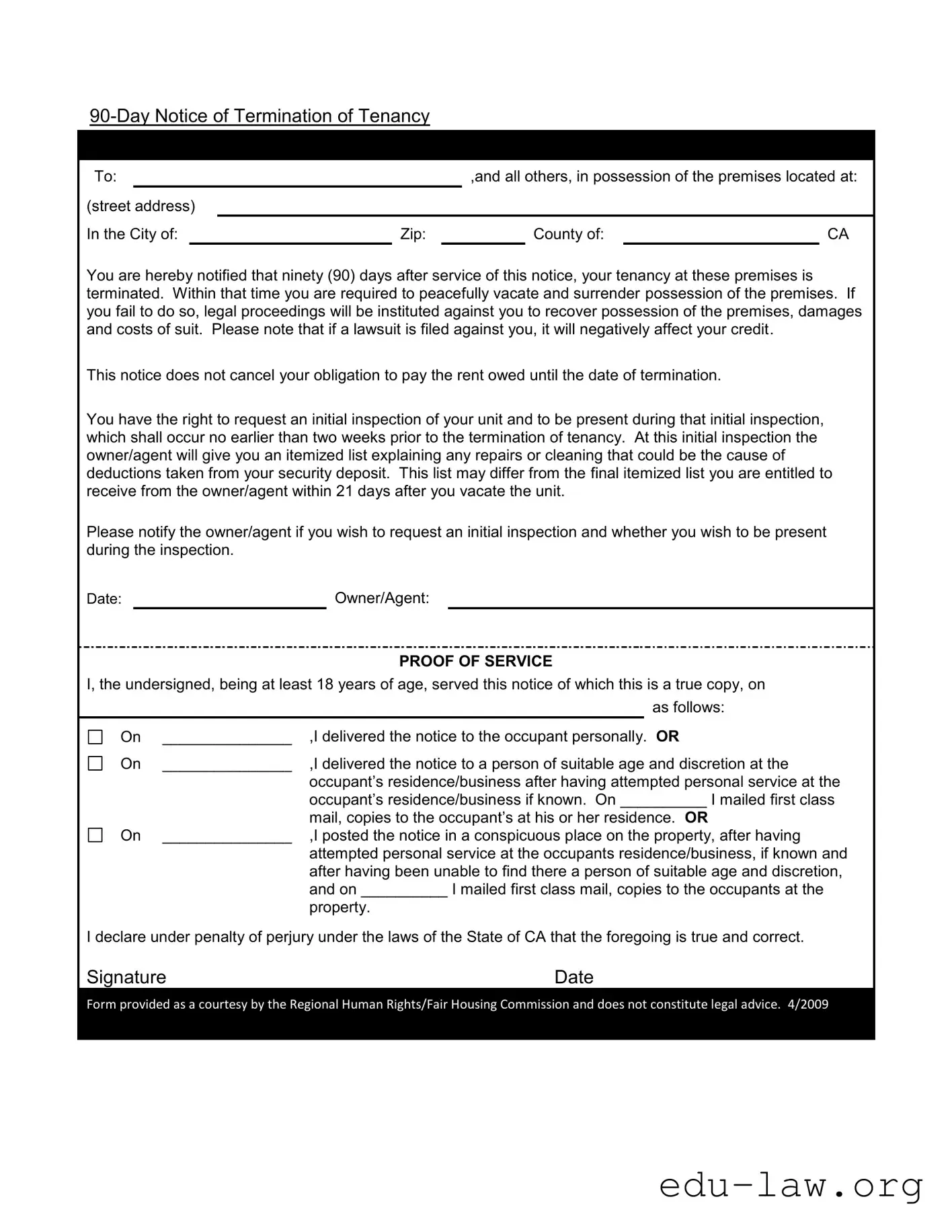
When it comes to ending a tenancy in California, the 90-Day Notice to Move Out form serves as a crucial document for both landlords and tenants. This notice informs tenants that their rental agreement will terminate in ninety days, providing them with ample time to vacate the premises. Within this period, tenants must peacefully surrender possession of the property. Failure to do so may lead to legal actions aimed at recovering possession, along with potential damages and court costs. It's important for tenants to understand that their obligation to pay rent continues until the termination date. Additionally, tenants have the right to request an initial inspection of their unit, allowing them to be present as the landlord provides an itemized list of any necessary repairs or cleaning that might affect their security deposit. This proactive step can help avoid surprises when it comes time to settle the deposit. The form also includes a proof of service section, ensuring that tenants are properly notified, whether through personal delivery, a suitable person at the residence, or via mail. Understanding these elements can empower tenants to navigate the moving process with greater confidence and clarity.

To: |
|
|
|
|
|
,and all others, in possession of the premises located at: |
||||
(street address) |
|
|
|
|
|
|
|
|
||
In the City of: |
|
|
|
Zip: |
|
|
County of: |
|
CA |
|
You are hereby notified that ninety (90) days after service of this notice, your tenancy at these premises is terminated. Within that time you are required to peacefully vacate and surrender possession of the premises. If you fail to do so, legal proceedings will be instituted against you to recover possession of the premises, damages and costs of suit. Please note that if a lawsuit is filed against you, it will negatively affect your credit.
This notice does not cancel your obligation to pay the rent owed until the date of termination.
You have the right to request an initial inspection of your unit and to be present during that initial inspection, which shall occur no earlier than two weeks prior to the termination of tenancy. At this initial inspection the owner/agent will give you an itemized list explaining any repairs or cleaning that could be the cause of deductions taken from your security deposit. This list may differ from the final itemized list you are entitled to receive from the owner/agent within 21 days after you vacate the unit.
Please notify the owner/agent if you wish to request an initial inspection and whether you wish to be present during the inspection.
Date:Owner/Agent:
PROOF OF SERVICE
I, the undersigned, being at least 18 years of age, served this notice of which this is a true copy, on
|
|
|
as follows: |
On |
_______________ |
,I delivered the notice to the occupant personally. OR |
|
On |
_______________ |
,I delivered the notice to a person of suitable age and discretion at the |
|
|
|
occupant’s residence/business after having attempted personal service at the |
|
|
|
occupant’s residence/business if known. On __________ I mailed first class |
|
|
|
mail, copies to the occupant’s at his or her residence. OR |
|
On |
_______________ |
,I posted the notice in a conspicuous place on the property, after having |
|
|
|
attempted personal service at the occupants residence/business, if known and |
|
|
|
after having been unable to find there a person of suitable age and discretion, |
|
|
|
and on __________ I mailed first class mail, copies to the occupants at the |
|
|
|
property. |
|
I declare under penalty of perjury under the laws of the State of CA that the foregoing is true and correct.
Signature |
Date |
Form provided as a courtesy by the Regional Human Rights/Fair Housing Commission and does not constitute legal advice. 4/2009
| Fact Name | Description |
|---|---|
| Notice Period | The 90-Day Notice To Move Out requires tenants to vacate the premises within ninety days of receiving the notice. This is a legal requirement in California. |
| Legal Consequences | If tenants do not comply with the notice, landlords may initiate legal proceedings to recover possession of the property, along with damages and costs. |
| Inspection Rights | Tenants have the right to request an initial inspection of the unit. This inspection should occur no earlier than two weeks before the termination date. |
| Security Deposit | The notice does not waive the tenant's obligation to pay rent until the termination date. Additionally, deductions from the security deposit may occur based on the inspection findings. |
| Governing Law | This notice is governed by California Civil Code Section 1946.1, which outlines the legal framework for termination of tenancy. |
Filling out the 90-Day Notice to Move Out form is a straightforward process. After completing the form, you will need to serve it to the tenants. This step is crucial, as it officially notifies them of the termination of their tenancy. Make sure to follow each step carefully to ensure that the notice is valid.
Once the form is filled out and signed, it must be served to the tenant. Keep a copy for your records. This will ensure that you have proof of the notice should any issues arise later.
What is a 90 Day Notice To Move Out?
The 90 Day Notice To Move Out is a formal document used by landlords to notify tenants that their tenancy will be terminated in 90 days. It serves as an official communication that the tenant must vacate the premises by the specified date.
Who needs to receive this notice?
This notice must be served to all individuals in possession of the rental property. This includes the primary tenant as well as any other occupants residing at the address listed in the notice.
What happens if I do not move out by the deadline?
If you fail to vacate the premises within the 90-day period, legal proceedings may be initiated against you. This could lead to eviction and may also affect your credit score negatively.
Do I still have to pay rent during the notice period?
Yes, you are still obligated to pay rent for the duration of the notice period. Your responsibility to pay rent continues until the termination date specified in the notice.
Can I request an initial inspection of my unit?
Yes, you have the right to request an initial inspection of your unit. This inspection can occur no earlier than two weeks before your tenancy ends. You may also choose to be present during this inspection.
What will happen during the initial inspection?
During the initial inspection, the landlord or agent will provide you with an itemized list of any repairs or cleaning that may affect your security deposit. This list may differ from the final list you receive after you vacate the unit.
How should I notify my landlord about the inspection?
You should inform your landlord or agent if you wish to request an initial inspection and whether you want to be present during that inspection. Clear communication will help ensure the process goes smoothly.
Failing to include the correct address of the rental property. Make sure to fill in the street address, city, zip code, and county accurately.
Not providing the date of service. This date is crucial as it starts the 90-day countdown for the tenant to vacate.
Neglecting to sign the form. A signature is required to validate the notice and confirm that you are the owner or agent.
Using an incorrect method of service. Ensure you follow the proper procedures for delivering the notice, whether in person, by mail, or posting.
Not keeping a copy of the notice for your records. It’s important to have documentation in case of disputes.
Overlooking the initial inspection request. Tenants have the right to request an inspection, and failing to mention this can lead to misunderstandings.
Forgetting to inform the tenant about the consequences of non-compliance. Clearly state that failure to vacate may result in legal action and impact their credit.
When preparing to move out, it's essential to have the right documents in place. Alongside the 90-Day Notice to Move Out form, several other forms and documents can be helpful for both tenants and landlords. Here’s a list of commonly used forms that might accompany the notice:
Having these documents organized can facilitate a smoother transition during the moving process. Understanding each form's purpose ensures that both tenants and landlords are on the same page, minimizing potential disputes and ensuring compliance with rental laws.
The 30-Day Notice to Quit is a document that landlords use to inform tenants that they must vacate the property within 30 days. This notice is typically employed in situations where the tenant has violated a lease term or has not paid rent. Like the 90-Day Notice to Move Out, it serves as a formal communication that the tenancy will end. The key difference lies in the timeframe; while the 90-Day Notice allows for a longer period for tenants to prepare for their move, the 30-Day Notice demands a quicker response.
The Eviction Notice is another document that shares similarities with the 90-Day Notice to Move Out. It is issued when a landlord seeks to terminate a tenancy due to specific reasons, such as non-payment of rent or lease violations. While the 90-Day Notice provides a longer notice period, the Eviction Notice often leads directly to legal action if the tenant does not comply. Both documents aim to formally notify tenants of their obligations and the potential consequences of failing to vacate.
The Lease Termination Letter can also be compared to the 90-Day Notice. This letter is typically sent by either party to terminate a lease agreement. It outlines the end date of the lease and any necessary steps to conclude the tenancy. Similar to the 90-Day Notice, it serves as a formal notification, but it may not specify a timeframe as strictly as the 90-Day Notice does. Instead, it focuses on the mutual agreement to end the lease.
The Notice of Rent Increase is another related document. While it does not terminate a tenancy, it informs tenants of a change in rental terms. This notice can lead to a tenant deciding to move out if they find the new rent unacceptable. Like the 90-Day Notice, it is a formal communication, but it focuses on changes to the lease rather than its termination.
The Security Deposit Return Letter is similar in that it addresses the conclusion of a tenancy. This letter is sent to tenants after they vacate the property, detailing the return of their security deposit. It often includes deductions for damages or unpaid rent. While the 90-Day Notice initiates the process of moving out, the Security Deposit Return Letter finalizes it, both serving as important documents in the rental relationship.
The Move-Out Checklist is a practical document that tenants may receive or create in conjunction with a notice to move out. It outlines the tasks that need to be completed before vacating the premises, such as cleaning and repairs. While the 90-Day Notice provides the legal framework for ending a tenancy, the Move-Out Checklist serves as a guide to ensure that tenants fulfill their responsibilities before leaving.
The Initial Inspection Notice is another document related to the 90-Day Notice. This notice informs tenants of their right to request an initial inspection of the unit before they move out. It highlights the importance of understanding potential deductions from the security deposit. Both documents emphasize the tenant's rights and responsibilities during the moving process, but the Initial Inspection Notice focuses specifically on the inspection aspect.
The Notice to Remedy is similar to the 90-Day Notice in that it addresses issues with the tenancy. It is typically issued when a tenant has violated lease terms, providing them with an opportunity to correct the issue before further action is taken. While the 90-Day Notice ultimately ends the tenancy, the Notice to Remedy seeks to resolve issues and maintain the rental relationship.
The Notice of Default is another document that can be likened to the 90-Day Notice. It is often used in the context of mortgage agreements, notifying a borrower that they are behind on payments. While it primarily concerns financial obligations, it serves a similar purpose of formally alerting individuals to a serious issue that could lead to eviction or foreclosure if not addressed. Both documents create a sense of urgency for the recipient to take action.
Finally, the Written Agreement to Terminate Tenancy is a document that both landlords and tenants can sign to mutually agree to end a lease. This agreement is often more amicable than a formal notice and can outline specific terms for vacating the property. Like the 90-Day Notice, it serves to officially document the end of the tenancy, but it emphasizes cooperation between the parties involved.
When filling out the 90-Day Notice To Move Out form, there are important dos and don'ts to keep in mind. Here’s a straightforward list to guide you:
Following these guidelines will help ensure a smoother transition as you prepare to move out. Properly completing the form is essential to protect your rights and responsibilities as a tenant.
Misconceptions about the 90 Day Notice To Move Out form can lead to confusion for both tenants and landlords. Here are five common misconceptions:
This is incorrect. While the notice provides a 90-day period before termination, tenants are still responsible for paying rent until the termination date.
Ignoring the notice can lead to legal action. If tenants do not vacate, landlords may initiate eviction proceedings, which can negatively impact the tenant's credit.
Tenants do have the right to request an initial inspection. This inspection allows tenants to be present and receive an itemized list of potential deductions from their security deposit.
The initial inspection list may differ from the final itemized list provided within 21 days after the tenant vacates. Tenants should be aware that deductions can change based on the final assessment.
The notice must be served following specific legal methods, such as personal delivery, delivery to a suitable person, or posting on the property. Proper service is crucial for the notice to be valid.
Filling out and using the 90 Day Notice To Move Out form is a crucial step for both landlords and tenants. Here are some key takeaways to consider:
Understanding these points can help ensure a smoother transition for both landlords and tenants during the moving process.