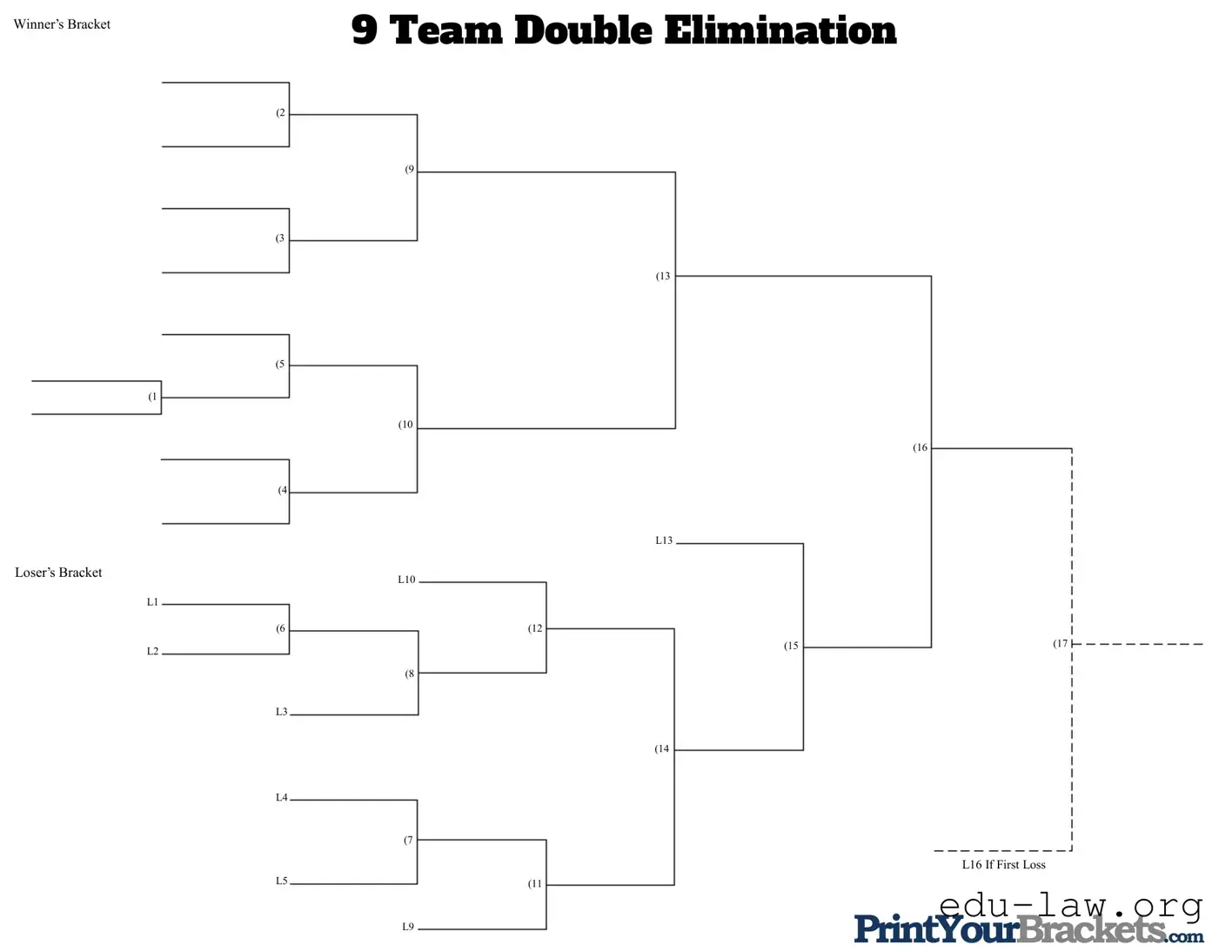
The 9 Team Double Elimination Bracket format is an exciting and strategic way to organize a tournament, allowing teams multiple chances to compete for victory. In this structure, each team must lose twice before being eliminated from the competition, fostering a more forgiving environment for participants. The tournament begins with a Winner's Bracket, where teams compete head-to-head, and the winners continue to advance. Those who lose in this initial round are not out of the tournament; instead, they move to the Loser's Bracket, where they have the opportunity to fight their way back into contention. The bracket is designed to ensure that every match is crucial, as teams strive to avoid that second loss which would end their journey. The layout includes a series of matchups, labeled for clarity, guiding teams through each stage of the tournament. This format not only heightens the stakes but also enhances the experience for both players and spectators, as the potential for comebacks keeps the excitement alive throughout the event.

Winner’s Bracket
(2
(3
(5
(1
(4
Loser’s Bracket
L1
(6
L2
L3
L4
L5
9 Team Double Elimination
(9
(13
(10
(16
L13
L10
(12
(15 |
(17 |
(8
(14
(7
L16 If First Loss
(11
L9PrintYourBrackets.com
| Fact Name | Details |
|---|---|
| Format Type | This is a 9-team double elimination bracket format. |
| Winners Bracket | Teams that win their matches continue in the winners bracket. |
| Losers Bracket | Teams that lose a match drop to the losers bracket for a chance to continue. |
| First Loss | A team is not eliminated after their first loss; they move to the losers bracket. |
| Final Matches | The final match may involve a team from the winners bracket and a team from the losers bracket. |
| Elimination | A team is eliminated after their second loss in the tournament. |
| Match Structure | Matches are structured to allow teams to compete multiple times. |
| Advancement | Teams advance in the winners bracket until they lose, then they compete in the losers bracket. |
| State-Specific Forms | Governing laws may vary by state; consult local regulations for specifics. |
| Seeding | Teams may be seeded based on previous performance or rankings. |
Filling out the 9 Team Double Elimination Bracket form is an important step in organizing your tournament. This form helps you keep track of the matches and determine which teams progress through the winner's and loser's brackets. Follow the steps below to ensure that the bracket is completed correctly.
What is a 9 Team Double Elimination Bracket?
A 9 Team Double Elimination Bracket is a tournament format that allows teams to compete in a way that gives them a second chance after losing a match. In this format, teams must lose twice to be eliminated from the tournament. This structure ensures that even if a team has one bad game, they still have the opportunity to continue competing for the championship.
How does the bracket structure work?
The bracket is divided into two main sections: the Winner's Bracket and the Loser's Bracket. Initially, all teams start in the Winner's Bracket. As matches are played, the winners continue in this bracket while the losing teams drop down to the Loser's Bracket. If a team loses a match in the Loser's Bracket, they are eliminated from the tournament.
How are teams matched up in the first round?
In the first round, the matchups are typically determined by seeding. Higher-seeded teams face lower-seeded teams to ensure a competitive balance. For example, the top seed might play the lowest seed, while the second seed faces the second-lowest seed. This system helps maintain fairness and competitiveness throughout the tournament.
What happens if a team loses in the Winner's Bracket?
If a team loses in the Winner's Bracket, they are not immediately eliminated. Instead, they move down to the Loser's Bracket, where they have another chance to compete. They will need to win all subsequent matches in the Loser's Bracket to stay in the tournament. If they lose again, they will be eliminated.
How many matches does each team need to play?
Each team must play a minimum of two matches in a double elimination format. However, depending on how far they advance, they may play more. A team that remains in the Winner's Bracket could play up to four matches, while a team that drops to the Loser's Bracket could play additional matches to stay in contention for the championship.
How is the champion determined in a 9 Team Double Elimination Bracket?
The champion is determined by the final matches played between the last remaining teams in the Winner's and Loser's Brackets. If a team from the Winner's Bracket loses, they must face the same opponent from the Loser's Bracket again, as they have not yet lost twice. The team that wins this final match is declared the champion of the tournament.
Not understanding the format of a double elimination tournament. Many people assume it works like a single elimination, leading to confusion.
Failing to accurately fill in all team names. Leaving out a team can disrupt the entire bracket.
Misplacing teams in the wrong brackets. Teams must be correctly assigned to either the winner’s or loser’s bracket.
Overlooking the importance of seeding. Teams should be placed based on their skill level to ensure fair competition.
Not updating the bracket after each match. Keeping track of wins and losses is crucial for the tournament's progression.
Ignoring the rules for advancing teams. Understanding how teams move from the winner’s bracket to the loser’s bracket is essential.
Rushing through the process. Taking time to carefully review each entry can prevent mistakes.
When organizing a tournament, especially one utilizing a 9 Team Double Elimination Bracket, there are several additional forms and documents that can enhance the experience for both organizers and participants. Each of these documents serves a specific purpose, ensuring clarity and smooth operation throughout the event.
Having these forms readily available can greatly enhance the organization of a tournament. By ensuring all necessary information is documented and accessible, organizers can focus on creating a memorable experience for everyone involved.
The 9 Team Double Elimination Bracket form is similar to a single elimination tournament bracket. In a single elimination format, teams compete in head-to-head matches, and the loser is eliminated from the tournament. This structure is straightforward, as it requires fewer matches to determine a winner compared to double elimination. However, unlike the double elimination format, teams do not have a second chance to compete after losing a match.
A round-robin tournament schedule shares similarities with the double elimination bracket as well. In a round-robin format, each team plays against every other team at least once. This ensures that all teams have an equal opportunity to compete. While it does not provide the same elimination structure, it allows for a comprehensive assessment of team performance over multiple matches, similar to the way teams progress through the winner's and loser's brackets in a double elimination setup.
The Swiss-system tournament is another document that bears resemblance to the double elimination bracket. In a Swiss-system format, teams are paired in each round based on their performance in previous rounds. This method allows for a fair competition among participants with varying skill levels. While it does not involve elimination, it shares the goal of determining a champion through multiple rounds, akin to the progression of teams in a double elimination bracket.
A league table is also comparable to the 9 Team Double Elimination Bracket form. In a league table, teams earn points based on their performance in matches. The ranking is determined by total points accumulated over a season. Although it does not feature elimination rounds, it allows for a clear ranking of teams, similar to how teams are positioned based on their wins and losses in the double elimination format.
The playoff bracket is another document that resembles the double elimination bracket. In a playoff bracket, teams compete in a series of elimination rounds to determine a champion. While traditional playoff formats may not offer a second chance after a loss, the overall structure of matching teams in a series of rounds aligns with the progression seen in double elimination tournaments.
Lastly, a challenge ladder serves a similar purpose to the double elimination bracket. In a challenge ladder, participants can challenge others to matches to improve their ranking. While the format allows for continuous competition without formal elimination, it encourages ongoing engagement and progression, reflecting the competitive nature found in double elimination tournaments.
When filling out the 9 Team Double Elimination Bracket form, there are some important things to keep in mind. Here’s a list of what you should and shouldn’t do:
By following these guidelines, you can ensure that your bracket is filled out correctly and efficiently.
In the world of competitive sports and tournaments, the double elimination format is a popular choice. However, many people hold misconceptions about how a 9 team double elimination bracket works. Here are eight common misconceptions, along with clarifications for each.
Understanding these misconceptions can enhance your appreciation of the double elimination format and the strategic elements involved in tournament play.
Understanding how to fill out and use a 9 Team Double Elimination Bracket can enhance your experience in organizing and participating in tournaments. Here are some key takeaways to keep in mind:
By following these key points, you can effectively manage a 9 Team Double Elimination Bracket, ensuring a smooth and enjoyable tournament experience for everyone involved.