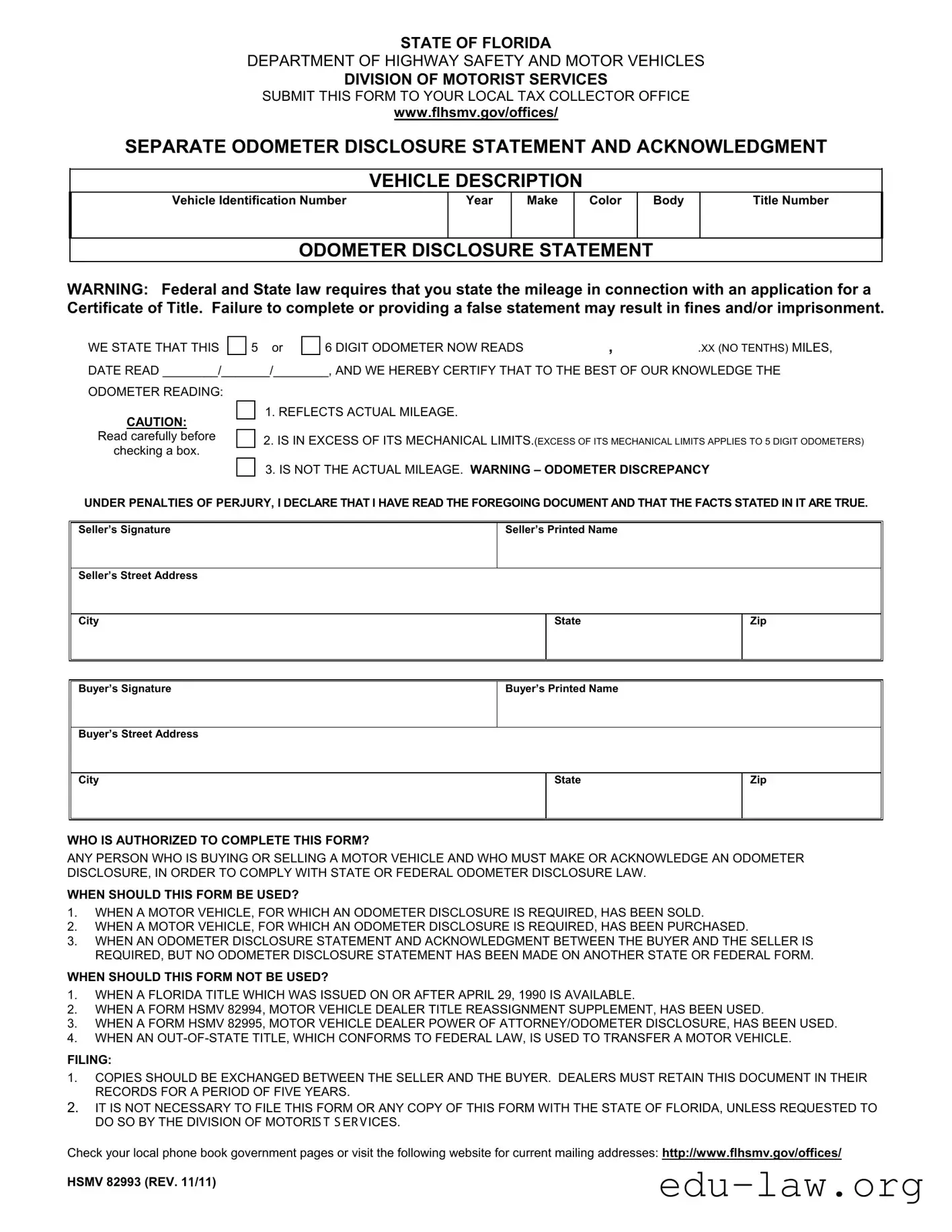
The 82993 form is an essential document used in the state of Florida for odometer disclosure when buying or selling a motor vehicle. It serves as a separate odometer disclosure statement and acknowledgment, ensuring compliance with both federal and state laws regarding mileage reporting. This form requires specific vehicle information, including the Vehicle Identification Number (VIN), year, make, color, and title number. The odometer disclosure statement must accurately reflect the vehicle's current mileage, and it is crucial that sellers and buyers certify the information provided. The form also outlines who is authorized to complete it, typically anyone involved in the transaction of a motor vehicle that requires odometer disclosure. It is important to use this form when a vehicle has been sold or purchased and no other odometer disclosure has been made. However, it should not be used if a Florida title issued after April 29, 1990 is available or if other specific forms have been utilized. Copies of the form should be exchanged between parties, and while dealers must keep it for five years, it is not necessary to file it with the state unless requested. Adhering to these guidelines helps prevent potential legal consequences related to false odometer statements.
STATE OF FLORIDA
DEPARTMENT OF HIGHWAY SAFETY AND MOTOR VEHICLES
DIVISION OF MOTORIST SERVICES
SUBMIT THIS FORM TO YOUR LOCAL TAX COLLECTOR OFFICE
www.flhsmv.gov/offices/
SEPARATE ODOMETER DISCLOSURE STATEMENT AND ACKNOWLEDGMENT
VEHICLE DESCRIPTION
Vehicle Identification Number
Year
Make
Color Body
Title Number
ODOMETER DISCLOSURE STATEMENT
WARNING: Federal and State law requires that you state the mileage in connection with an application for a Certificate of Title. Failure to complete or providing a false statement may result in fines and/or imprisonment.
WE STATE THAT THIS |
5 or |
6 DIGIT ODOMETER NOW READS |
, |
.XX (NO TENTHS) MILES, |
DATE READ ________/_______/________, AND WE HEREBY CERTIFY THAT TO THE BEST OF OUR KNOWLEDGE THE
ODOMETER READING:
1. REFLECTS ACTUAL MILEAGE.
CAUTION:
Read carefully before 2. IS IN EXCESS OF ITS MECHANICAL LIMITS.(EXCESS OF ITS MECHANICAL LIMITS APPLIES TO 5 DIGIT ODOMETERS) checking a box.
3. IS NOT THE ACTUAL MILEAGE. WARNING – ODOMETER DISCREPANCY
UNDER PENALTIES OF PERJURY, I DECLARE THAT I HAVE READ THE FOREGOING DOCUMENT AND THAT THE FACTS STATED IN IT ARE TRUE.
Seller’s Signature |
Seller’s Printed Name |
|
|
|
|
|
|
Seller’s Street Address |
|
|
|
|
|
|
|
City |
|
State |
Zip |
|
|
|
|
|
|
|
|
Buyer’s Signature |
Buyer’s Printed Name |
|
|
|
|
|
|
Buyer’s Street Address |
|
|
|
|
|
|
|
City |
|
State |
Zip |
|
|
|
|
WHO IS AUTHORIZED TO COMPLETE THIS FORM?
ANY PERSON WHO IS BUYING OR SELLING A MOTOR VEHICLE AND WHO MUST MAKE OR ACKNOWLEDGE AN ODOMETER DISCLOSURE, IN ORDER TO COMPLY WITH STATE OR FEDERAL ODOMETER DISCLOSURE LAW.
WHEN SHOULD THIS FORM BE USED?
1.WHEN A MOTOR VEHICLE, FOR WHICH AN ODOMETER DISCLOSURE IS REQUIRED, HAS BEEN SOLD.
2.WHEN A MOTOR VEHICLE, FOR WHICH AN ODOMETER DISCLOSURE IS REQUIRED, HAS BEEN PURCHASED.
3.WHEN AN ODOMETER DISCLOSURE STATEMENT AND ACKNOWLEDGMENT BETWEEN THE BUYER AND THE SELLER IS REQUIRED, BUT NO ODOMETER DISCLOSURE STATEMENT HAS BEEN MADE ON ANOTHER STATE OR FEDERAL FORM.
WHEN SHOULD THIS FORM NOT BE USED?
1.WHEN A FLORIDA TITLE WHICH WAS ISSUED ON OR AFTER APRIL 29, 1990 IS AVAILABLE.
2.WHEN A FORM HSMV 82994, MOTOR VEHICLE DEALER TITLE REASSIGNMENT SUPPLEMENT, HAS BEEN USED.
3.WHEN A FORM HSMV 82995, MOTOR VEHICLE DEALER POWER OF ATTORNEY/ODOMETER DISCLOSURE, HAS BEEN USED.
4.WHEN AN
FILING:
1.COPIES SHOULD BE EXCHANGED BETWEEN THE SELLER AND THE BUYER. DEALERS MUST RETAIN THIS DOCUMENT IN THEIR RECORDS FOR A PERIOD OF FIVE YEARS.
2.IT IS NOT NECESSARY TO FILE THIS FORM OR ANY COPY OF THIS FORM WITH THE STATE OF FLORIDA, UNLESS REQUESTED TO DO SO BY THE DIVISION OF MOTORIS T S ER VICES.
Check your local phone book government pages or visit the following website for current mailing addresses: http://www.flhsmv.gov/offices/
HSMV 82993 (REV. 1/11)
| Fact Name | Description |
|---|---|
| Form Purpose | This form is used for odometer disclosure when buying or selling a motor vehicle in Florida. |
| Governing Law | Federal and Florida state laws require odometer disclosures to prevent fraud. |
| Who Can Use It | Any individual involved in the sale or purchase of a motor vehicle must complete this form. |
| When to Use | Use this form when selling or purchasing a vehicle requiring an odometer disclosure. |
| When Not to Use | Do not use if a Florida title issued after April 29, 1990 is available or if other specific forms have been used. |
| Odometer Reading | The form requires the current odometer reading, which must be stated without tenths. |
| Signature Requirement | Both the seller and buyer must sign and print their names on the form to validate the transaction. |
| Filing Instructions | No need to file this form with the state unless requested; copies should be exchanged between parties. |
| Record Retention | Dealers must keep this document for five years as part of their records. |
Filling out the 82993 form is a straightforward process that requires accurate information about the vehicle and its odometer reading. After completing the form, it must be submitted to your local tax collector's office. Both the buyer and seller should retain copies for their records.
What is the purpose of Form 82993?
Form 82993 is used to disclose the odometer reading when a motor vehicle is bought or sold. This form ensures that both the buyer and seller acknowledge the vehicle's mileage, which is a legal requirement under federal and state law. Accurate disclosure helps prevent fraud and protects consumers from potential issues related to odometer discrepancies.
Who needs to fill out Form 82993?
Anyone involved in the buying or selling of a motor vehicle must complete this form if an odometer disclosure is required. This includes private sellers, buyers, and even dealers in certain situations. If you’re transferring ownership of a vehicle, this form is essential to comply with legal requirements.
When should I use Form 82993?
You should use Form 82993 when you sell or purchase a motor vehicle that requires an odometer disclosure. It is also necessary if an odometer disclosure statement is needed but hasn't been provided on another form. This ensures that the transaction is documented correctly and legally.
When should I NOT use Form 82993?
This form should not be used if a Florida title issued on or after April 29, 1990 is available. Additionally, if you have used Form HSMV 82994 or Form HSMV 82995, you do not need to complete Form 82993. Lastly, if you are using an out-of-state title that meets federal law requirements, this form is unnecessary.
What information do I need to provide on Form 82993?
You will need to provide details such as the vehicle identification number (VIN), year, make, color, and title number of the vehicle. Additionally, the form requires you to state the current odometer reading, the date of the reading, and certify the accuracy of this information. Both the buyer and seller must sign and print their names and addresses.
What happens if I provide false information on Form 82993?
Providing false information on this form can lead to serious consequences, including fines and potential imprisonment. It's crucial to be honest about the vehicle's mileage to avoid any legal issues down the line. Remember, transparency protects both parties in the transaction.
How should I handle copies of Form 82993?
Both the seller and the buyer should exchange copies of Form 82993. If you are a dealer, it's important to keep this document in your records for five years. While you don’t need to file this form with the state unless requested, having copies on hand is a good practice for your records.
Where can I find more information about Form 82993?
For more details, you can visit the Florida Department of Highway Safety and Motor Vehicles website. They provide comprehensive information about motor vehicle services, including how to properly complete and submit Form 82993. It's always a good idea to stay informed about the latest requirements and procedures.
What if I have more questions about the odometer disclosure process?
If you have additional questions, consider reaching out to your local tax collector's office or the Florida Department of Highway Safety and Motor Vehicles. They can provide specific guidance tailored to your situation and ensure that you understand all aspects of the odometer disclosure process.
Incomplete Vehicle Information: Failing to provide all necessary details about the vehicle, such as the Vehicle Identification Number (VIN), year, make, color, and title number, can lead to processing delays. Each field is essential for proper identification.
Incorrect Odometer Reading: Entering an inaccurate odometer reading can have serious consequences. It’s crucial to ensure the mileage is recorded correctly and without tenths, as specified in the form.
Neglecting Signatures: Omitting signatures from either the seller or buyer can invalidate the form. Both parties must sign to acknowledge the odometer disclosure and certify the accuracy of the information provided.
Misunderstanding Odometer Disclosure Requirements: Some individuals may not realize when this form is necessary. It should be used only when a motor vehicle is sold or purchased, and no other disclosure has been made.
Not Retaining Copies: Failing to keep copies of the completed form can create issues down the line. Both the seller and buyer should retain copies for their records, as this documentation is important for future reference.
The HSMV 82993 form is essential for documenting odometer disclosures during the sale or purchase of a motor vehicle in Florida. Several other forms and documents often accompany this form to ensure compliance with state and federal regulations. Below is a list of these related documents, along with brief descriptions of each.
Understanding these related documents can help ensure a smooth transaction when buying or selling a vehicle. Properly completing and exchanging all necessary forms is vital for compliance and protecting the interests of both parties involved.
The Form HSMV 82994, known as the Motor Vehicle Dealer Title Reassignment Supplement, serves a similar purpose as the HSMV 82993. Both forms facilitate the transfer of vehicle ownership and require odometer disclosures. However, the 82994 is specifically designed for use by motor vehicle dealers when reassigning titles. This form allows dealers to document multiple transfers on a single title, streamlining the process for dealerships that frequently buy and sell vehicles.
The HSMV 82995, or Motor Vehicle Dealer Power of Attorney/Odometer Disclosure, is another document that parallels the HSMV 82993. This form allows a dealer to act on behalf of a buyer or seller in the transaction of a vehicle. Like the 82993, it includes an odometer disclosure section. The key difference lies in the power of attorney aspect, which grants the dealer the authority to sign documents on behalf of the buyer or seller, making it particularly useful in transactions where the original owner is unavailable.
The HSMV 82040, the Application for Certificate of Title With/Without Registration, is also relevant. This form is used to apply for a new title when purchasing a vehicle. While it does not specifically focus on odometer disclosure, it requires the same information regarding the vehicle's mileage. Both forms are essential in the title application process, ensuring that buyers and sellers are aware of the vehicle's mileage at the time of sale.
The HSMV 82041, or the Application for Duplicate Title, shares similarities with the HSMV 82993 in that it also requires odometer information. This form is used when an individual needs to replace a lost or damaged title. It ensures that the odometer reading is accurately recorded, maintaining transparency in vehicle transactions, just as the 82993 does during the sale of a vehicle.
The HSMV 82042, the Notice of Sale, is another document that has overlapping functions. This form is used to notify the state of the sale of a vehicle. While it does not serve as an odometer disclosure form, it does require the seller to provide the vehicle's mileage at the time of sale. This ensures that the new owner is informed about the vehicle's condition, similar to the disclosures required in the HSMV 82993.
The HSMV 82043, known as the Application for Title and Registration, is also akin to the HSMV 82993. It is used when a vehicle is being registered for the first time. This form includes sections for odometer disclosures, ensuring that the mileage is documented accurately. Both forms are crucial in the process of establishing legal ownership and maintaining accurate vehicle records.
The HSMV 82056, or the Affidavit of Heirship, can be compared to the HSMV 82993 as it involves the transfer of vehicle ownership. This form is used when a vehicle is inherited, and it requires the disclosure of the vehicle's mileage. Like the 82993, it ensures that the new owner is informed about the vehicle's condition at the time of transfer, maintaining compliance with state regulations.
The HSMV 82057, the Application for Title by a Surviving Spouse, is another document that shares similarities. This form is utilized when a spouse inherits a vehicle after the death of the other spouse. It includes odometer disclosure requirements, ensuring that the mileage is accurately reported, just as it is in the HSMV 82993. Both forms aim to facilitate the legal transfer of ownership while adhering to state laws.
The HSMV 83020, or the Vehicle Identification Number (VIN) Verification, is also relevant in this context. While its primary purpose is to verify the identity of the vehicle, it often accompanies other forms that require odometer disclosures. The HSMV 82993 and the VIN Verification form work together to ensure that all necessary information about the vehicle is accurate and complete during the transfer process.
Lastly, the HSMV 83030, the Title Transfer Notification, is similar to the HSMV 82993 in that it serves to inform the state of a vehicle's change in ownership. This form also requires the disclosure of the vehicle's mileage at the time of sale. Both documents are essential in ensuring that all parties involved in the transaction are aware of the vehicle's history and condition, promoting transparency and compliance with state regulations.
When filling out the 82993 form, attention to detail is crucial. Here are some guidelines to follow and avoid to ensure a smooth process.
Following these dos and don'ts can help facilitate the process of transferring vehicle ownership while adhering to legal requirements.
Understanding the 82993 form is essential for anyone involved in buying or selling a motor vehicle in Florida. However, several misconceptions can lead to confusion. Here are four common misunderstandings:
This form can be used by anyone involved in a vehicle transaction, including private sellers, dealers, and buyers. It is not limited to private sales.
It is not necessary to submit this form to the state unless specifically requested. Both the buyer and seller should keep copies for their records.
The 82993 form is required for any vehicle where an odometer disclosure is mandated, regardless of the vehicle's age. This applies to both new and used vehicles.
Filling out the 82993 form is a legal requirement when selling or buying a vehicle in Florida. Failure to complete it accurately can lead to fines or other penalties.
Here are some key takeaways about filling out and using the 82993 form: