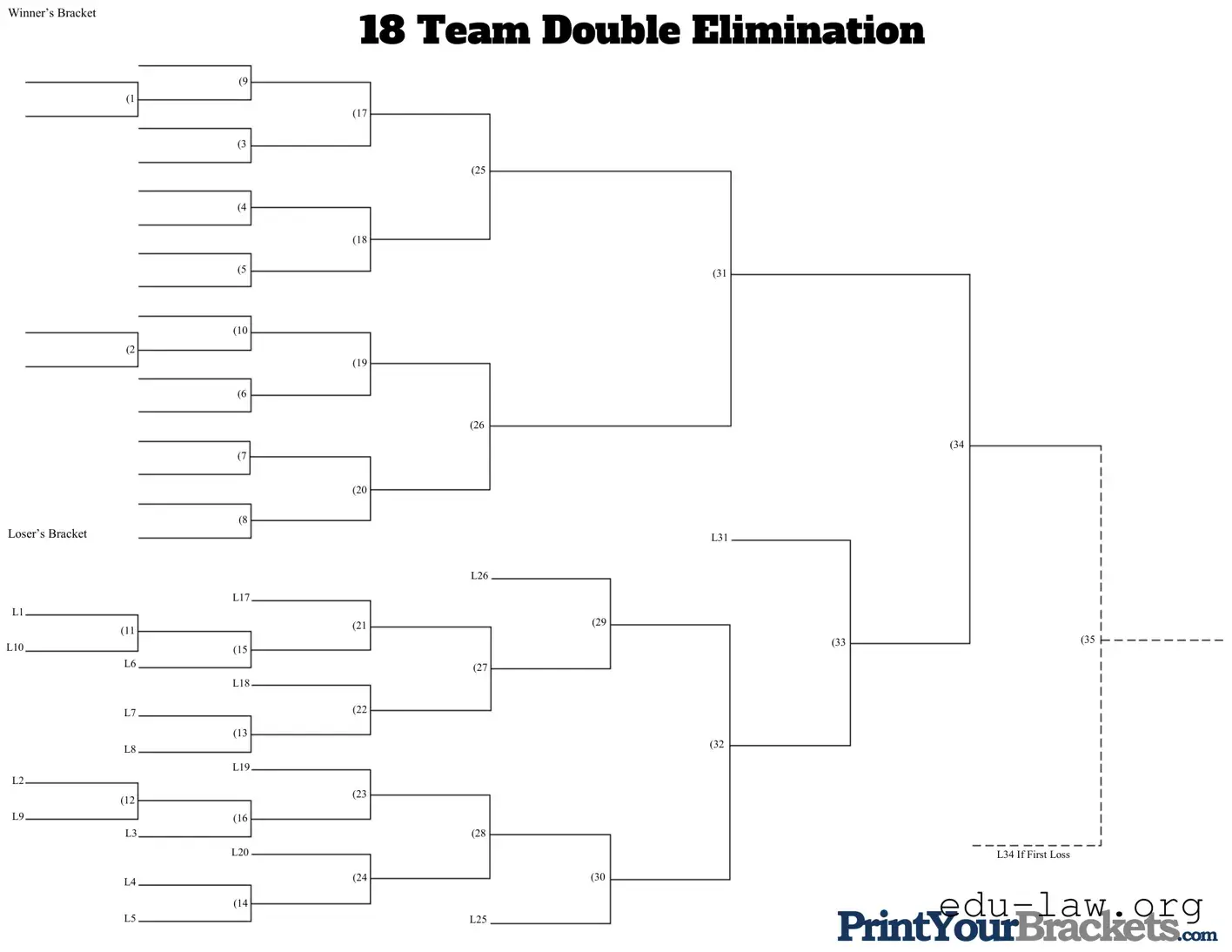
The 18 Double Elimination form is designed to provide a fair and engaging competition structure for tournaments involving 18 teams. In this format, each team has the opportunity to compete twice before being eliminated, ensuring that even a single loss does not end their chances of winning the tournament. The competition is divided into two main brackets: the Winner’s Bracket and the Loser’s Bracket. Teams that win their matches advance in the Winner’s Bracket, while those that lose get a second chance in the Loser’s Bracket. This setup allows for a more dynamic and exciting tournament experience, as teams can battle back from an early defeat. The progression through the brackets is carefully structured, with teams facing off in a series of matches that ultimately lead to a championship showdown. Understanding how the brackets work, including the implications of each win and loss, is crucial for teams and fans alike. The 18 Double Elimination format not only enhances competition but also keeps the excitement alive until the very end.
Winner’s Bracket
(9
(1
(3
(4
(5
(10
(2
|
(6 |
|
(7 |
Loser’s Bracket |
(8 |
|
|
|
L17 |
L1 |
|
|
(11 |
L10 |
(15 |
|
L6 |
|
L18 |
L7
(13
L8
L19
L2
(12
L9 |
(16 |
L3
L20
L4
(14
L5
18 Team Double Elimination
(17
(25
(18
(31
(19
(26
(34
(20
L31
L26
(21 |
(29 |
(33 |
(35 |
(27
(22
(32
(23
(28
L34 If First Loss
(24 |
(30 |
L25PrintYourBrackets.com
| Fact Name | Description |
|---|---|
| Format Type | This is an 18-team double elimination tournament format. |
| Winner’s Bracket | The winner’s bracket includes teams that have not lost, progressing through rounds until a champion is determined. |
| Loser’s Bracket | Teams that lose in the winner’s bracket move to the loser’s bracket, where they have a chance to continue competing. |
| Governing Laws | State-specific forms may be governed by local sports regulations and tournament rules. |
Filling out the 18 Double Elimination form requires attention to detail and a clear understanding of the teams participating in the tournament. Once completed, this form will help in organizing the matches and tracking the progress of each team through the brackets.
What is the 18 Double Elimination format?
The 18 Double Elimination format is a tournament structure designed to give teams a second chance after losing a match. In this format, a team is not eliminated until it has lost two matches. This allows for a more competitive environment, as teams have the opportunity to recover from an early loss and still compete for the championship.
How does the winner’s bracket work?
The winner’s bracket is where teams that win their matches compete. As teams progress through this bracket, they move closer to the finals. If a team loses in the winner’s bracket, they drop down to the loser’s bracket, where they still have a chance to continue competing for the championship.
What happens in the loser’s bracket?
The loser’s bracket is for teams that have lost one match. Here, they face elimination if they lose again. Teams that advance through the loser’s bracket can potentially face the last remaining team in the winner’s bracket in a final match, giving them a shot at the title.
How are match pairings determined?
Can a team come back from the loser’s bracket to win?
Yes, a team can come back from the loser’s bracket to win the tournament. If they win all their matches in the loser’s bracket, they will face the winner of the winner’s bracket in a final match. If they win that match, they often have to play again to determine the champion, as both teams would then have one loss.
How many matches does a team need to win to become the champion?
A team must win enough matches to remain in the winner’s bracket or come through the loser’s bracket and win the final match. Typically, this means winning a minimum of four matches in the winner’s bracket or winning multiple matches in the loser’s bracket before facing the winner’s bracket champion.
What is the significance of the first loss in the tournament?
The first loss is crucial as it determines whether a team moves to the loser’s bracket or remains in the winner’s bracket. This loss can impact a team's strategy and morale, making it essential for teams to perform well in their initial matches.
Are there any specific rules regarding substitutions or player eligibility?
Yes, each tournament may have specific rules regarding player eligibility and substitutions. These rules can vary by organization, so it is important for teams to review the tournament guidelines before the competition begins. Ensuring compliance with these rules is essential to avoid disqualification.
Filling out the 18 Double Elimination form can be a straightforward process, but there are common mistakes that individuals often make. Here is a list of some of those mistakes:
Incomplete Team Information: Failing to provide all required details about the teams can lead to confusion later on. Ensure that every team has a name and contact information listed.
Incorrect Match Pairings: Sometimes, individuals mistakenly pair teams that should not compete against each other in the initial rounds. Review the pairing rules carefully.
Neglecting to Track Wins and Losses: Keeping an accurate record of each team's wins and losses is crucial. Omitting this information can disrupt the tournament flow.
Misunderstanding the Bracket Structure: Some may not fully grasp how the winner’s and loser’s brackets work. It is important to understand how teams advance or are eliminated.
Failing to Update the Bracket: After each match, it is vital to update the bracket promptly. Delays in updating can create confusion for teams and spectators alike.
Ignoring Time Limits: Each match typically has a set time limit. Not adhering to these limits can lead to disputes and delays.
Overlooking Tie-Breaker Rules: In the event of a tie, specific rules must be followed. Failing to understand these can result in unfair outcomes.
Not Communicating Changes: If any changes are made to the schedule or team line-ups, it is essential to communicate these changes to all participants promptly.
By being aware of these common mistakes, individuals can help ensure a smoother and more enjoyable tournament experience for everyone involved.
The 18 Double Elimination form is commonly used in tournament settings to track the progress of teams through a competition. However, several other forms and documents often accompany this form to ensure smooth operations and accurate record-keeping. Below is a list of related documents that may be required.
Having these documents in place alongside the 18 Double Elimination form helps ensure that the tournament runs smoothly. Each form serves a specific purpose, contributing to the overall organization and success of the event.
The 18 Double Elimination form shares similarities with tournament brackets commonly used in various sports competitions. A single-elimination bracket, for instance, features teams competing in a knockout format. In this setup, a team that loses a match is eliminated from the tournament. The double elimination format, like the 18 Double Elimination form, allows teams a second chance. This design ensures that a single loss does not automatically disqualify a team, promoting fairness and competitiveness.
A round-robin tournament format is another document similar to the 18 Double Elimination form. In a round-robin, each team competes against every other team, which allows for a comprehensive evaluation of team performance. While this format differs in structure, it shares the goal of determining a champion based on performance across multiple matches. Both formats prioritize fairness, but the round-robin requires more matches to be played, which can be time-consuming.
The Swiss-system tournament is also comparable to the 18 Double Elimination form. This format pairs teams with similar performance levels in each round, allowing for a balanced competition. Like double elimination, it ensures that teams do not face elimination after a single loss. The Swiss-system is often used in chess and other games, providing a structured way to determine standings without requiring every team to play against every other team.
A league format can be likened to the 18 Double Elimination form as well. In a league, teams accumulate points over a series of matches to determine standings. This ongoing evaluation allows for a more extended competition period, similar to how teams in a double elimination tournament can continue competing even after a loss. Both formats aim to crown a champion based on overall performance rather than a single match outcome.
The best-of series format is another document that shares characteristics with the 18 Double Elimination form. In a best-of series, teams compete in multiple matches, with the first to win a predetermined number of matches declared the winner. This format allows for a more thorough assessment of team abilities, similar to how double elimination provides teams with multiple opportunities to succeed before being eliminated.
A playoff bracket is also relevant to this discussion. Playoff brackets often feature a series of elimination rounds leading to a final championship match. The structure can vary, but like the 18 Double Elimination form, it allows teams to compete in multiple rounds. The main difference lies in the fact that playoff brackets typically do not offer a second chance after a loss, while double elimination does.
The challenge cup format resembles the 18 Double Elimination form in that it allows teams to compete in a series of matches, often with a knockout stage. In a challenge cup, teams can sometimes be re-entered into the competition after a loss, which aligns with the second-chance aspect of double elimination. Both formats encourage ongoing competition and engagement from participants.
Lastly, the seeding bracket is similar to the 18 Double Elimination form in its organization and structure. Seeding brackets often determine matchups based on team rankings or performance in prior competitions. This organization helps ensure that higher-ranked teams face lower-ranked teams initially, much like how teams are matched in double elimination formats. Both formats aim to create a fair and competitive environment for all participants.
When filling out the 18 Double Elimination form, there are several important guidelines to keep in mind. Here are nine do's and don'ts to ensure the process goes smoothly.
By adhering to these guidelines, you can help ensure that your submission is processed without issues.
There are several misconceptions surrounding the 18 Double Elimination format. Understanding these misconceptions is crucial for participants and organizers alike. Below is a list of common misunderstandings:
Each of these misconceptions can lead to confusion during the tournament. It is essential to clarify these points to ensure a smooth and fair competition.
Addressing these misconceptions can enhance the experience for all involved and promote a better understanding of the tournament structure.
Understanding the 18 Double Elimination form can enhance your experience in organizing and participating in tournaments. Here are some key takeaways to keep in mind:
Using the 18 Double Elimination form effectively can lead to a smoother tournament experience for everyone involved.